
trunc-, truncat-
(Latin: to maim, to cut off; mutilated; cut short)
2. Referring to an arterial or main nerve or blood vessel of the body: "The truncal sections of the nerves or blood vessels don't include the branches but refer to the main parts of those bodily elements."
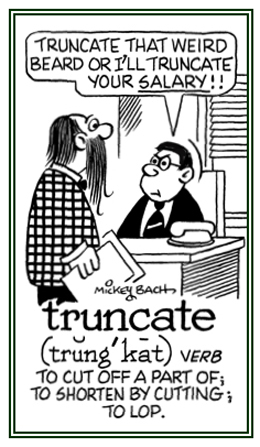
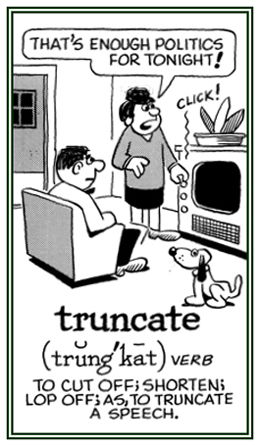
2. To decrease a presentation by making it briefer; especially, by removing the end of it: Television coverage of the soccer match was truncated by a technical fault.
3. To restrict the precision of a decimal number by limiting or dropping the digits to the right of the decimal point without rounding them: The numbers 1.4262 and 1.4887 can both be truncated to 1.4 by not rounding them off.
4. Etymology: from Latin truncare, "to cut short, to mutilate".
Go to this Word A Day Revisited Index
so you can see more of Mickey Bach's cartoons.
2. Leaves that are square or broad at the end, as if cut off transversely.
3. Lacking the apex or point, as certain spiral shells.
2. In banking, a system of electronic check recording under which canceled checks are not returned to customers by the bank.
3. Something that has been shortened, lopped, or cut off.
4. Anything that has a square end as if it were cut off; lacking an apex or point.
2. A baton carried as a symbol of rank or authority, a baton or a military staff of command.
3. The shaft of a spear or the shattered shaft of a spear.
4. A stout stem, as of a tree, with the branches trimmed off, to produce rapid growth. 5. Etymology: The "shaft of a spear", also "a short stick, a cudgel", from Old Norse French tronchon, Old French tronchon (11th century), "a piece cut off, a thick stick, a stump", from Vulgar Latin truncionem, from Latin truncus. The meaning "staff as a symbol of office" is recorded from 1575; the sense of "policeman's club" is recorded from 1880.
2. The main part of the body of a human or animal not including the head, legs, and arms.
"The trunk is the central part of the body, consisting of the chest and abdomen, to which the head, the arms, and the legs are connected."
3. The thorax of an insect: "That part of an insect’s body to which its legs and wings are connected."4. The main stem of a blood vessel excluding the branches: "In this case, the trunk is a large blood vessel or a nerve from which smaller vessels or nerves branch off or divide into smaller structures."
5. A compartment in an automobile that carries luggage, shopping goods, tools, etc.: "Before going on her trip, Kassandra loaded up the trunk of her antique car with hand bags."
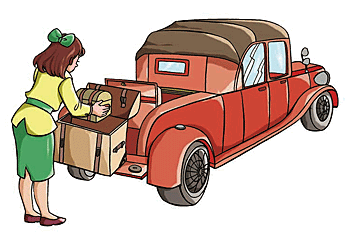
The sense of "luggage compartment of a motor vehicle" is from 1930; probably from a reference to a large strong traveling case or box with a hinged lid that is bigger, more rigid, and less portable than a suitcase which was attached to the back of early automobiles. "Trunk" is used in North-American English while "boot" is used in most of the other English-speaking countries.
Engish acquired the other two senses of the Old French word later; the sense of "main stem of a tree" dates from 1490; that of "torso of a human body" from 1494.
The reference to an elephant's snout is from 1565, probably from confusion with trump (short for trumpet). Railroad trunk line is attested from 1843; the telephone version is from 1889; a telephone line or channel between two central offices or switching devices that is used in providing telephone connections between subscribers generally.
A list of synonyms for trunk
- Trunk, tree trunk, bole, stalk, stem; usage: the main stem of a tree; usually covered with bark; the bole is usually the part of the tree that is commercially useful for lumber.
- Trunk, baggage, luggage; usage: luggage consisting of a large strong case used when traveling or for storage.
- Torso, trunk, body, body part; usage: the body excluding the head and neck and limbs.
- Luggage compartment, automobile trunk, trunk, compartment; usage: compartment in an automobile that carries luggage or shopping or tools; such as, "He put his tools in the trunk of his car."
- Proboscis, trunk, snout, neb; usage: a long flexible snout; such as, of an elephant.
2. Cut-off pants.
Related cutting-word units: cast-; castrat-; -cise, -cide; -ectomy; mutil-; put-; sec-, seg-; temno-; -tomy.