-ectomy, -ectome, -ectomize
(Greek: a suffix; cut, excise, surgical removal of)
abdominohysterectomy
Surgical removal of the uterus through an incision made in the abdominal wall which is the opposite of a vaginal hysterectomy.
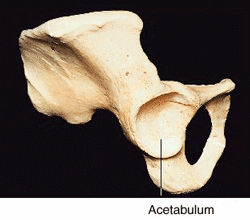
acetabulectomy
Excision of the
acetabulum (the hollow, cuplike portion of the pelvis into which the head of the thigh bone (femur) fits); also called,
acetabular bone, cotyloid cavity, and
os acetabuli.
acromionectomy
1. The partial or total surgical excision of the acromion.
2. Resection of the distal end of the acromion, done in the treatment of acromioclavicular arthritis.
The acromion is the lateral extension of the spine of the scapula, projecting over the shoulder joint and forming the highest point of the shoulder; also called the acromial process and acromion scapulae.
adenectomy, adenectomies
The surgical excision or removal of all or part of a gland.
adenohypophysectomy
Excision or
ablation* of the adenohypophysis (the anterior lobe of the hypophysis (pituitary gland).
The part that secretes growth hormone, fibroblast growth hormone, corticotropin, β-endorphin, thyrotropin, follicle-stimulating hormone, luteinizing hormone, and prolactin; these are released by hypophysiotropic hormones, releasing hormones secreted by the hypothalamus, and they regulate the functioning of the thyroid gland, gonads, adrenal cortex, and other endocrine organs.
As a consequence, the hypothalamo-pituitary unit is of vital importance to the growth, maturation, and reproduction of the individual.
*Ablation is usually carried out surgically; for example, the surgical removal of the thyroid gland (a total thyroidectomy) is an ablation of the thyroid.
The word ablation comes from the Latin ablatum, "to carry away".
adenoidectomy
Adenoid removal is the surgical removal of the adenoid glands from the area between the nasal airway and the back of the throat (nasopharynx).
Adenoidectomy is frequently done in conjunction with surgical removal of tonsils (tonsillectomy).
While the patient is under general anesthesia, the ear-nose-throat (ENT) surgeon inserts a small instrument into the mouth to prop it open.
The adenoid tissue can be removed with an instrument; such as, a curette or a microdebrider. Some surgeons may opt to cauterize the adenoids instead of removing the tissue. Bleeding is controlled with packing and cauterization.
The patient will remain in the recovery room after surgery until he is awake and able to breathe easily, cough, and swallow. Most patients are allowed to go home several hours later.
adenomectomy
The surgical removal of an adenoma (a benign epithelial tumor in which the cells form recognizable glandular structures or in which the cells are clearly derived from glandular epithelium: the covering of internal and external surfaces of the body, including the lining of vessels and other small cavities).
adenotonsillectomy
The surgical removal of tonsils and adenoids
adipectomy
The excision of a mass of subcutaneous adipose (fat) tissue, as from the abdominal wall; also, lipectomy.
adnexectomy
1. Excision of any adnexa.
2. In gynecology, excision of the fallopian tube and ovary if unilateral and excision of both tubes and ovaries (adnexa uteri) if bilateral.
This plural Latin word is used in medicine in reference to appendages; for example, in gynecology the adnexa are the appendages of the uterus, namely the ovaries, Fallopian tubes (ducts or canals which conduct the ova from the ovaries to the uterus), and ligaments that hold the uterus in place.
adrenalectomize
To make a surgical operation or excision of one (unilateral adrenalectomy) or both (bilateral adrenalectomy) adrenal glands.
adrenalectomy
The removal of one or more adrenal glands.
The adrenal glands are part of the endocrine system and are located just above the kidneys.
This is a minimally invasive surgical procedure that is most often performed laparoscopically. A laparoscope is a device that allows the physician to see the surgical area with a small camera. Laparoscopic procedures use smaller incisions than traditional, open procedures.
alveolectomy
Subtotal or complete excision of the alveolar process (portion of a bone in either the maxilla [upper jaw bone] or the mandible [jaw bone] which surrounds and supports the teeth) of the maxilla or mandible.
amygdalectomy
The surgical removal of the amygdala (the cerebellar tonsil, as well as the lymphatic tonsils; such as, pharyngeal, palatine, lingual, laryngeal, and tubal.
The amygdaloid nucleus in the brain; or the tonsils. These structures were so named because they appeared to be shaped like an almond. From the Greek amydale, "almond" plus the Greek eidos, "like".
aneurectomy
A relatively complex surgical intervention; such as, invasive surgery, was previously required in order to eliminate the potential risk of a brain aneurysm (a bulge in a blood vessel that bursts usually near the brain).
In this operation, called clipping, a craniotomy was performed, and afterwards a titanium clip was attached around the aneurysm's neck.
This operation became the standard of care for the treatment of cerebral aneurysms as microneurosurgical techniques were refined in the 1980s and 1990s.
In the mid to late 1990s, a different method of aneurysm treatment was developed which allowed for treatment without open surgery; namely, coil embolization of cerebral aneurysms which involves the insertion of a catheter through the groin with a small microcatheter navigated to the aneurysm itself through the cerebral arteries.
Coils (known as GDCs) are then deployed into the aneurysm filling it from within and thus preventing blood from entering the aneurysm itself.
Not every type of aneurysm can be treated with the previously described method; for example, certain wide-necked and inaccessible aneurysms currently still require surgical intervention, even though new methods (that use a type of stent) are already being studied and tested.
Surgery is also usually required for venous aneurysms as introducing foreign material in the low flow veins can produce a high risk blood clotting environment.
—Based on information from
Wikipedia: http://en.wikipedia.org/wiki/Aneuryism
Related cutting-word units:
castrat-;
-cise, -cide;
put-;
sec-, seg-;
temno-;
-tomy;
trunc-.
-Ectomy Word-Sources of Definitions