
-cise, -cis, -cide
(Latin: to cut, a cut)
From this combining form, we also get -cide, "kill", but don't confuse the two elements because they have different meanings and applications.
1. A powdered substance composed primarily of burned clay and limestone that is mixed with water, sand, and gravel to form concrete.
2. In geology, any chemically precipitated material or ore mineral that minds together loose particles of sediment into coherent rock.
3. Any substance; such as, a preparation of glue, red lead, or lime, the hardening of which causes objects between which it is applied to adhere firmly.
4. Any compound or substance applied in the form of a mortar and used for producing a hard and stony, smooth, water proof surface, coating, filling, or lining; as, for a floor or a cistern.
6. Auriferous gravel held together by a clay or silicic bond; also, the binding substance.
7. Etymology: from Old French ciment, which came from Latin cæmenta, "stone chips used for making mortar", from cædere, "to cut down, chop, beat, hew, fell, slay".
2. In geology, any chemically precipitated material or ore mineral that minds together loose particles of sediment into coherent rock.
3. Any substance; such as, a preparation of glue, red lead, or lime, the hardening of which causes objects between which it is applied to adhere firmly.
4. Any compound or substance applied in the form of a mortar and used for producing a hard and stony, smooth, water proof surface, coating, filling, or lining; as, for a floor or a cistern.
Ordinary cement is made by heating limestone and clay, or a natural rock containing both materials in the right proportions. When it hardens under water, it is called hydraulic cement
5. That which serves to bind people or special interests together.6. Auriferous gravel held together by a clay or silicic bond; also, the binding substance.
7. Etymology: from Old French ciment, which came from Latin cæmenta, "stone chips used for making mortar", from cædere, "to cut down, chop, beat, hew, fell, slay".
The evolution of the meaning, "small broken stones" to "powdered stones used in construction", took place before the word became a part of English.
cement (verb), cements; cemented; cementing
chisel (verb), chisels; chiseled; chiselled; chiseling, chiselling
1. To shape or cut with a chisel.
2. From Old French cisel, from Vulgar Latin cisellum "cutting tool," from Latin caesellum, diminutive of caesus past participle of caedere "to cut".
2. From Old French cisel, from Vulgar Latin cisellum "cutting tool," from Latin caesellum, diminutive of caesus past participle of caedere "to cut".
circumcise (verb), circumcises; circumcised; circumcising
To cut the protecting foreskin off males, or to cut away a girl's clitoris and the skin around it, for medical, traditional, or religious reasons.
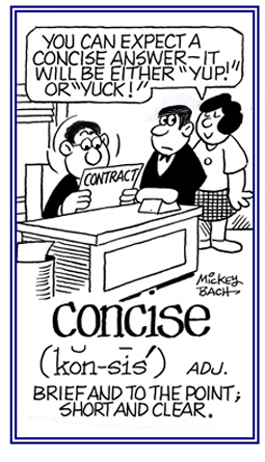
concise (adjective), more concise, most concise
1. A reference to the use of as few words as possible to provide necessary information, or which is compressed in order to be brief: When correcting the term papers for his students, Mr. Mount was very concise in his remarks, making sure they were short and to the point.
2. Pertaining to the expression of a great deal of information in a few words or using clear and succinct statements: The biography of the famous author was written in a concise and short summary.
© ALL rights are reserved.
Go to this Word A Day Revisited Index
2. Pertaining to the expression of a great deal of information in a few words or using clear and succinct statements: The biography of the famous author was written in a concise and short summary.
Go to this Word A Day Revisited Index
so you can see more of Mickey Bach's cartoons.
concisely (adverb), more concisely, most concisely
Descriptive of a speaking or writing in a few words: The history of this country is summed up concisely in the book used in the high school class.
1. Terseness and economy in writing and speaking achieved by expressing a great deal in just a few words.
2. The quality of being short and to the point.
2. The quality of being short and to the point.
1. Concise quality or terseness: The quotation from Shakespeare, "Brevity is the soul of wit" is an example of concision when making a speech or giving a talk.
2. Archaic, a cutting up or off; mutilation: The soldiers of ancient times suffered severe concisions in the battlefield when they were fighting other warriors who were using swords and pikes.
© ALL rights are reserved.
Go to this Word A Day Revisited Index
2. Archaic, a cutting up or off; mutilation: The soldiers of ancient times suffered severe concisions in the battlefield when they were fighting other warriors who were using swords and pikes.
The cartoon provides a clear understanding of what this concision word means.
Go to this Word A Day Revisited Index
so you can see more of Mickey Bach's cartoons.
decide (verb), decides; decided; deciding
1. To make a choice or come to a conclusion about something: "Fortunately, we decided not to go on the trip because there was a severe storm."
3. To bring something to an end in a definite or obvious way: "The final football touchdown decided the winner of the game."
4. To come to a verdict or judgment after thinking about it: "They decided to start the party at 7 p.m. and so they informed their guests accordingly."
5. Etymology: from or French décider; from Latin decidere "to cut off" from the prefix de-, "off" + caedere "to cut, to strike".
"Her son was having a problem deciding which university to go to."
2. To make someone choose what to do or come to a conclusion about something: "You have to decide which presidential candidate you want to vote for."3. To bring something to an end in a definite or obvious way: "The final football touchdown decided the winner of the game."
4. To come to a verdict or judgment after thinking about it: "They decided to start the party at 7 p.m. and so they informed their guests accordingly."
5. Etymology: from or French décider; from Latin decidere "to cut off" from the prefix de-, "off" + caedere "to cut, to strike".
"The term decide refers to a resolving of alternatives or difficulties by "cutting through them as if with a knife or a sword" and so dealing with them "at a stroke" or with "one complete action".
1. The act of mentally determining what a person wants to do: The burden of making a proper decision regarding the medical treatment for Sam was up to the doctor.
2. A position, opinion, or judgment that is reached after consideration: The politician made a decision that was unfavorable for his supporters and so, he lost the election.
3. Passing judgment on an issue under thinking about it: Greg asked, “Has Jack’s father come to a decision yet, as to whether we can use his car to go to the beach this weekend?"
4. A conclusion or a legal judgment reached or pronounced; a verdict: The judge went into his office where he had to think about which decision or ruling he should make regarding whether the testimony of a witness could be considered valid and legally acceptable.
5. In sports, when there is no knockout in a boxing match, the awarding of the fight goes to the boxer who won the most rounds or with more points than the opponent: A controversial decision was made one evening at the boxing club which resulted in Jack winning the contest.
6. Etymology: "to settle a dispute", from Old French decider, from Latin decidere, "to determine"; literally, "to cut off"; from de-, "off, down, down from, from" + caedere, "to cut".
2. A position, opinion, or judgment that is reached after consideration: The politician made a decision that was unfavorable for his supporters and so, he lost the election.
3. Passing judgment on an issue under thinking about it: Greg asked, “Has Jack’s father come to a decision yet, as to whether we can use his car to go to the beach this weekend?"
4. A conclusion or a legal judgment reached or pronounced; a verdict: The judge went into his office where he had to think about which decision or ruling he should make regarding whether the testimony of a witness could be considered valid and legally acceptable.
5. In sports, when there is no knockout in a boxing match, the awarding of the fight goes to the boxer who won the most rounds or with more points than the opponent: A controversial decision was made one evening at the boxing club which resulted in Jack winning the contest.
6. Etymology: "to settle a dispute", from Old French decider, from Latin decidere, "to determine"; literally, "to cut off"; from de-, "off, down, down from, from" + caedere, "to cut".
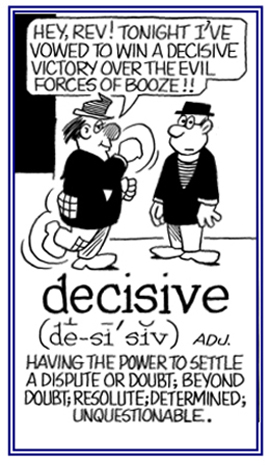
decisive (adjective), more decisive, most decisive
1. Descriptive of something which has been determined by a decision or a resolution as being crucial or most important: Carol's argument was the decisive one in determining when her family would go on their vacation.
2. Characterizing little or no hesitation; determined: The general was known for his decisive manners.
3. Indisputable; definite: The military unit suffered a decisive defeat.
4. Unsurpassable; commanding: Greg had a decisive lead in the voting of the city council.
5. Concerning a person's firmness when making crucial resolutions: Nothing could influence Jane's determination and willpower to continue helping poor people because she had a very decisive temperament and disposition.
© ALL rights are reserved.
Go to this Word A Day Revisited Index
2. Characterizing little or no hesitation; determined: The general was known for his decisive manners.
3. Indisputable; definite: The military unit suffered a decisive defeat.
4. Unsurpassable; commanding: Greg had a decisive lead in the voting of the city council.
5. Concerning a person's firmness when making crucial resolutions: Nothing could influence Jane's determination and willpower to continue helping poor people because she had a very decisive temperament and disposition.
Go to this Word A Day Revisited Index
so you can see more of Mickey Bach's cartoons.
decisively (adverb), more decisively, most decisively
excide (verb), excides; excided; exciding
To cut out or to cut off.
excise (verb), excises; excised; excising
1. To remove surgically or as if by cutting: The doctor excised the tumor during the Tom's operation.
2. To delete a part of something such as a text, part of a film, etc: The producer excised two scenes from the movie.
3. Etymology: from Latin excis-, past participle of excidere "to cut out" from ex-, "out" + caedere "to cut".
2. To delete a part of something such as a text, part of a film, etc: The producer excised two scenes from the movie.
3. Etymology: from Latin excis-, past participle of excidere "to cut out" from ex-, "out" + caedere "to cut".
