
tomo-,-tom, -toma, -tomic, -tomize, -tome, -tomical, -tomically, -tomist, -tomous, -tomy; -otomy
(Greek: cut, incision; section; more often used as a suffix)
2. The study of form, or the branch of science that studies the physical structure of animals, plants, and other organisms.
3. The physical structure; especially, the internal structure, of an animal, plant, or other organism, or of any of its parts.
Gross anatomy involves structures that can be seen with the naked eye. It is the opposite of "microscopic anatomy" (or histology) which involves structures seen under the microscope.
Traditionally, both gross and microscopic anatomy have been studied in the first year of medical school in the U.S. The most celebrated textbook of anatomy in the English-speaking world is Gray's Anatomy, still a useful reference book.
The word anatomy comes from the Greek ana-, "up" or "through" + tome, "a cutting". Anatomy was once a "cutting up" because the structure of the body was originally learned through dissecting it; that is, cutting it up.
Carbon, the sixth element of the periodic table of atoms, forms the basis of most biological molecules and oxygen is another atom, one of about a hundred basic elements that make up all of the objects around us.
2. The fundament building blocks for all matter: An atom is the smallest representative sample of a chemical element and it consists of a positively charged nucleus surrounded by negatively charged electrons.All of the matter on the Earth is made of atoms which are the chemical structures of our world.
New modern atomic theory is generally credited to an English meteorologist, John Dalton (1766-1844), who suggested that for each chemical element there was a corresponding species of indivisible objects called atoms.
Two or more atoms that are joined together form a molecule which is the same term that applies to any cluster of atoms which can be isolated, whether it contains two atoms or a thousand atoms.
3. A tiny particle or a very small amount of anything: After the politician's presentation, Nicola was heard to say that there was not an atom of truth in anything that he had said.4. Etymology: atom means "not cut, indivisible"; from Greek atomos, "uncut, indivisible"; from a-, "not" + tomos, "a cutting"; from temnein, "to cut".
2. A dissection of the fetal head.
A colostomy is commonly performed by severing the colon and then attaching the end leading to the stomach to the skin, through the wall of the abdomen. At the exterior opening (stoma), a bag can be attached to receive bodily-waste removal.
2. A computerized axial tomography scan which is an x-ray procedure that combines many x-ray images with the aid of a computer to generate cross-sectional views and, if needed, three-dimensional images of the internal organs and structures of the body.
Computerized axial tomography is more commonly known by its abbreviated names, CT scan or CAT scan. A CT scan is used to define normal and abnormal structures in the body and/or to assist in procedures by helping to accurately guide the placement of instruments or treatments.
The procedure was used first in 1972 to study the brain and is a painless and noninvasive procedure that does not require any special preparation. It is considered to be 100 times more sensitive than conventional radiography or X-rays.
As well as being essential for the study of the brain, CT scanning is considered to be invaluable in investigating diseases of any part of the body. It is particularly useful for locating and imaging tumors, and for guiding the operator who is performing a needle biopsy.
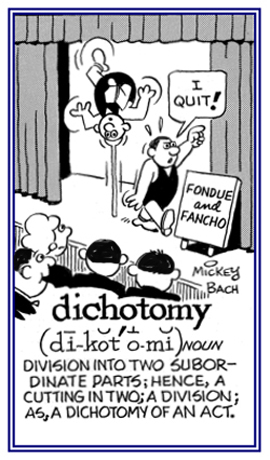
Tim's psychologist discussed the dichotomy of love and hate when associating with people.
Go to this Word A Day Revisited Index
so you can see more of Mickey Bach's cartoons.
Related cutting-word units: cast-; castrat-; -cise, -cide; -ectomy; mutil-; put-; sec-, seg-; temno-; trunc-.
