
duc-, -duce, -duct, -ducent, -ductor, -duction, -ductive, -ducer, -ducement, -ducation
(Latin: to lead, leading; bringing; to take; to draw along or out)
The ditch abduces the flood water off the street.
The children were abduced from the proximity of the barking dog by their teacher.
The woman saved the kitten's life using a bowl of milk when she abduced it to move from the ledge of the window.
2. To draw away or to move away from a median plane: The doctor had to abduce Sarah's right arm from its mid plane to the side and back again.Abducent muscles refer to the movements of one part of the body away from another section.
The abducent nerve originates in the pons, or part of the brain stem, and emerges from the brain immediately below it, then, from this point, it extends through the skull, eventually entering the back of the eye socket through a space between the skull bones.
The hitchhiker tried to abduct Jim's backpack, which was lying next to the road, when Jim was taking a toilet break.
Melinda Pearl was wondering what would happen if the man abducted the puppy without getting permission.
The customer saw Douglas Johnson who was abducting a package of grapes from the store.
2. To pull something, such as a muscle, away from the midpoint or midline of the body or of a bodily limb: When Jason fell, he abducted a muscle in his leg and so he had to limp to the bench so he could sit down.Three of the abductees agreed to meet with the police in an effort to catch the guy who held them in captivity for several days before he was paid the ransom that he demanded.
The story of the Lindbergh baby abduction on March 1, 1932, was news all around the world when the child's absence was discovered and reported to his parents, who were at home, at approximately 10:00 p.m.
Today there are many reports of abductions taking place in impoverished countries.
2. A muscle that pulls the body or a limb away from a midpoint or midline, such as raising the arm out from the side: Eric strained both abductors in his right arm when he tried to throw the baseball.
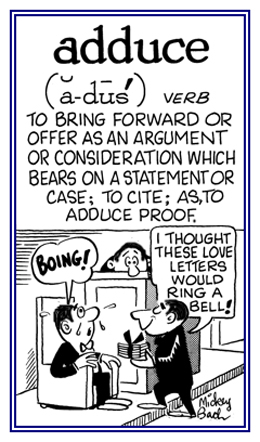
2. To present as pertinent, conclusive, or persuasive confirmation that something is true beyond any doubt: The speaker adduced three reasons for his actions as a government official.
As a Senator, Harry tried to adduce reasons for not supporting the congressional bill.
Go to this Word A Day Revisited Index
so you can see more of Mickey Bach's cartoons.
2. The action of bringing something forward as a fact or a statement.
