
port-, portat-
(Latin: carry, bring, bear)
Don't confuse this port-, portat with another port- meaning "door, gate, entrance," or "harbor".
1. The production of material objects, supposedly by occult supernormal means, at a spiritualistic séance: Mark, the spiritualist, was using paranormal methods to show apports from the world beyond the one in which we are now living.
2. Etymology: from French aport; literally, "bringing to", from aporter, "to carry to"; from porter, "to carry".
2. Etymology: from French aport; literally, "bringing to", from aporter, "to carry to"; from porter, "to carry".
apport (verb), apports; apported; apporting
To bring, to provide; to arrive at: Elvira was interested in attending the séance in hopes of seeing if the spiritual leader could actually apport something from another realm of existence.
apportable (adjective), more apportable, most apportable
Pertaining to that which can be brought forward or revealed, especially from the nonmaterial world: The spiritual medium made apportable procedures to communicate with those who were killed in the bomb explosions.
The spiritualist or occult process of making items disappear from one location and to reappear in another place: The asport of objects from place to place in the room by the occult process of medium was transfixing or amazing the audience.
asport (verb), asports; asported; asporting
To carry away, to remove feloniously or by theft: Tom and Steven, the bank robbers, were able to asport all the gold from the safe during the break in.
1. The larcenous action whereby a person's property is stolen or illegally carried away: The police officers were investigating the asportation of the office machines that were missing when the office staff came to work the following morning.
2. Etymology: from Latin asportatio, from asportare, "to carry off"; from abs-, "away" + portare, "to carry".
2. Etymology: from Latin asportatio, from asportare, "to carry off"; from abs-, "away" + portare, "to carry".
colportage (noun) (no plural)
The act or process of selling religious books and literature by individuals specifically employed to do so: Tom's cousin was employed during the summer to complete the colportage of Bibles and other books about his denomination's religious beliefs.
1. A hawker or seller of books, essays, newspapers, etc.; especially in English use, someone who is employed by a religious group to travel around and to sell or to distribute Bibles and other religious writings: The colporteurs, Susan and Sally, were going from one house to another in Jan's neighborhood in an effort to sell their religious publications.
2. Etymology: from French colporter; probably from Old French comporter, "to carry"; influenced through folk etymology by porter à col, "to carry on one's neck". A French alteration influenced by col, "neck", from the idea that "peddlers carried their wares on trays suspended from straps around their necks".
2. Etymology: from French colporter; probably from Old French comporter, "to carry"; influenced through folk etymology by porter à col, "to carry on one's neck". A French alteration influenced by col, "neck", from the idea that "peddlers carried their wares on trays suspended from straps around their necks".
comport (verb), comports; comported; comporting
1. To behave or to conduct oneself in an acceptable way: Jim's mother told him to comport himself properly when he goes to his cousin's birthday party.
2. To agree with or to harmonize with: Sally comported herself during the interview with the newspaper reporter regarding her political views.
3. Etymology: from Latin comportare, "to bear, to collect; from com-, "together" + portare, "to carry"; literally, "to carry together"; "to behave oneself in a certain way"; such as, "to comport oneself properly".
2. To agree with or to harmonize with: Sally comported herself during the interview with the newspaper reporter regarding her political views.
3. Etymology: from Latin comportare, "to bear, to collect; from com-, "together" + portare, "to carry"; literally, "to carry together"; "to behave oneself in a certain way"; such as, "to comport oneself properly".
comportable (adjective), more comportable, most comportable
Characterized by behavior that is appropriate or appropriate for a situation: Kate’s comportable discretion during the funeral of her friend was respectful and appreciated.
Personal behavior, public conduct, or course of action: The positive comportment of the politician encouraged many people to vote for him.
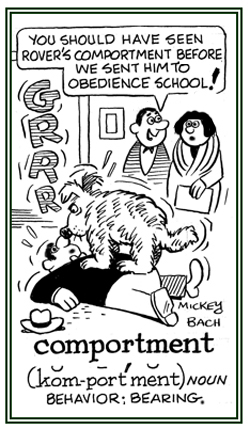
© ALL rights are reserved.
Go to this Word A Day Revisited Index
The good comportments of the students made it easier for the teacher to teach and for the students to learn more.
Go to this Word A Day Revisited Index
so you can see more of Mickey Bach's cartoons.
deport (verb), deports; deported; deporting
1. To remove into exile, to banish; to expel from a country: The court order sought to deport the mother even though her children, Jan and Jake, were born in the country where she had been living for the last ten years.
2. To behave or to conduct oneself in a specified way: Mrs. Thompson, the dance instructor, indicated that she expected her students to deport themselves appropriately during the dance competition.
2. To behave or to conduct oneself in a specified way: Mrs. Thompson, the dance instructor, indicated that she expected her students to deport themselves appropriately during the dance competition.
Sally and Tommy, the young children, deported themselves with socially good behavior.
3. Etymology: from Modern French déporter; from Latin deportare, "to carry off, to transport, to banish, to exile"; from de-, "off, away" + portare. "to carry".
deportable (adjective), more deportable, most deportable
Subject to or punishable by being exiled or ordered to leave a specific location: Henry's deportable status as an illegal immigrant was in the process of being appealed by his lawyer in court.
1. The forcible transfer of a foreign national from a country: The deportation of Mr. and Mrs. Jackson took place when they were found to be without a visa or the official stamp in their passports that would allow them to legally enter the country.
2. The removal or sending back of aliens to the country from which they came because their presence is legally considered inconsistent with public safety: Deportations may be done without any punishments being imposed or considered for the deportees.
2. The removal or sending back of aliens to the country from which they came because their presence is legally considered inconsistent with public safety: Deportations may be done without any punishments being imposed or considered for the deportees.
A person who has been ordered to be removed from a specific area or country: Jeb, the deportee, was allowed to say goodbye to his family before boarding his plane back to his native country.
Cross references of word families related to "bear, carry, bring": duc-; -fer; ger-; later-, -lation; phoro-.
