
verg-, -vergent, -vergence
(Latin: bend, curve, turn, tend toward, incline)
converge (verb), converges; converged; converging
1. To tend to go to one point from different places.
2. To meet in at a common result of operation; to reach the same point coming from different directions: The travelers met where the roads were converging.
3. To become the same; to become gradually less different and eventually the same: The political beliefs of the voters were rapidly converging.
4. To tend toward or to achieve a union or a common conclusion or result: In time, the views and the efforts of the politicians converged.
5. In mathematics, to approximate in the sum of its terms toward a definite limit.
6. To arrive at same destination; to gather or meet at the same destination: The delegates to the convention came from all over the world and are converging on the city of Berlin.
7. In biology, to develop similar characteristics; to develop, independently of other species, superficially similar characteristics in response to a set of environmental conditions: In nature, there are converges of the development of wings in birds and insects.
2. To meet in at a common result of operation; to reach the same point coming from different directions: The travelers met where the roads were converging.
3. To become the same; to become gradually less different and eventually the same: The political beliefs of the voters were rapidly converging.
4. To tend toward or to achieve a union or a common conclusion or result: In time, the views and the efforts of the politicians converged.
5. In mathematics, to approximate in the sum of its terms toward a definite limit.
6. To arrive at same destination; to gather or meet at the same destination: The delegates to the convention came from all over the world and are converging on the city of Berlin.
7. In biology, to develop similar characteristics; to develop, independently of other species, superficially similar characteristics in response to a set of environmental conditions: In nature, there are converges of the development of wings in birds and insects.
1. The action or fact of movement directed toward or terminating at the same point: In meteorology, the accumulation of air in a region caused by the convergences of winds which result in upward air-currents.
2. The tendency of two or more objects moving toward a common point or a uniformity of operations.
2. The tendency of two or more objects moving toward a common point or a uniformity of operations.
convergency (noun), convergencies (pl)
The state or quality of being closer.
The action or fact of drawing together.
convergent (adjective), more convergent, most convergent
1. A reference to inclining towards each other or a common point of meeting.
2. In psychology, thinking, reasoning, etc.; of a kind that tends towards only one answer to a problem.
2. In psychology, thinking, reasoning, etc.; of a kind that tends towards only one answer to a problem.
converging (adjective), (not comparable)
1. Relating to inclining towards each other or towards a common point of meeting; tending to meet in a point.
2. In optics, descriptive of that which is applied to rays of light that meet or tend to meet in a focus.
3. In botany, a reference to pairs of organs that bend towards each other.
2. In optics, descriptive of that which is applied to rays of light that meet or tend to meet in a focus.
3. In botany, a reference to pairs of organs that bend towards each other.
diverge (verb), diverges; diverged; diverging
1. To proceed in different directions from a point or from each other; as with lines, rays of light, etc.; the opposite of converge.
2. To take different courses; to turn off from a track or course; to differ in opinion or character; to deviate from a typical form or normal state.
3. In mathematics, said of an infinite series the sum of which increases indefinitely as the number of terms is increased.
4. To cause (lines or rays) to branch off in different directions; to make divergent, to deflect.
2. To take different courses; to turn off from a track or course; to differ in opinion or character; to deviate from a typical form or normal state.
3. In mathematics, said of an infinite series the sum of which increases indefinitely as the number of terms is increased.
4. To cause (lines or rays) to branch off in different directions; to make divergent, to deflect.
Two roads diverged in a wood, and I—
I took the one less traveled by,
And that has made all the difference.
I took the one less traveled by,
And that has made all the difference.
1. The action of moving off in different directions from the same point, so that the intervening distance continually increases.
2. The departure from each other of two paths, courses, modes of action, or processes; continuous departure or deviation from a standard or norm.
3. Difference or disparity: a difference between two or more things such as opinions or attitudes.
4. Moving apart: the process of separating or moving away to follow different paths or different courses.
2. The departure from each other of two paths, courses, modes of action, or processes; continuous departure or deviation from a standard or norm.
3. Difference or disparity: a difference between two or more things such as opinions or attitudes.
4. Moving apart: the process of separating or moving away to follow different paths or different courses.
divergent (adjective), more divergent, most divergent
1. Descriptive of going in different directions from each other or from a common point: Even though the families went in two different cars from divergent directions, they both arrived at the cottage where they would be living together and go skiing.
3. A reference to thinking or reasoning that results in a wide variety of possible answers to a problem: The symposium encouraged divergent thinking from the students as they searched for answers to the challenges of creating a better environment on campus.
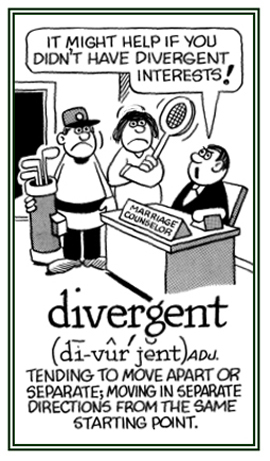
© ALL rights are reserved.
Go to this Word A Day Revisited Index
While driving on the roundabout on the highway, Pete noticed two divergent roads leading to the same city.
2. Relating to proceeding in dissimilar routes, lines of action, or types of thinking: The professor was known for her divergent thinking about solving the math equation.3. A reference to thinking or reasoning that results in a wide variety of possible answers to a problem: The symposium encouraged divergent thinking from the students as they searched for answers to the challenges of creating a better environment on campus.
Go to this Word A Day Revisited Index
so you can see more of Mickey Bach's cartoons.
divergently (adverb), more divergently, most divergently
Descriptive of a manner that is tending to be different or developing in different directions.
1. Someone who thinks in a different way.
2. Something that is characterized or produced by moving or extending in other directions.
2. Something that is characterized or produced by moving or extending in other directions.
diverging (adjective), more diverging, most diverging
1. Descriptive of proceeding or tending to move apart in different directions from a common point or center, so as to become more and more widely separated.
2. A reference to turning off from a straight course.
2. A reference to turning off from a straight course.
diverting (adjective), more diverting, most diverting
Referring to drawing the attention of someone away from a serious activity with entertainment: Reading an interesting book can be a diverting pleasure for many people.
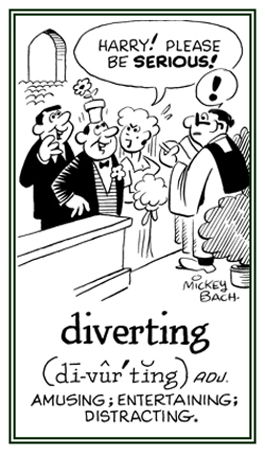
© ALL rights are reserved.
Go to this Word A Day Revisited Index
Go to this Word A Day Revisited Index
so you can see more of Mickey Bach's cartoons.
1. An extreme limit beyond which something specific will begin or happen: Grace was on the verge of tears when she heard about her mother being in the train accident.
2. A boarder, a margin, or an edge of anything: The hedge or boundary formed by closely growing bushes or shrubs was a verge created by Tom's neighbor which extended around the whole length of his property.
3. Etymology: from Latin virga, "twig, rod, wand."
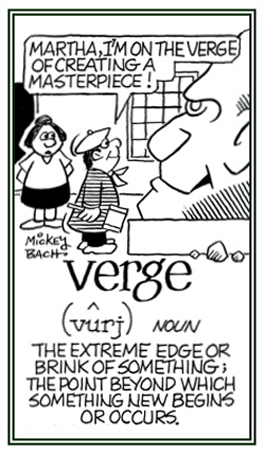
© ALL rights are reserved.
Go to this Word A Day Revisited Index
2. A boarder, a margin, or an edge of anything: The hedge or boundary formed by closely growing bushes or shrubs was a verge created by Tom's neighbor which extended around the whole length of his property.
3. Etymology: from Latin virga, "twig, rod, wand."
Go to this Word A Day Revisited Index
so you can see more of Mickey Bach's cartoons.
verge (verb), verges, verged, verging
1. To incline or tend to approach or to draw near, towards some state or condition.
2. To pass or undergo a gradual transition into something else.
3. The limit beyond which something happens or changes: Shirley was verging with tears when she was told that she could not go to the movie.
4. To border on; to come close to.
5. Etymology: from Latin vergere, "to bend, to turn, to tend toward, to incline".
2. To pass or undergo a gradual transition into something else.
3. The limit beyond which something happens or changes: Shirley was verging with tears when she was told that she could not go to the movie.
4. To border on; to come close to.
5. Etymology: from Latin vergere, "to bend, to turn, to tend toward, to incline".
Inter-related cross references involving word units meaning "bend, curve, turn": diversi-; diverticul-; flect-, flex-; gyro-; meand-; -plex; streph-; stroph-; tors-; tropo-; vers-; volv-.

Showing page 1 out of 2 pages of 16 main-word entries or main-word-entry groups.