
diversi-, divers-, divert-
(Latin: different, separate, opposite; literally, turned away [from each other])
Directly related to the large vers-, vert- family of words.
biodiversity
1. The number and variety of organisms in a given locality, community, or ecosystem at a given time.
2. In different contexts it may denote: the number of different species present in a given environment (species diversity); the genetic diversity within a species (genetic diversity); the number of different ecosystems present in a given environment (ecological diversity).
2. In different contexts it may denote: the number of different species present in a given environment (species diversity); the genetic diversity within a species (genetic diversity); the number of different ecosystems present in a given environment (ecological diversity).
High biodiversity is typical of complex and highly productive ecosystems; such as, tropical rain forests, where a small area can contain many different species of animals, plants, and other organisms.
Biodiversity is often used as an indicator of the health of such ecosystems.
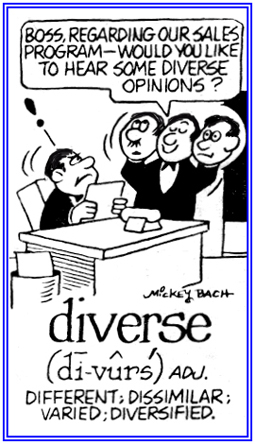
diverse (adjective), more diverse, most diverse
1. Made up of distinct characteristics, qualities, or elements; for example, consisting of many differing parts, topics, or subjects: The students in Jaden's psychology class presented several diverse explanations about how people think.
2. Very different or distinct from one another: Henry was someone who had many diverse interests and activities.
3. Composed of many ethnic, as well as socioeconomic and gender, groups: The large city had a very diverse population, including people from each continent in the world.
4. Etymology: associated with Latin diversus, "turned different ways" and since about 1700, restricted to the meaning "different in character or quality".
© ALL rights are reserved.
Go to this Word A Day Revisited Index
2. Very different or distinct from one another: Henry was someone who had many diverse interests and activities.
3. Composed of many ethnic, as well as socioeconomic and gender, groups: The large city had a very diverse population, including people from each continent in the world.
4. Etymology: associated with Latin diversus, "turned different ways" and since about 1700, restricted to the meaning "different in character or quality".
Go to this Word A Day Revisited Index
so you can see more of Mickey Bach's cartoons.
diversely
diverseness
diversifiable (adjective), more diversifiable, most diversifiable
Inclined to be varied, expanded, or spread out: The diversifiable risks were explained to the prospective buyer, including the fact that such risks do not necessarily involve any further anticipated return.
diversification
diversifier
diversify (verb), diversifies; diversified; diversifying
1. To distribute (investments) among different companies or securities in order to limit losses in the event of a fall in a particular market or industry.
2. To become more varied or to make something more varied.
3. To expand into new areas of business, or to expand a commercial organization into new areas of manufactured products, crops, etc.
2. To become more varied or to make something more varied.
3. To expand into new areas of business, or to expand a commercial organization into new areas of manufactured products, crops, etc.
diversiloquent, diversiloquence
Speaking in different ways.
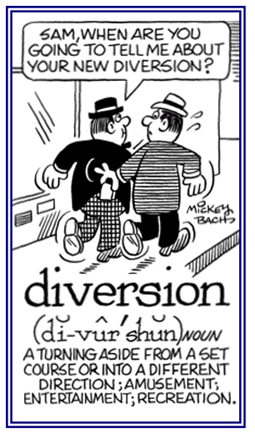
1. An action that takes another person's attention away from something else: The rainbow in the sky was a beautiful diversion for the children while their parents were driving on the highway.
2. A change in the purpose or the use of something from what was intended or from what it was previously: While she was baking in the kitchen, Sarah saw a package of chocolate chips that became a welcome diversion of the kind of cookies she was thinking about baking; which was, chocolate chip instead of peanut butter.
3. A change in the direction or the path of something: The rock slide in the mountains caused a diversion of traffic along the nearby highway.
4. An activity or interest that takes a person's mind off more routine or serious things: Jason joined a golf club as a diversion from the pressures of his work at the bank.
5. An action aimed at distracting the attention of others from the place of an intended destination: When the children were playing hide and seek in the park, Elaine tossed a stone into the bushes to create a noisy diversion while she ran to hide behind a park bench.
6. Etymology: from Middle French diversion, from Late Latin diversionem, diversio and from Latin divertere, "in different directions"; blended with devertere, "to turn aside,"; from dis-, "aside" and de-, "from" + vertere, "to turn".
© ALL rights are reserved.
Go to this Word A Day Revisited Index
2. A change in the purpose or the use of something from what was intended or from what it was previously: While she was baking in the kitchen, Sarah saw a package of chocolate chips that became a welcome diversion of the kind of cookies she was thinking about baking; which was, chocolate chip instead of peanut butter.
3. A change in the direction or the path of something: The rock slide in the mountains caused a diversion of traffic along the nearby highway.
4. An activity or interest that takes a person's mind off more routine or serious things: Jason joined a golf club as a diversion from the pressures of his work at the bank.
5. An action aimed at distracting the attention of others from the place of an intended destination: When the children were playing hide and seek in the park, Elaine tossed a stone into the bushes to create a noisy diversion while she ran to hide behind a park bench.
6. Etymology: from Middle French diversion, from Late Latin diversionem, diversio and from Latin divertere, "in different directions"; blended with devertere, "to turn aside,"; from dis-, "aside" and de-, "from" + vertere, "to turn".
Go to this Word A Day Revisited Index
so you can see more of Mickey Bach's cartoons.
diversity
1. A variety of something; such as, opinion, color, or style: "We live in a country with great cultural diversity."
2. Ethnic variety, as well as socioeconomic and gender variety, in a group, a society, or an institution; such as, working in a society committed to diversity.
3. Discrepancy, variety, multiformity, or a difference from what is considered to be normal or expected.
2. Ethnic variety, as well as socioeconomic and gender variety, in a group, a society, or an institution; such as, working in a society committed to diversity.
3. Discrepancy, variety, multiformity, or a difference from what is considered to be normal or expected.
diversivolent (adjective)
Desiring strife or differences.
divert
1. To change the route or path taken by something; such as, traffic, traveling, or a river.
2. To take someone's mind off something and to draw attention to something else.
3. To change the purpose or use of something from what it was previously.
4. To entertain by distracting attention from worrisome thoughts or cares; to amuse or to entertain someone or yourself.
5. Etymology: from Middle French divertir, from Latin divertere, "in different directions"; blended with devertere, "to turn aside" from dis-, "aside" and de-, "from" + vertere, "to turn".
2. To take someone's mind off something and to draw attention to something else.
3. To change the purpose or use of something from what it was previously.
4. To entertain by distracting attention from worrisome thoughts or cares; to amuse or to entertain someone or yourself.
5. Etymology: from Middle French divertir, from Latin divertere, "in different directions"; blended with devertere, "to turn aside" from dis-, "aside" and de-, "from" + vertere, "to turn".
diverticula
Plural of diverticulum.
diverticular
Relating to a diverticulum.
Inter-related cross references involving word units meaning "bend, curve, turn": diverticul-; flect-, flex-; gyro-; meand-; -plex; streph-; stroph-; tors-; tropo-; verg-; vers-; volv-.

Showing page 1 out of 2 pages of 28 main-word entries or main-word-entry groups.