
ursi-, urs- +
(Latin: bear [the omnivorous animal, a.k.a. a carnivore])
Orson
1. A male given name: from an Old French word meaning “bearlike”.
2. A masculine proper name, from French ourson, diminutive of ours "bear", from Latin ursus.
2. A masculine proper name, from French ourson, diminutive of ours "bear", from Latin ursus.
A female-bear, also, a constellation, the feminine form of a bear.
Ursa Major
In astronomy, the "Great Bear", the most prominent northern constellation, containing the seven stars that form the Big Dipper.
Ursa Minor
The "Little Bear", the constellation nearest the north pole. It contains the north star, or polestar, which is situated in the extremity of the tail.
The killing of bears.
Ursidae
A bear is a large mammal of the order Carnivora, family Ursidae.
ursiform (adjective), more ursiform, most ursiform
Characteristic of having the form of a bear; bear-shaped; such as, the koala: For the party, Karin's friend, Sam, wore a ursiform costume and won first prize for his creativity.
© ALL rights are reserved.
Go to this Word A Day Revisited Index
In fact, Sam's outfit was more ursiform than those of two other guests who had similar bear-like costumes.
Go to this Word A Day Revisited Index
so you can see more of Mickey Bach's cartoons.
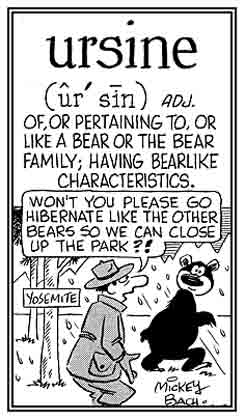
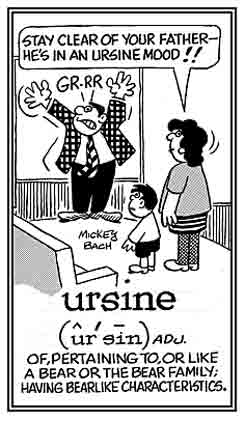
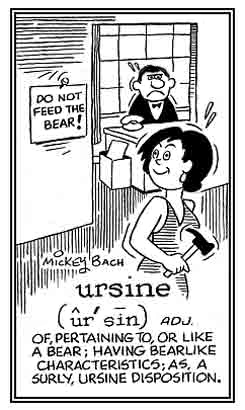
ursine (adjective), more ursine, most ursine
Relating to a bear or having bear-like characteristics: Todd was a football player who had ursine attitudes and physical strength when he was playing against his opponents.
© ALL rights are reserved.
© ALL rights are reserved.
Go to this Word A Day Revisited Index
Go to this Word A Day Revisited Index
so you can see more of Mickey Bach's cartoons.
The Canadian porcupine: "This urson is sometimes called the bear-porcupine.
Ursula
1. A female given name from a Latin word meaning “bear”.
2. Saint, a legendary British princess who, with 11,000 virgins, is said to have been martyred by the Huns at Cologne.
2. Saint, a legendary British princess who, with 11,000 virgins, is said to have been martyred by the Huns at Cologne.
Ursus
Type genus of Ursidae, brown bears; in some classifications genus Ursus includes all bears.
Ursus spelaeus
1. A hollow place in the earth, either natural or artificial; a subterraneous cavity; a cavern; a den.
2. A very large fossil bear (Ursus spelaeus) similar to the grizzly bear, but larger; common in European caves.
2. A very large fossil bear (Ursus spelaeus) similar to the grizzly bear, but larger; common in European caves.
<img src="/img/left_arrow_sm.gif" alt="" /> <img src="/img/right_arrow_sm.gif" alt="" />
Showing 1 page of 12 main-word entries or main-word-entry groups.