
Berserk
(Old Norse: berserkar, literally, “bear’s skin”; a Norse-myth warrior)
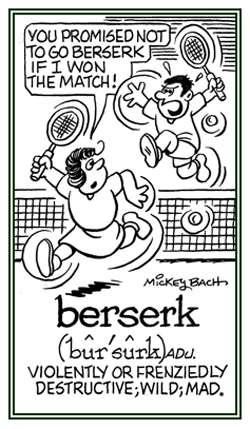
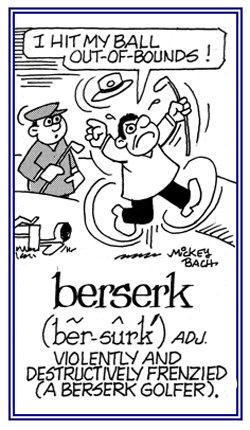
Go to this Word A Day Revisited Index
for a list of additional Mickey Bach illustrations.
2. An informal expression indicating being extremely excited or enthusiastic about something: The crowd went berserk when the movie star finally appeared.3. Destructively or frenetically violent: The berserk worker started to smash all of the windows.
4. Mentally or emotionally deranged and greatly disturbed: Irene was berserk with grief when her son stumbled and fell down the stairs.
5. Informal: Unrestrained, as with enthusiasm or appetite; wild: The children went berserk over the chocolates.
When people informally say, "the group went berserk", they probably don't realize how extreme such a remark really is.
The adjective comes from the noun berserker, or berserk, which is from the Old Norse word berserkr, “a wild warrior or champion”. Such warriors wore hides of bears, which explains the probable origin of berserkr as a compound of bera, “bear” and serkr, “shirt, coat”.
These berserkers became frenzied in battle, howling like animals, foaming at the mouth, and biting the edges of their iron shields.
The term berserker was first recorded in English in the early 19th century, long after these wild warriors ceased to exist.
If you came here from the amok adverb entry and want to go back to it, you may use this amok link to return there.
2. One of a band of ancient Norse warriors legendary for their savagery and reckless frenzy in battle.
3. One of the ancient Norse warriors legendary for working themselves into a frenzy before a battle and fighting with reckless savagery and insane fury.
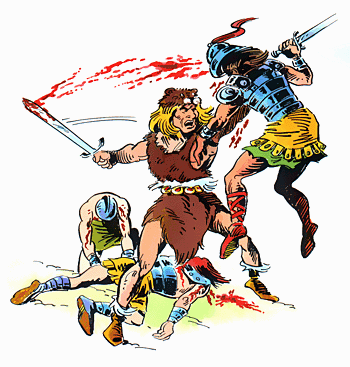
Old Berserker (Bear Skin) was a famous character in Norse mythology who was a supernatural warrior who fought with great fury and feared nothing. It is said that he even fought without weapons or armor and rushed into battle “protected” only by the bear skin thrown over his shoulder and clawing and biting his victims to death.
Examples of modern berserkers minus the bear skins
Based on this myth, any fierce figher was soon called a berserker; especially one who fought with a fury that seemed almost insane and terrified even his allies. In time, to go berserk came to mean the violent, furious rage of a madman.
Modern berserkers gone wild.
Back in 1995, there was an article about three young men, sixteen, seventeen, and eighteen years of age; two of whom were arrested for killing their parents.
The brothers are charged with three counts each of homicide and conspiracy to commit homicide in the slayings of their parents and their younger brother.
Police say the brothers had threatened for years to kill their parents as revenge for trying to impose their strict way of life as Jehovah’s Witnesses on the boys.
The three, two brothers and a cousin, all had shaven heads and tattoos. One had “Sieg Heil!” tattooed above his eyebrows, while two of them had “Berserker” tattooed on their foreheads; an apparent reference to Norse folk stories about warriors so fierce they needed no armor.
 Try this berserk quiz to see what you have learned about this topic.