
phanero-, phaner-, -phane, -phan, -phanic, -phanous,
-phany +
(Greek: to show; to make visible, to manifest, to open)
An amorphous clay mineral having a variable composition of aluminum silicate, hydrated water, and traces of other minerals: in her book, Judy read about an allophane as being an amorphous, variously colored, hydrated aluminosilicate mineral.
autophanous
Self-luminous; that is, emitting or reflecting light.
cellophane
1. A transparent paper-like product that is impervious to moisture and used to wrap candy or cigarettes, etc.
2. A thin, flexible, transparent cellulose material made from wood pulp and used as a moistureproof wrapping.
3. Etymology: from a 1912 trademark name for a product made from regenerated cellulose, coined by the inventor, Swiss chemist Jacques E. Brandenberger (1872-1954), probably from cell(ulose) + o + phane; from Greek phainein, "to appear".
2. A thin, flexible, transparent cellulose material made from wood pulp and used as a moistureproof wrapping.
3. Etymology: from a 1912 trademark name for a product made from regenerated cellulose, coined by the inventor, Swiss chemist Jacques E. Brandenberger (1872-1954), probably from cell(ulose) + o + phane; from Greek phainein, "to appear".
diaphane
A minute, or very small, electric lamp for use in transillumination.
diaphaneity
Transparency or permitting the passage of rays of light, so that objects may be seen through the substance.
diaphanography
Transillumination of the breast, with photography of the transilluminated light on infrared-sensitive film.
diaphanometer
1. An instrument for measuring the transparency of a solid, liquid, or gas.
2. An instrument for testing urine and other fluids by means of transmitted light.
2. An instrument for testing urine and other fluids by means of transmitted light.
diaphanometry
The measurement of the transparency of a fluid.
1. A dark box constructed for viewing transparent pictures, with or without a lens.
2. An instrument for the transillumination of a body cavity or the passage of strong light through a body structure, to permit inspection by an observer on the opposite side.
2. An instrument for the transillumination of a body cavity or the passage of strong light through a body structure, to permit inspection by an observer on the opposite side.
diaphanoscopic
A reference to a system whereby an instrument for illuminating a body cavity with transillumination is utilized.
A transillumination or the passage of light through body tissues for the purpose of medical examination which involves the object or part under examination being interposed between the observer and the light source.
diaphanous (adjective), more diaphanous, most diaphanous
So fine and translucent in texture as to be transparent: A diaphanous material or article allows light to pass through so that objects behind it can be easily seen.
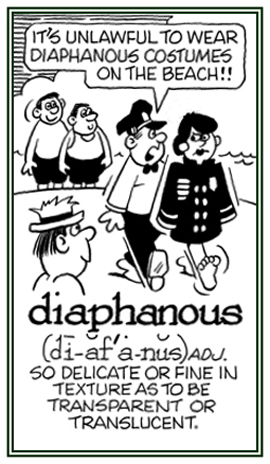
© ALL rights are reserved.
Go to this Word A Day Revisited Index
Go to this Word A Day Revisited Index
so you can see more of Mickey Bach's cartoons.
Epiphany, epiphany
1. When capitalized, a Christian festival, observed on January 6, commemorating the manifestation of Christ to the gentiles in the persons of the Magi; Twelfth-day.
2. An appearance or manifestation; especially, of a deity.
3. A sudden, intuitive perception of or insight into the reality or essential meaning of something, usually initiated by some simple, homely, or commonplace occurrence or experience.
4. A literary work or section of a work presenting, usually symbolically, such a moment of revelation and insight.
5. Etymology: from Greek epiphainein, "to manifest, to display" from epi- "on, to" + phainein, "to show".
2. An appearance or manifestation; especially, of a deity.
3. A sudden, intuitive perception of or insight into the reality or essential meaning of something, usually initiated by some simple, homely, or commonplace occurrence or experience.
4. A literary work or section of a work presenting, usually symbolically, such a moment of revelation and insight.
5. Etymology: from Greek epiphainein, "to manifest, to display" from epi- "on, to" + phainein, "to show".
hydrophane
1. A semitranslucent variety of opal that becomes translucent or transparent when immersed in water.
1. An opal that is almost opaque when dry but transparent when wet.
1. An opal that is almost opaque when dry but transparent when wet.
hydrophanous
A reference to or description of hydrophane.
Cross references of word families that are related directly, or indirectly, to: "appear, visible, visual, manifest, show, see, reveal, look": blep-; delo-; demonstra-; opt-; -orama; pare-; phant-; pheno-; scopo-; spec-; vela-, veal-; video-, visuo-.
