
demonstra-
(Latin: to point out, to display, to show)
The words in this unit come from Latin de-, "utterly, completely" (in this situation) plus monstrare, "to show, to point out" (from monstrum, "divine portent", which came from monere, "to warn").
A public display held in opposition to another public attitude or behavior: Some people in the city advocated that their country go to war while others had counterdemonstrations against any kind of military violence.
Someone who participates publicly in opposition to another display of feelings for or against something: David and Maurice were two of the couterdemonstrators protesting against those who want to do away with the university requirement that all students must take at least one year of Latin before they can earn their undergraduate degree.
demonstrable (adjective), more demonstrable, most demonstrable
1. Descriptive of something which is obvious or easy to recognize: Gwen was telling demonstrable lies so often that no one could believe her even when she was telling the truth.
2. Capable of being shown to be true or to exist: There was demonstrable proof that the neighbor set fire to his house so he could collect the insurance.
2. Capable of being shown to be true or to exist: There was demonstrable proof that the neighbor set fire to his house so he could collect the insurance.
The quality of being provable or logically validated: The employees were shown the demonstrableness of the new manufacturing process.
The new administrator revealed the demonstrableness regarding the lack of concern that the previous administrator had for his staff.
demonstrate (verb), demonstrates; demonstrated; demonstrating
1. To show clearly and deliberately, manifest: They were able to demonstrate their desire to help the street people by collecting food and preparing meals for them.
2. To show to be true by reasoning or adducing evidence; to prove.
3. To present by experiments, examples, or practical application; to explain and illustrate.
4. To show the use of; such as, an article to a prospective buyer.
5. To give an example of how to do something: Mrs. Shaffer described the dance step, then she chose a partner and demonstrated how it could be done.
6. To participate in a public display of opinion: The day laborers demonstrated against the new tax hikes.
7. In the military, to attack or to make a show of force to deceive an enemy.
2. To show to be true by reasoning or adducing evidence; to prove.
3. To present by experiments, examples, or practical application; to explain and illustrate.
4. To show the use of; such as, an article to a prospective buyer.
5. To give an example of how to do something: Mrs. Shaffer described the dance step, then she chose a partner and demonstrated how it could be done.
6. To participate in a public display of opinion: The day laborers demonstrated against the new tax hikes.
7. In the military, to attack or to make a show of force to deceive an enemy.
demonstrated (adjective), more demonstrated, most demonstrated
A reference to something that has been verified, or shown to be true, beyond any doubt; or is incapable of being contested or disputed.
1. The act of showing or making evident; a presentation to others of the way in which something works or is done.
2. Conclusive evidence; proof.
3. An illustration or explanation, as of a theory or product, by exemplification or practical application; conclusive proof.
4. A manifestation, as of one's feelings.
5. A public display of group opinion; a public show as a group for or against an issue, cause, or person; as by a rally or march: Ted and his friends attended the peace demonstrations.
6. A show of military force or readiness for combat.
2. Conclusive evidence; proof.
3. An illustration or explanation, as of a theory or product, by exemplification or practical application; conclusive proof.
4. A manifestation, as of one's feelings.
5. A public display of group opinion; a public show as a group for or against an issue, cause, or person; as by a rally or march: Ted and his friends attended the peace demonstrations.
6. A show of military force or readiness for combat.
demonstrational (adjective), more demonstrational, most demonstrational
A reference to showing or proving something: The TV program showed a demonstrational video of the street scenes.
demonstrative (di MOHN struh tiv) (adjective), more demonstrative, most demonstrative
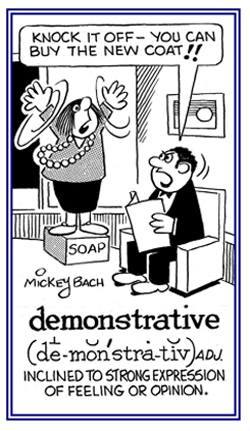
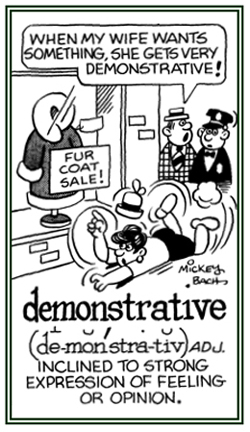
1. Descriptive of openly and freely showing emotions or feelings: Jake's sister is more demonstrative than he is about their father's death.
3. In grammar, specifying or singling out the person or thing referred to: The demonstrative pronouns include the following examples: "this", "these", "that", and "those".
© ALL rights are reserved.
© ALL rights are reserved.
Go to this Word A Day Revisited Index
The little puppy is very demonstrative with everyone it meets.
2. Involving or characterized by revealing something: The mayor's speech is demonstrative of the financial problems the city is facing.3. In grammar, specifying or singling out the person or thing referred to: The demonstrative pronouns include the following examples: "this", "these", "that", and "those".
Go to this Word A Day Revisited Index
so you can see more of Mickey Bach's cartoons.
demonstratively (adverb)
In a manifestation of emotion or feelings: "Freda's husband greeted her demonstratively with a big hug."
demonstrativeness (s) (noun)
1. Tending to express one's feelings freely.
2. Marked by a display of feeling.
3. Inclined to display feelings openly.
2. Marked by a display of feeling.
3. Inclined to display feelings openly.
1. Those who participate in a public display of group feelings: There were thousands of demonstrators marching through the streets opposing the new austerity measures.
2. A person who shows an article to a prospective buyer.
3. An instructor, or an assistant, who explains the principles that are being taught or studied: The professor was an expert demonstrator of the procedures required to properly prepare the experiment.
2. A person who shows an article to a prospective buyer.
3. An instructor, or an assistant, who explains the principles that are being taught or studied: The professor was an expert demonstrator of the procedures required to properly prepare the experiment.
digitus demonstrativus
This usage is a result of the habit of pointing with the finger.
Quod erat demonstrandum.
1. "That which was to be proven."
2. A phrase used to signal that a proof has just been completed.
3. Used in a formal conclusion to indicate that something; such as, evidence of a fact is proof of the theory that has just been been advanced.
2. A phrase used to signal that a proof has just been completed.
3. Used in a formal conclusion to indicate that something; such as, evidence of a fact is proof of the theory that has just been been advanced.
undemonstrable (adjective) (not comparable)
Not capable of showing or presenting fuller evidence: The suppositions were undemonstrable, undefinable, and refutable as far as Mrs. Smith could judge.
This word group is directly related to the monstro-, monstr- unit.
Cross references of word families that are related directly, or indirectly, to: "appear, visible, visual, manifest, show, see, reveal, look": blep-; delo-; opt-; -orama; pare-; phanero-; phant-; pheno-; scopo-; spec-; vela-, veal-; video-, visuo-.

Showing page 1 out of 2 pages of 17 main-word entries or main-word-entry groups.