
hiat-; -hisc-
(Latin: to stand open, to split; opening, aperture, gap; to yawn)
2. To rupture or to break open, as a surgical wound: A surgical wound may partially or completely dehisce after surgery, depending upon whether some or all of the layers of tissue come open.
3. Etymology: from Latin dehiscere, "to split open", and from hiscere, "to gape, to yawn"; from Latin hiare, "to yawn".
2. A rupture, bursting open, or splitting open, as of a surgical wound, or of an organ or structure to discharge its contents: A dehiscence is a complication of surgery which takes place in a secondary to poor wound healing.
Risk factors of dehiscences include diabetes, advanced age, obesity, and trauma during the post-surgical period.
3. Etymology: from Latin dehiscere, "to split open"; from hiscere, "to gape, to yawn", and from Latin hiare, "to yawn".The word dehiscence is one of the most vexing words in the surgeon's vocabulary. When a post-operation patient has a dehiscence, one or more of the tissue layers of the incision have come apart. In a worst scenario, underlying organs; such as, the gut, lung, etc. bulge out of the wound.
2. A reference to the splitting open of a partially healed surgery: There are times when a surgical incision, which has been closed with sutures or clips, becomes a dehiscent wound when it breaks open before it heals.
2. Etymology: from Latin hians and hiare, "to gape or to open wide">
2. A slight pause occurring when two adjacent vowels in consecutive syllables are pronounced, as in "duality": In Voni's English class she learned that the terms "naive" and "cooperate" were two good examples of hiatuses.
3. In anatomy, a separation, aperture, fissure, or short passage in an organ or a body part: The spinal cord passes through the hiatus, a large opening called the foramen magnum, which is located at the base of the cranium.
4. In printing, a space where something is missing; especially, in manuscripts: The scholars detected a hiatus, or a lost passage in the medieval writings which they were trying to transcribe.
5. Etymology: from Latin hiatus, "opening, rupture, gap", from hiare, "to gape, to stand open"; "a break or opening in a material object".
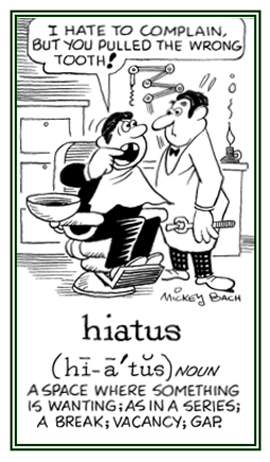
Go to this Word A Day Revisited Index
so you can see more of Mickey Bach's cartoons.
Some types of vegetation are indehiscent because they lack a distinct opening mechanism, like spores that shed by irregular rupture or breakdown of the capsule walls.
 Another gaping, yawning unit.
A cross reference of other word family units that are related directly, indirectly, or partially with: "opening, hole, cavity, tract, tube": alveolo-; antro-; anu-; celo-; coelio-; concho-; fenestra-; hernio-; meato-; ora-; parieto-; poro-; pyl-, pyle-; pylor-; sphinctero-; splanchn-; stomato-; syringo-; uretero-; urethro-; vagino-; ventricul-.