
ambi-, amb-, ambo-
(Latin: both, on both sides; around, about; vague; obscure)
2. Anything which surrounds or encompasses a surroundings: The ambience of candles, comfortable furniture, and soft music increased the pleasure of being in Lydia's and Patrick's living room in the evening.
2. General skillfulness; especially, with the hands; very skillful and versatile; using both hands with equal facility: Greg’s wife was obviously an amibidexter because she played the piano with magnificent expertise!
3. Someone who is equally ready to act on either side of disputes: As the supervisor of his company, Steven was an ambidexter who listened to the arguments presented by two employees and he made a decision as to which one had the most rational viewpoint to follow.
2. General skillfulness, especially with the hands; very skillful and versatile; using both hands with equal success: Jane was an expert at making her own ceramics, which was of excellent quality and showed her ambidexterity and mastery in creating perfectly formed vases and bowls.
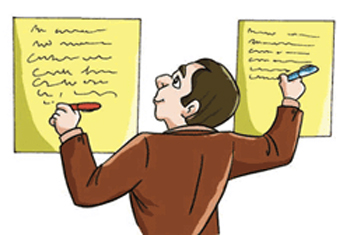
Since Mike, the juggler, was ambidextrous, he could start his performance with a circular motion to either his left or to his right side.
2. Unusually skillful; adroit; quickness with mental skills: Gilbert was an ambidextrous pianist.3. Two faced, dishonest, and hypocritical: Becky Sharp, in the novel Vanity Fair, was ambidextrous in her personal relationships.
4. Etymology: the word ambidextrous is derived from the Latin roots ambi, "both" and dexter, "right" (as opposed to left) or "favorable"; therefore, ambidextrous literally means "right on both sides".
Ambidexterity refers to being equally adept with each hand (or, to a limited degree, feet).
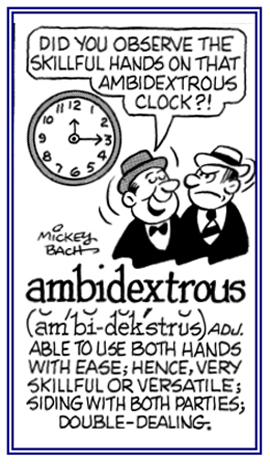
Go to this Word A Day Revisited Index
so you can see more of Mickey Bach's cartoons.
2. Descriptive of how someone is quick or clever in a cognitive way: Joan was a good player at scrabble, being ambidextrously talented at finding new words for the game.
3. Referring to acting or behaving in a false and insincere way: Jack ambidextrously deceived his friends by pretending to support them in the demonstration and then purposely never showing up!
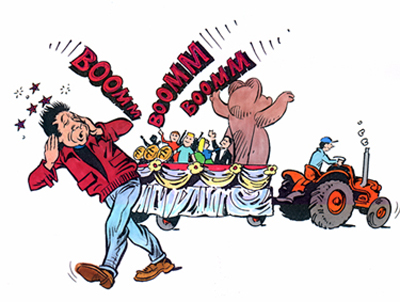
Sometimes parades can produce ambient noises that are very disturbing for some people.
2. An expression or statement that has more than one meaning: There were ambiguities in the diagnosis by the physician regarding Nick's mental condition.
3. That which causes uncertainty or confusion: Because of the nature of the ambiguities of the answers provided by the politician, people were becoming less confident in his qualifications.
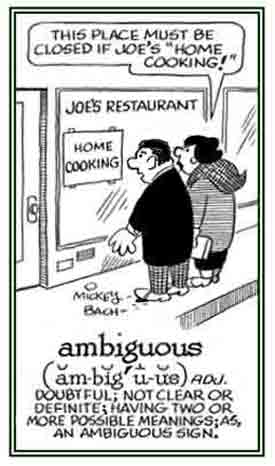
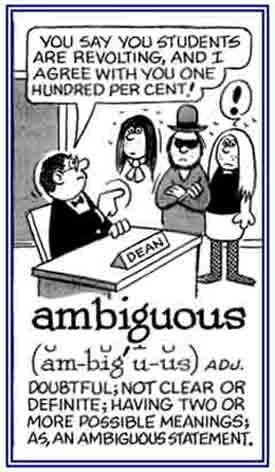
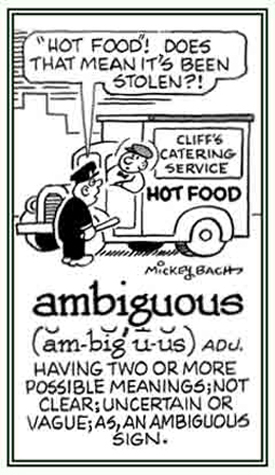
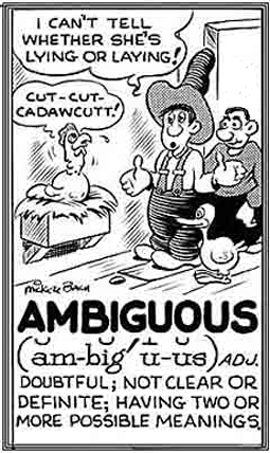
2. Relating to something of a doubtful or uncertain nature; regarding an aspect difficult to comprehend, to distinguish, or to classify: It was clear from Jim's note to his parents that he had left the country, but as to where his destination would be, he was ambiguous.
3. Pertaining to a situation which lacks clearness or definiteness; obscure; indistinct: Ambiguous can refer to a person or the contents in a piece of writing.
4. Etymology: from Latin ambiguus, "having double meanings, shifting, changeable, doubtful"; derived from ambigere, "to dispute about"; literally, "to wander"; from ambi-, "about" + agere, "to drive, to lead, to act".
"Ambivalent" refers to people and their attitudes while ambiguous refers to something said or written.
Go to this Word A Day Revisited Index
for a list of additional Mickey Bach illustrations.
Word History
Latin amb-, "about, around," combined with agere, "to drive", formed ambigere, literally, "to drive around, to waver". Out of this word grew the Latin ambiguus, "hesitating, uncertain". English borrowed it as ambiguous, with the meaning "equivocal, capable of being understood in either of two or more possible senses, vague."
2. Etymology: a descriptive term derived from ambigere, "to dispute about"; literally, "to wander" from ambi-, "about" + agere, "to drive, to lead, to act".
2. The vagueness of something which makes people hesitant to accept what has been presented by someone: The ambiguousness of the mayor’s plans for the new city hall created a lot of confusion in the minds of the citizens.
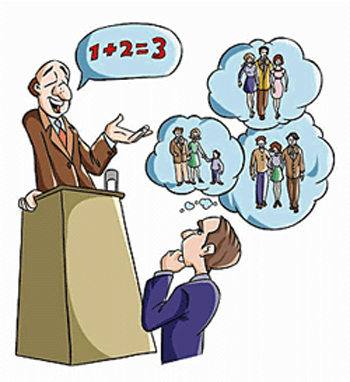
When the speaker used the ambiguousness of "1 + 2 = 3", Mark didn't know if the man meant "one man plus two women", or "one woman plus two men", or "a father, a mother, plus a child", as shown in the illustration below.
Jane broke both of her arms when she fell down the stairs and had them in casts; the ambilevosity that followed prevented her from doing anything until her arms were healed again.
Little Tommy was just one year old and the ambilevosity of holding a cup properly to drink from still needed more development!
