
her-, hes-
(Latin: stick to, cling to, cleave to)
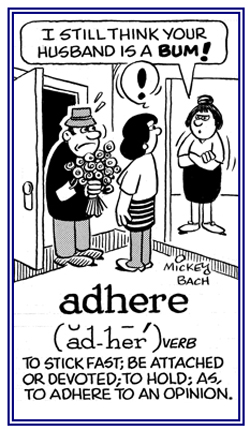
2. To cleave or stay attached to an opinion, practice, or method; to continue to maintain or to observe: The politician said that he would adhere to the proposal that he presented until there is evidence that proves he is wrong.
A plan for cutting taxes will always have many who adhere to the idea, despite what the results might be.
Go to this Word A Day Revisited Index
so you can see more of Mickey Bach's cartoons.
2. Adhesion, adhesiveness, stickiness: Put more glue on the wallpaper to increase its adherence.
2. Attachment (to a person or party); adhesion.
3. Persistence in a practice or tenet with steady observance or maintenance.
As a politician, the senator was a leader with many loyal adherents.
2. A substance that can stick firmly to a surface or an object, such as glue or wax: Jim was using a strong adherent on the broken parts of the wooden chair.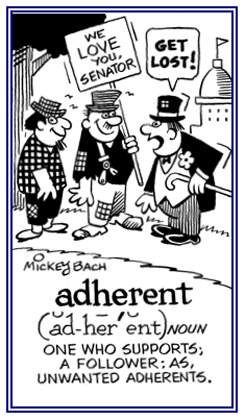
Go to this Word A Day Revisited Index
so you can see more of Mickey Bach's cartoons.
2. The property of sticking together, as of substances or tissues; the attachment of one thing to another: Glue and paste provide the means of adhesion as well as adhesive tape.
3. The grip of a wheel on a track, etc. which is produced by friction, or the friction itself: It was difficult to convince the elderly to write e-mails with the computer considering their adhesion to using a pencil or pen and paper for written communication.
4. The attachment to someone or an organization by remaining with it as a partizan, a supporter, or a follower: Patricia was honored for her adhesion as a worker for homeless people for so many years.
5. A mass of fibrous connective tissue in the body that joins two surfaces that are normally separate: Adhesions are usually scar tissues that have formed after an inflammation of some part of the anatomy, or the natural healing process that takes place after surgery.
Some abdominal adhesions bind loops of obstructions together and so they usually require the surgical cutting of the fibrous tissue in order to free them of the blockages.
Synthetic nanoadhesive mimics sticking powers of gecko and mussel
Geckos are remarkable for their ability to scurry up vertical surfaces and even move along upside down.
Their feet adhere temporarily, coming off of surfaces again and again like a sticky note; but put those feet underwater, and their ability to stick is dramatically reduced.
Water is an enemy of adhesives, which typically do not work well in wet environments; think of how long a bandage on your finger lasts. Now two Northwestern University biomedical engineers have successfully married the gecko’s adhesive ability with that of an animal well known for its sticking power underwater: the mussel.
Combining the important elements of gecko and mussel adhesion, the new adhesive material, called “geckel”, functions like a sticky note and exhibits strong yet reversible adhesion in both air and water.
“I envision that adhesive tapes made out of geckel could be used to replace sutures for wound closures and may also be useful as a water-resistant adhesive for bandages and drug-delivery patches.
Such a bandage would remain firmly attached to the skin during bathing but would permit easy removal upon healing,” said Phillip B. Messersmith, professor of biomedical engineering at Northwestern’s McCormick School of Engineering and Applied Science.
A gecko’s strong but temporary adhesion comes from a mechanical principle known as contact splitting.
Each gecko foot has a flat pad that is densely packed with very fine hairs that are split at the ends, resulting in a greater number of contact points than if the hairs were not split. In fact, the diameter of one of the split hairs is as small as 200 nanometers.
More contact points between hairs and surface result in a significant increase in the strength of adhesion. Flies, bees and other insects also use this strategy.
2. Having a propensity to form and to maintain attachments to people, and to promote social relationships.
2. To hold together in a mass that resists separation: The ballet was so beautiful because all of the dancers were in exact timing and motion with each other and so they seemed to cohere into one united group.
3. When referring to people: to remain together; to unite or to stay united in some action: For the project, the students in the group cohered their ideas in order to produce a well organized and informative report about the migrating birds.
4. Etymology: borrowed from Latin cohaerere, "to cling together, to cleave together"; from co-, "together" + haerere, "to cling to, to cleave to (to hold together and to resist separation)".
2. A logical connection or relation; congruity, consistency: The speaker used his ability to diplomatically utilize coherence as he presented the objectives of the project to the committee.
3. Etymology: from Latin cohaerent-; from the verb cohaerere, "to stick together"; from co-, "together" + haerere "to stay".
2. A logical, orderly, and aesthetically consistent relation of parts that form a whole: The coherency of the business styles of the company encouraged more people to invest in it.
2. In botany, sticking to but not fused with a part or an organ of the same kind.
3. A reference to thought, speech, reasoning, etc. in which all of the parts are consistent, and hang well together.
4. Logically or aesthetically consistent and holding together as a whole.
