
granulo-, granul-, granuli-, gran- +
(Latin: particle; grain, kernel)
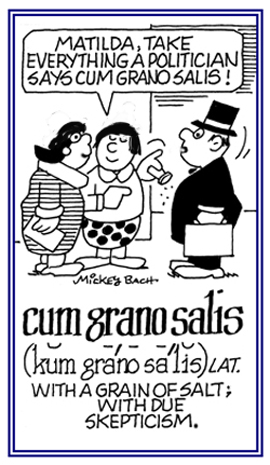
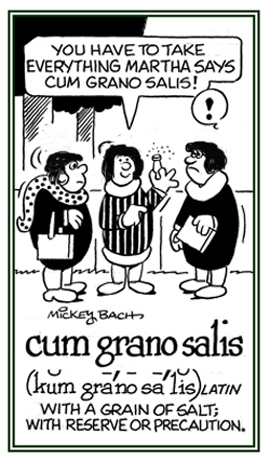
Referring to how certain things are doubted or questioned, either fully or literally: There is some truth in the statement, but we must be careful about accepting it as correct, take it cum grano salis.
A cum grano salis is said to be one of the most familiar Latin expressions available when a person does not fully believe something or someone and suggests a certain caution or reserve.
Salt was a valuable commodity in the ancient world, so a grain of salt is not to be taken as a trivial matter. The English word “salary” is derived from the Latin, salarium, which was the money allotted to Roman soldiers for purchases of salt; therefore, it was their pay.
Go to this Word A Day Revisited Index
so you can see more of Mickey Bach's cartoons.
2. Delicate and intricate ornamentation; usually, in gold or silver or other fine twisted wire.
3. Anything very delicate or fanciful; such as, a filigree of frost.
Corrupted from filigrane, a kind of enrichment on gold and silver, wrought delicately in the manner of little threads or grains, or of both intermixed.
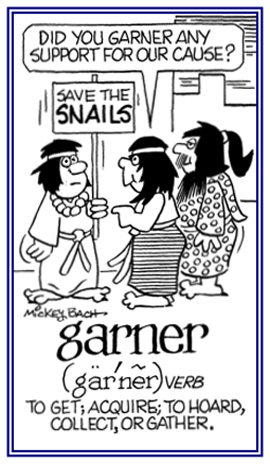
2. To collect or to accumulate information or facts: The lawyer had to garner the evidence as much as possible before the lawsuit went to court.
3. To gather items into storage or into a granary: The crop was garnered by the farmer after it had been reaped from the fields.
4. To assemble or to compile something: David likes to garner and to put rare stamps into his collection.
Bill garnered his thoughts together while he was working on his essay.
5. Etymology: Originally a noun derived from Latin granarium, "granary".

Go to this Word A Day Revisited Index
so you can see more of Mickey Bach's cartoons.
2. The gathered seed of food plants, especially of cereal plants.
3. Any small, hard particle, as of sand, gold, pepper, or gunpowder.
4. The smallest unit of weight in most systems, originally determined by the weight of a plump grain of wheat.
In the U.S. and British systems, as in avoirdupois, troy, and apothecaries' weights, the grain is identical. In an avoirdupois ounce there are 437.5 grains; in the troy and apothecaries' ounces there are 480 grains (one grain equals 0.0648 gram).
6. The arrangement or direction of fibers in wood, or the pattern resulting from this.
7. The side of leather from which the hair has been removed.
8. The fibers or yarn in a piece of fabric as differentiated from the fabric itself.
9. In metallurgy, any of the individual crystalline particles forming a metal.
10. The size of constituent particles of any substance; texture; such as, sugar of fine grain.
11. To form into grains; to granulate.
12. To feed grain to (an animal). 13. Against one's grain, in opposition to one's temper, inclination, or character: "Arguing about prices always went against her grain."
14. With a grain of salt: with an attitude of skepticism; with reserve or allowance: "Diplomats took the reports of an impending crisis with a grain of salt."
15. Etymology: from Old French which came from Latin granum, "seed".
2. In the U.K.: a large farmhouse or country house with other buildings; such as, stables or barns attached to it.
2. Unyielding endurance; steadfastness: a will of granite.
3. Etymology: from French granit(e), from Italian granito, "granite"; originally, "grained"; past participle of granire, "granulate", from grano, "grain", from Latin granum, "grain".
Quartz usually makes up ten to fifty percent of the light-colored minerals in granite, with the remaining minerals consisting of the feldspars and muscovite.
The darker minerals in granite are usually biotite and hornblende. Granite is one of the most common rocks in the crust of continents, and is formed by the slow, underground cooling of magma.
2. Having austere inflexibility.
3. Consisting of granite; such as, granitic mountains.
2. Slang: profit or money easily obtained or received unexpectedly; money illegally or dishonestly acquired; especially, through graft.
3. Something advantageous or valuable that is received or obtained as a benefit beyond what is due or expected.
4. Etymology: from Middle English graue (pronounced grave), from a misreading of Old French grane, "a dish powdered with grains"; literally, "grained", from Medieval Latin granatus, past participle of granare, "to grain", from Latin granum, "grain, seed".
