
fus-, fun-, fund-, fut-, found-
(Latin > French: pour, melt, blend)
affuse (verb), affuses; affused; affusing
To pour upon; to sprinkle; such as when using a liquid.
1. The pouring on of water or another liquid on a person's head, as in the rite of baptism: Lester's young son was having an affusion as a religious celebration that he is a Christian.
2. The pouring of a natural fluid on the body or any of its parts for therapeutic purposes: David was getting a cold affusion by a doctor in order to reduce the temperature of his fever and to calm his nervous condition.
2. The pouring of a natural fluid on the body or any of its parts for therapeutic purposes: David was getting a cold affusion by a doctor in order to reduce the temperature of his fever and to calm his nervous condition.
The exchange of fluid parcels between regions in the atmosphere in the apparently random motions of a scale too small to be treated by the equations of motion: Mr. Fox explained the expression atmospheric diffusion by using an example of air pollutants in the air.
Forcing the blood from the extremities with the applications of bandages, or other pressure devices, to raise the fluid pressure and to fill the vessels in the vital organs of the body: The use of autoinfusions take place after an abnormal loss of blood or other body fluids has occurred.
Autoinfusions are used to force venous blood towards the heart for patients who have had significant losses of the vital body substance.
A procedure for collecting and storing a patient's own blood several weeks before its expected need by the patient: This method of providing blood, or autologous transfusion, for an individual is done in order to prevent the transmission of diseases which can take place with the use of donor blood.
Blood that is lost during a surgical procedure can be recovered from the operation site and processed for the circulatory system when a patient's autologous transfusion is available.
autotransfusion (s) (noun), autotransfusions (pl); autohemotransfusion (s), autohemotransfusions (pl); autoreinfusion (s), autoreinfusions (pl)
Withdrawal of and re-injection or transfer of a patient's own blood: "Autotransfusion, autohemotransfusion, and autoreinfusion all have the same meaning of being an infusion of a patient's own blood, which has either been collected and returned to the body during a surgery or transfused from a stored supply of blood."
A transfer of vital bodily fluid that is obtained from a dead body within a short time after a person's death: Cadaver blood transfusion is acceptable for movement into other living humans.
circumfuse (verb), circumfuses; circumfused; circumfusing
1. To pour around; to diffuse.
2. To surround as with a fluid.
3. To spread something around something else.
2. To surround as with a fluid.
3. To spread something around something else.
1. The act of pouring or spreading around.
2. The state of being poured around.
2. The state of being poured around.
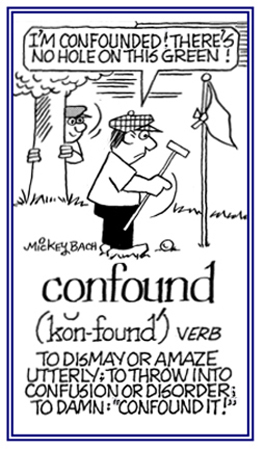
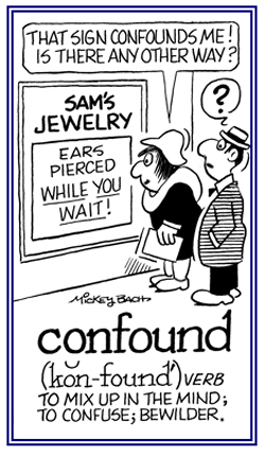
confound (verb), confounds; confounded; confounding
1. To perplex or to amaze; especially, by a sudden disturbance or surprise; to bewilder; to confuse: Trying to comprehend the complicated directions for operating his new TV confounded the father too much.
2. To throw into confusion or disorder: The new tax system confounded the people, because it seemed to be much more complicated than in the previous years.
3. To throw into increased confusion or disorder: The Smith family was planning on going on a camping trip for the very first time and they had a list of what they needed and put everything into orderly piles in the living room. Their little daughter confounded everything by hurling some of their camping gear into the air!
4. To treat or regard erroneously as identical; to mix or associate by mistake: What Jacob said confounded truth with errors.
5. To mingle so that the elements cannot be distinguished or separated: When water and sugar are dissolved together in hot water they are confounded and cannot be parted again.
6. To contradict or to refute: Sharon tried to confound her parent's arguments about her quitting her current job and looking for a new one.
7. Etymology: from Middle English confounden, from Anglo-Norman confundre, from Latin confundere, "to mix together, to confuse"; from com-, "together" + fundere, "to pour".
© ALL rights are reserved.
© ALL rights are reserved.
Go to this Word A Day Revisited Index
2. To throw into confusion or disorder: The new tax system confounded the people, because it seemed to be much more complicated than in the previous years.
3. To throw into increased confusion or disorder: The Smith family was planning on going on a camping trip for the very first time and they had a list of what they needed and put everything into orderly piles in the living room. Their little daughter confounded everything by hurling some of their camping gear into the air!
4. To treat or regard erroneously as identical; to mix or associate by mistake: What Jacob said confounded truth with errors.
5. To mingle so that the elements cannot be distinguished or separated: When water and sugar are dissolved together in hot water they are confounded and cannot be parted again.
6. To contradict or to refute: Sharon tried to confound her parent's arguments about her quitting her current job and looking for a new one.
7. Etymology: from Middle English confounden, from Anglo-Norman confundre, from Latin confundere, "to mix together, to confuse"; from com-, "together" + fundere, "to pour".
Go to this Word A Day Revisited Index
so you can see more of Mickey Bach's cartoons.
confounded (adjective), more confounded, most confounded
1. Confused or perplexed; having caused the inability to think clearly: "These confounded questions even confused the professors."
2. Having mistaken one thing for another, confused.
2. Having mistaken one thing for another, confused.
Someone who causes confusion, or disorder, in a situation or relationship.
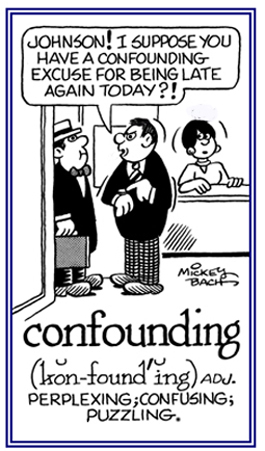
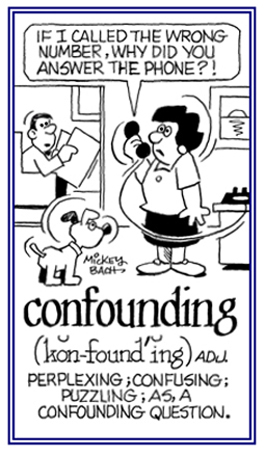
confounding (adjective), more confounding, most confounding
Relating to being complicated, chaotic, lacking order, or difficult to comprehend: There are confounding explanations for many words found in some dictionaries.
© ALL rights are reserved.
© ALL rights are reserved.
Go to this Word A Day Revisited Index
Go to this Word A Day Revisited Index
so you can see more of Mickey Bach's cartoons.
confusable (adjective), more confusable, most confusable
Pertaining to something that is so similar as to be easily identified for another thing: The dictionary contained potentially confusable and mistakable senses of words.
confuse (verb), confuses; confused; confusing
1. To make unclear, indistinct, or blurred.
2. To make unclear or incomprehensible.
3. To make something hard, or harder, to understand.
2. To make unclear or incomprehensible.
3. To make something hard, or harder, to understand.
