
frug-, fruct-
(Latin: fruit; from Old French fruit, from Latin fructus, "fruit, produce, profit" from frug-, stem of frui, "to use, to enjoy".)
fructescence
The maturing or ripening of fruit.
fructicole (verb), fructicoles; fructicoled; fructicoling: fruit
1. Living on or in fruits.
2. Inhabiting fruit; especially, parasitic fungi.
2. Inhabiting fruit; especially, parasitic fungi.
fructiferous (adjective), more fructiferous, most fructiferous
Pertaining to trees or other plants that produce a form of food, some of which taste sweet and contains seeds or a large, hard seed: Apple trees and orange trees are just two examples of fructiferous plants which supply farmers, like Charles and Joseph, with incomes because of their global consumption.
fructification
1. The bearing or production of fruit.
2. The production of fruit or fruits by a tree or other plant.
3. Organs of fruiting; especially, the reproductive parts of ferns and mosses.
2. The production of fruit or fruits by a tree or other plant.
3. Organs of fruiting; especially, the reproductive parts of ferns and mosses.
fructifier
Someone or a thing that fructifies; or that which causes or becomes productive or fruitful.
fructify
1. To make fruitful or productive.
2. To become productive or fruitful, or to cause to become productive or fruitful.
2. To become productive or fruitful, or to cause to become productive or fruitful.
fructiparous
Producing fruit.
fructivorous
1. Existing on a diet composed of fruit.
2. Eating fruit.
2. Eating fruit.
fructose
1. A chemical name occurring in honey and many sweet fruits and a component of many disaccharides and polysaccharides that are obtained by inversion of aqueous solutions of sucrose and subsequent separation of fructose from glucose.
2. The official preparation, administered intravenously in solution as a fluid and nutrient replenisher.
3. A simple sugar found in honey and in many ripe fruits.
2. The official preparation, administered intravenously in solution as a fluid and nutrient replenisher.
3. A simple sugar found in honey and in many ripe fruits.
Fructose is a "sugar found in fruit', from 1864, coined in English from Latin fructus ccurring in invert sugar, honey, and a great many fruits. It is used in foodstuffs and in medicine chiefly in solution as an intravenous nutrient. Also called: levulose and fruit sugar.
fructosuria
Excretion of fructose in the urine; also, levulosuria
Fructu non foliis arborem aestima.
Judge a tree by its fruit, not by its leaves.
Another version is, "Judge by results, not by appearances."
fructuary
1. Someone who enjoys the profits, income, or increase of anything.
2. A person who enjoys the "fruits" of anything.
2. A person who enjoys the "fruits" of anything.
fructuation
1. Coming to fruit or the bearing of fruit.
2. Producing fruit.
2. Producing fruit.
fructuous (adjective), more fructuous, most fructuous
1. A reference to large amounts of goods or other commodities; profitable: The students had a very fructuous discussion about the effects of smoking and even continued their conversation on this topic after the teacher left at the end of the lesson!
2. Relating to crops that have produced much fruit: The winegrowers were convinced that they had had a fructuous year after having harvested such a large quantity of grapes at the end of the season.
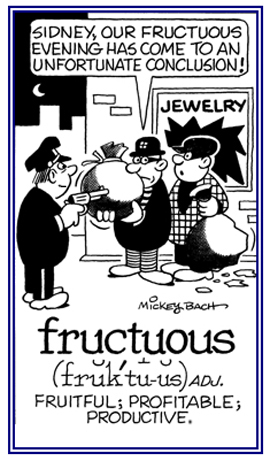
© ALL rights are reserved.
Go to this Word A Day Revisited Index
2. Relating to crops that have produced much fruit: The winegrowers were convinced that they had had a fructuous year after having harvested such a large quantity of grapes at the end of the season.
Go to this Word A Day Revisited Index
so you can see more of Mickey Bach's cartoons.
fructure
Use; fruition; enjoyment.
