
allo-, all-
(Greek: different, other, another; divergence; a combining form denoting a condition differing from the normal or a reversal, or referring to "another")
John Bunyan's Pilgrim's Progress and Herman Melville's Moby Dick are considered to be allegories.
2. The symbolic expression of a deeper meaning through a story or scene acted out by a human, an animal, or mythical characters: George Orwell's novel Animal Farm is an allegory in which animals behave and talk like humans..
3. A symbolic representation of something: "An allegory" by Sandro Botticelli created in 1488 is an example of a painted allegory.
The blindfolded figure holding scales is an allegory of justice.
4. A story in which people, things, and happenings have a hidden or symbolic meaning: Allegories are used for teaching or explaining ideas, moral principles, etc.
When seeking medical care, the physician needs to know whether the symptoms vary according to the time of day, or the season of the year, and whether there are any pets or other possible sources of allergens in the home.
2. Etymology: from Greek allos, "different, strange" + ergon, "action".2. Pertaining to a dislike of or a resistance to do certain things: Earl is an allergic person because he is required to get up and go to work five days a week.
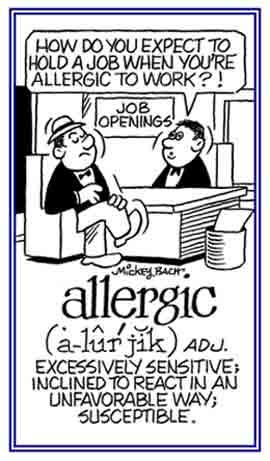
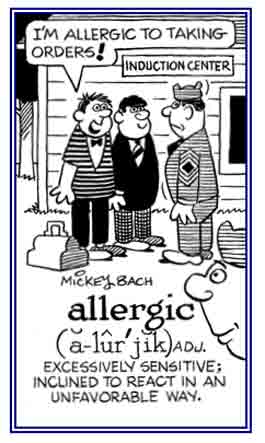
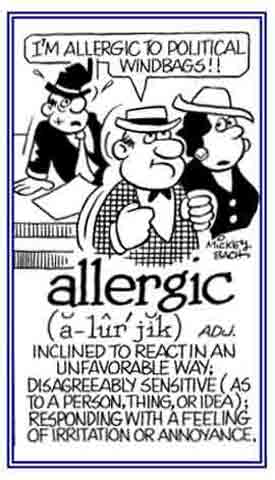
Go to this Word A Day Revisited Index
for a list of additional Mickey Bach illustrations.
When the allegist identifies the agent or agents that cause the ailment, he or she will recommend ways to avoid further exposure or put the patient on a regimen of medication to control the negative reactions to his or her health.
Allergization describes the process of becoming sensitive to an allergen.
The substances that trigger allergies include pollens, dust mite, molds, danders, and even certain foods.
Although allergies can develop at any age, the risk of developing them is often genetic or is related to one's family history.
Hay fever is the most common of the allergies and refers to seasonal nasal symptoms that are caused by pollens year round, or perennial rhinitis is usually due to indoor elements; such as, dust mites or molds.
Symptoms of allergies result from the inflammation of the tissues that line the inside of the nose (mucus lining or membranes) after the causes of allergies are inhaled, and adjacent areas, such as the ears, sinuses, and throat can also be involved.
The "allelic" is an alternative form of a gene. One of the different forms of a gene that can exist at a single locus (spot on a chromosome). Also one of the different forms of any segment of a chromosome.
