
flam-
(Latin: fire, burn, blaze)
aflame
1. In flames or blazing.
2. Highly aroused or impassioned.
3. Eager and excited: "They were aflame with curiosity."
2. Highly aroused or impassioned.
3. Eager and excited: "They were aflame with curiosity."
flambé
1. To drench with a liquor; such as, brandy, and ignite: "The waiter flambéed the steak at the table."
2. To pour alcohol over food and set fire to it during cooking.
2. To pour alcohol over food and set fire to it during cooking.
flambeau (s), flambeaux (pl)
1. A lighted torch.
2. A large ornamental candlestick.
3. In the Caribbean, a torch made by stuffing cloth into a bottle, or sometimes a bamboo joint, containing kerosene.
2. A large ornamental candlestick.
3. In the Caribbean, a torch made by stuffing cloth into a bottle, or sometimes a bamboo joint, containing kerosene.
flamboyance
A brilliant and very ornate object or structure: The city had a new government building with flamboyants in its architecture which were greatly admired by the citizens.
flamboyant (adjective), more flamboyant, most flamboyant
1. Relating to something that is highly elaborate and ornate or decorated with complex patterns: The company did not permit their employees to wear flamboyant clothes at work.
2. Characteristic of being richly colored and resplendent or attractive and impressive: Flamingoes are considered to be very flamboyant birds with their mainly pink or scarlet feathers.
3. Pertaining to a pretentious display which is designed to impress or to attract notice: The flamboyant pianist performed on TV for quite awhile with an orchestra in an unusually skillful way and with special facial expressions.
4. Etymology: "flame-like curves", from French flamboyant, "flaming, wavy" from flamboyer, "to flame" from Old French flamboier, from flambe, "flame".
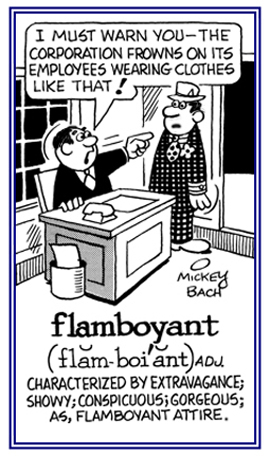
© ALL rights are reserved.
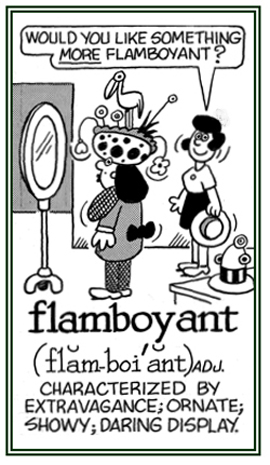
© ALL rights are reserved.
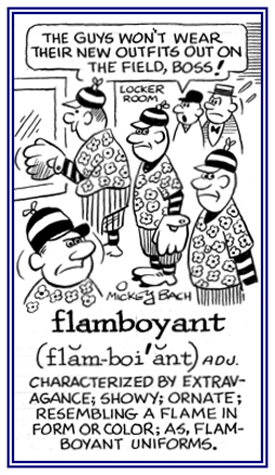
© ALL rights are reserved.
Go to this Word A Day Revisited Index
2. Characteristic of being richly colored and resplendent or attractive and impressive: Flamingoes are considered to be very flamboyant birds with their mainly pink or scarlet feathers.
3. Pertaining to a pretentious display which is designed to impress or to attract notice: The flamboyant pianist performed on TV for quite awhile with an orchestra in an unusually skillful way and with special facial expressions.
4. Etymology: "flame-like curves", from French flamboyant, "flaming, wavy" from flamboyer, "to flame" from Old French flamboier, from flambe, "flame".
Go to this Word A Day Revisited Index
so you can see more of Mickey Bach's cartoons.
flame
1. The process of combustion of flammable materials producing heat and light and (often) smoke.
2. A hot glowing mass of burning gas, often carrying fine incandescent particles.
3. Burning gas or vapor, as from wood or coal, that is undergoing combustion; a portion of ignited gas or vapor.
4. Often, flames; the state or condition of blazing combustion; to burst into flames.
5. Any flamelike condition; glow; inflamed condition.
6. Brilliant light; scintillating luster.
7. Intense ardor, zeal, or passion: "She was the flame of his love."
8. An object of one's passionate love; sweetheart: "He's taking out his new flame tonight."
9. Computer slang: an act or instance of angry criticism or disparagement; especially, on a computer network.
2. A hot glowing mass of burning gas, often carrying fine incandescent particles.
3. Burning gas or vapor, as from wood or coal, that is undergoing combustion; a portion of ignited gas or vapor.
4. Often, flames; the state or condition of blazing combustion; to burst into flames.
5. Any flamelike condition; glow; inflamed condition.
6. Brilliant light; scintillating luster.
7. Intense ardor, zeal, or passion: "She was the flame of his love."
8. An object of one's passionate love; sweetheart: "He's taking out his new flame tonight."
9. Computer slang: an act or instance of angry criticism or disparagement; especially, on a computer network.
flameless
1. Destitute of flame.
2. Without flame.
2. Without flame.
flameout
1. The unintentional extinguishing of the flame of a jet engine in flight, e.g. through a failure of combustion or the fuel supply.
2. Someone who fails suddenly, especially after having been successful.
2. Someone who fails suddenly, especially after having been successful.
flameproof
1. Resisting the effect of flames.
2. Not readily ignited or burned by flames.
3. Not likely to burn or to be damaged by fire; such as, flameproof clothing.
2. Not readily ignited or burned by flames.
3. Not likely to burn or to be damaged by fire; such as, flameproof clothing.
flamethrower
1. A weapon or equipment that projects a stream of burning liquid.
2. A military weapon, either mounted or portable, that sprays ignited incendiary fuel for some distance.
2. A military weapon, either mounted or portable, that sprays ignited incendiary fuel for some distance.
flamingo
1. A large long-necked wading bird with a downward-curving beak, webbed feet, and pinkish white plumage with black wing feathers. Native to tropical brackish waters.
2. A deep pink color tinged with orange.
3. Etymology: from Portuguese flamengo, Spanish flamengo; literally, "flame-colored".
2. A deep pink color tinged with orange.
3. Etymology: from Portuguese flamengo, Spanish flamengo; literally, "flame-colored".
The quality of being able to maintain a fire; burnability: Jane wasn't sure of the flammability of the matches she had because they had been outside and were quite moist!.
flammable (adjective), more flammable, most flammable
Referring to something that is easily set on fire; combustible; inflammable: Many things are flammable, such as gasoline, dry grass, or old and dry branches, or wood and, of course, a match!
flammation
The act of setting in a flame or blaze.
Cross references of word groups that are related, directly, indirectly, or partly to: "fire, burn, glow, or ashes": ars-, ard-; -bust; cand-, cend-; caust-, caut-; crema-; ciner-; ether-; flagr-; focus, foci-; fulg-; gehenna-; ign-; phleg-; phlog-; pyreto-, -pyrexia; pyr-; spod- (ashes; waste); volcan-.
