
flagr-
(Latin: fire; burn, blaze)
2. Descriptive of blazing together in a common flame: The conflagrant collection of paper, wood, and cardboard made a great fire in the stove and warmed the family at the house in the winter.
2. To begin to burn or to burst into flames: The rags which were soaked with benzine quickly conflagrated when they were set on fire by the arsonist.
Go to this arsonist link so you can see this conflagrating entry in action.
2. Very intense and uncontrolled blazes: In the summer of 2016, there were many places of conflagrations that were going on in Southern California which could not be contained for many weeks and had burned large sections of land and houses.
3. A large and destructive fire; a general burning: Because a camper forgot to put out his small campfire properly one night, a great conflagration rapidly spread throughout the forests killing many animals and demolishing a lot of fir and redwood trees.
4. A large and violent event; such as, a war involving many people: After the 30-year conflagration of the two countries, they were finally able to resolve their conflicts and make peace with each other.
5. Etymology: from Latin conflagrationem; from conflagrare, "to burn up"; fromcon-, "with, together" + flagare, "to burn".
2. Characterizing an object which has blazed up in flames: The summer was so dry and it hadn’t rained in many weeks which caused the lawn to be quite conflagrative and making it necessary to water it every day.
The news on the TV talks more and more about conflagrators who deliberately and maliciously set fire to buildings, wildland areas, dumpsters, and even vehicles.
Conflagratory destructions can also be a result of natural causes: such as, lightening causing wildfires, or on purpose by an arsonist.
The deflagrability of other dry plants can be very fast and often uncontrollable.
2. Characterizing something that is liable to snap and crackle when heated: In his chemistry class at school, James found out that salt was quite deflagrable, because when it was heated, it produced popping and bursting sounds.
The grasslands were so dry from the long hot summer that they suddenly deflagrated when someone threw out his or her burning cigarette while driving through the country.
2. To cause to burn with sudden and sparkling combustion, as by the action of intense heat: The fireworks were deflagrated on Independence Day in the big town square, presenting spectacular colors and forms in the sky.2. A process of subsonic combustion that usually propagates through thermal conductivity: Deflagration describes the process of hot burning material which heats up the next layer of cold material and ignites it.
3. The kindling, or burning off in a crucible, a mixture of salt, or some mineral substance, with a gradual sparkling combustion of any substance without a violent explosion: Deflagration is particularly applied to combustion produced by nitre or niter, which is a colorless or white crystalline compound used in gunpowders, pyrotechnics, fertilizers, and as a preservative for foods; especially, as a curing salt for ham, sausages, etc.
2. Shocking because of being so obvious: Flagrancy was displayed by the construction workers when they did not follow the necessary steps involved in building the house as evidenced when the roof flew off in the storm the following week!
3. A burning; great heat; inflammation: The wildfire in the forest produced such fragrancy that all of the campers in the area had to be evacuated immediately.
4. The condition or quality of being atrocious, heinous, and excessive: Because of the flagrancy of Susan’s dishonest and harmful conduct with her fellow student, she was sent immediately to the principal’s office.
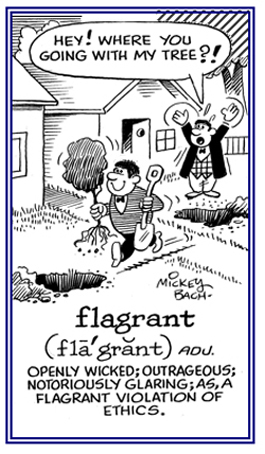
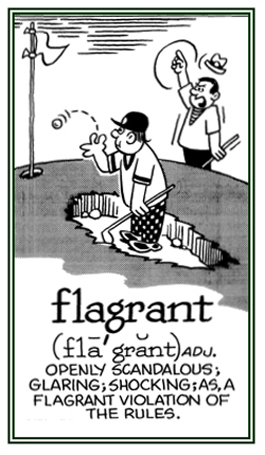
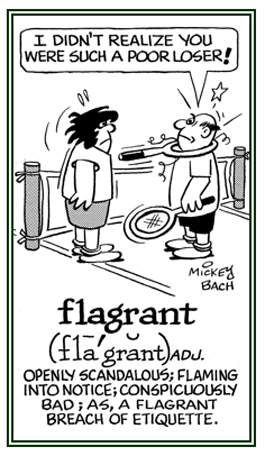
2. Notorious; scandalous: It was a flagrant crime committed by a flagrant offender who shot and killed so many people for no known reason.
3. Conspicuously and outrageously bad or reprehensible: The corrupt mayor demonstrated a flagrant disregard for the law when he participated in buying and using narcotics in public.
The police accused Jerome of committing a flagrant violation of the law when he stole a woman's credit card and PIN from her purse while she was eating in a restaurant.
4. Etymology: from Latin flagrare, "to burn"; then "blazing, burning, or glowing"; related to fulgere, "to shine".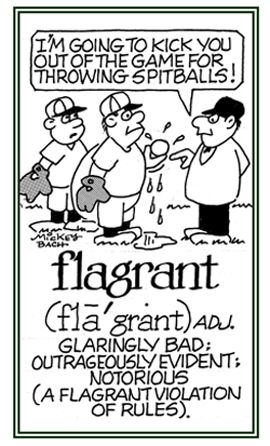
Go to this Word A Day Revisited Index
so you can see more of Mickey Bach's cartoons.
Cross references of word groups that are related, directly, indirectly, or partly to: "fire, burn, glow, or ashes": ars-, ard-; -bust; cand-, cend-; caust-, caut-; crema-; ciner-; ether-; flam-; focus, foci-; fulg-; gehenna-; ign-; phleg-; phlog-; pyreto-, -pyrexia; pyr-; spod- (ashes; waste); volcan-.
