
ex-, ec-, e-
(Greek: out of, out, outside; away from; used as a prefix)
This is a prefix that is supposed to be used with words or roots of Greek origin. The ex- form is used before vowels or h; ec- goes before consonants.
2. Strange or unusual: Jared, the scientist, had eccentric behaviors and ideas that were weird as indicated by his eccentric clothes.
3. Not following a perfectly circular path: The asteroid was moving in an eccentric orbit around the star.
The pictures which the eccentric artist painted appeared to have an acentric balance that puzzled the patrons of the gallery.
2. Anyone who deviates markedly from what is considered normal; especially, a person of odd or unconventional behavior.
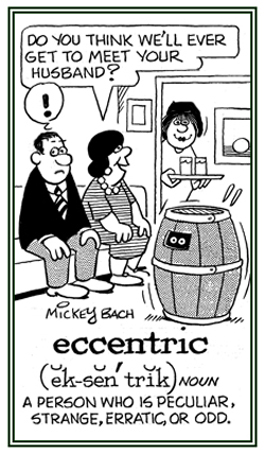
May's eccentric uncle willed all of his money to his cat.
2. Referring to something that turns from a normally circular path where the axis is located other than at the geometric center: The eccentric planet was going around its moon in an abnormally devious way.Karl's eccentric neighbor appeared in public wearing his clothes backward.


Go to this Word A Day Revisited Index
so you can see more of Mickey Bach's cartoons.
The fovea is located in the eye, a tiny pit located in the macula of the retina (a small spot in the eye where vision is sharpest) which provides the clearest vision of all.
Only in the fovea are the layers of the retina spread aside to let light fall directly on the cones, the cells that give the sharpest image.
Mildred's talking to her flowers everyday is just one of her eccentricities.

Go to this Word A Day Revisited Index
so you can see more of Mickey Bach's cartoons.
2. The public legislative assembly of the Greek Athenians.
3. The political assembly of citizens of an ancient Greek state.
2. Literally, "a ruler of a church" or church body.
2. Of or associated with a church (especially a Christian Church).
3. A member of the ecclesia in ancient Athens.
2. Associated with a church; especially, a Christian Church.
3. Appropriate to a church or to use in a church: "ecclesiastical architecture"; "ecclesiastical robes".
2. Religion appropriate to a church and to ecclesiastical principles and practices.
3. Ecclesiastical principles, practices, or spirit.
4. Devotion; especially, excessive devotion or adherence to the principles, forms, or interests of a church.
