
ex-, e-, ef-
(Latin: a prefix occurring in words of Latin origin used in the senses: out, out of, from; upward; completely, entirely; to remove from, deprive of; without; former [said of previous holders of office or dignity])
Before f, ex- becomes ef-; before all voiced consonants (as b, d, g, etc.) ex- becomes e-.
Motto of the United States of America, indicating that a single nation was made by uniting many states or a reference to the many states in the United States as being one nation. It may have been adapted from a line in Virgil's poem, "Moretum" which deals with the making of a salad and reads color est e pluribus unus, probably the first use of the phrase in any form. There was also an essay by Richard Steele in The Spectator, August 20, 1722, which opens with the Latin phrase Exempta juvat spiris e pluribus unus: "Better one thorn plucked than all remain."
The Continental Congress ordered the President of Congress to construct a seal in 1776 and E Pluribus Unum appeared on the first seal, as well as on many early coins. Congress adopted the motto in 1781 and it still appears on U.S. coins as well as on the Great Seal of the United States.
"Just a month after the completion of the Declaration of Independence, at a time when the delegates might have been expected to occupy themselves with more pressing concerns—like how they were going to win the war and escape hanging—Congress quite extraordinarily found time to debate the business of a motto for the new nation. (Their choice, E Pluribus Unum, ‘One from Many,' was taken from, of all places, a recipe for salad in an early poem by Virgil.)"
The translated poem, "Moretum", attributed to Virgil, lines 101-106
Then grinds everything equally in a juicy mixture.
The hand goes in circles: gradually the separate essences
Lose distinction, the color is out of many one [e pluribus unus],
Neither all green, since milky-white bits resist it,
Nor shining milky white, since the herbs are so various.
Virgil used unus because "color" is masculine in Latin; we use the neuter form unum because the United States is considered neuter (neither masculine nor feminine).
Thomas Jefferson is given credit for having suggested E pluribus unum, which was at that time integrated into the first version of the Great Seal in 1776 and has remained there ever since.
2. To arrange schooling for someone: The Johnson’s wanted to have their son educated in a private school, because they thought it would be better than in a public school.
3. To train, to instruct, or to improve somebody's awareness about a particular field of study: There were certain weeks set aside in school for specialists to educate the children about eating properly and staying healthy.
4. Etymology: from Latin educatus, past participle of educare "to lead out"; from ex-, "out" + ducere, "to lead".
2. To assume or to work out from given facts; to deduce.
3. To draw forth or to bring out, as something potential or latent; to elicit; to develop.
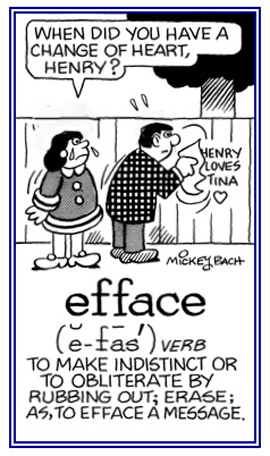
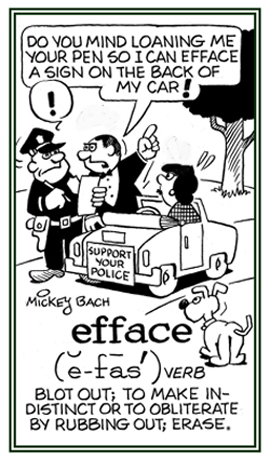
Bruno and Colby used brushes and spray paint to efface the words that someone had painted on the walls of their house.
2. To respond in a humble way because of shyness or modesty: Flossie was advised to accept the teacher's compliments regarding her report and not to efface herself by saying she could have done better if she had tried harder.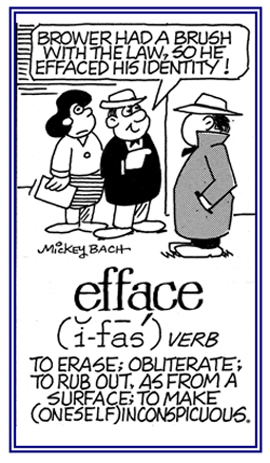
Go to this Word A Day Revisited Index
so you can see more of Mickey Bach's cartoons.
2. The shortening or thinning of a tissue in the body.
2. Concerning an individual who is exhausted of vigor or energy; worn out: After teaching teenagers for 40 years Mr. Hathaway was effete and totally spent.
3. Pertaining to a living being that is unable to produce; sterile: Jim's old feeble cat was effete and unprolific.
4. Marked by excessive self-indulgence and moral decay: Greg lived a decadent and effete life of excessive spending and no sense of responsibility.
5. Etymology: From Latin effetus (feminine, effeta) "unproductive, worn out (with bearing offspring)"; literally, "that has given birth" from ex- "out" plus fetus, "childbearing, offspring". The sense of "exhausted" is from 1662; that of "morally exhausted" from 1790, led to "decadent" in the nineteenth century.
2. Something, often an immaterial substance or intangible influence, that flows out from a source.
3. That which flows or issues from any body or substance; issue; efflux.
2. Liquid waste matter that results from sewage treatment or industrial processing; especially, such waste liquid released into waterways: "The factory up the river has been accused of discharging effluents into the river."
2. Characterized as odorous fumes given off by waste or decaying matter.
3. Etymology: from Latin effluere. "to flow out"; from ex- "out of, from within" + fluere, "to flow".
2. An unpleasant smell or harmful fumes usually given off by waste or decaying matter.
3. A slight or invisible exhalation or vapor; especially, one that is disagreeable or noxious.
2. Something that flows out of something else.
3. The passing away, or an expiration, of something; such as, time.
