
ergo-, erg-
(Greek: work)
Also see the urg- words that have been "transformed" from the basic elements of this unit.
2. Pertaining to a dislike of or a resistance to do certain things: Earl is an allergic person because he is required to get up and go to work five days a week.
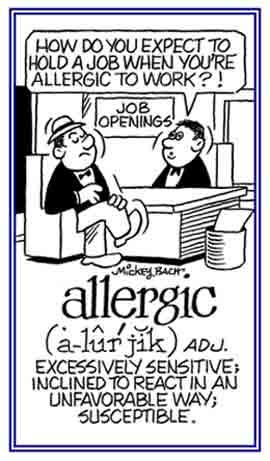
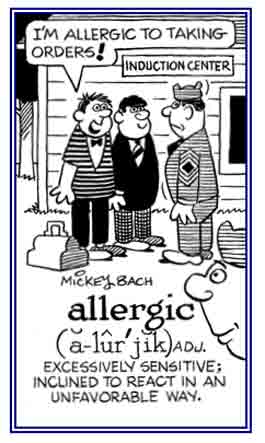
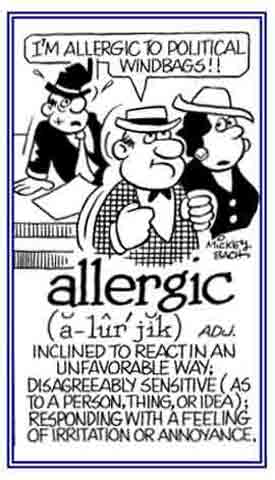
Go to this Word A Day Revisited Index
for a list of additional Mickey Bach illustrations.
The substances that trigger allergies include pollens, dust mite, molds, danders, and even certain foods.
Although allergies can develop at any age, the risk of developing them is often genetic or is related to one's family history.
Hay fever is the most common of the allergies and refers to seasonal nasal symptoms that are caused by pollens year round, or perennial rhinitis is usually due to indoor elements; such as, dust mites or molds.
Symptoms of allergies result from the inflammation of the tissues that line the inside of the nose (mucus lining or membranes) after the causes of allergies are inhaled, and adjacent areas, such as the ears, sinuses, and throat can also be involved.
2. Material that is directly or indirectly produced by photosynthesis and which is utilized as a feedstock in the manufacture of fuels and substitutes for petrochemical and other energy intensive products.
Organic waste from forestry and agriculture, and municipal solid waste are also included in the collaborative research; as well as, broader "system studies" on techno-economic aspects and greenhouse gas balances.
2. Exertion of vigor or power: "I have this project which is requiring a great deal of time and energy."
3. Vitality and intensity of expression; forcefulness of expression; such as, a speech delivered with energy and emotion.
4. Usable heat or power.
5. A source of usable power; such as, petroleum or coal.
6. In physics, the capacity to do work; the property of a system that diminishes when the system does work on any other system, by an amount equal to the work so done; potential energy.
Forms of energy include heat, light, sound, electricity, and chemical energy. Energy and work are measured in the same units—foot-pounds, joules, ergs, or some other, depending on the system of measurement being used. When a force acts on a body, the work performed (and the energy expended) is the product of the force and the distance over which it is exerted.
First recorded in 1599, from Middle French energie, from Late Latin energia, which was from Greek energeia, "efficiency, activity, operation" came from energos, "active, working" from en-, "at" + ergon, "work". Used by Aristotle with a sense of "force of expression"; the broader meaning of "power" was first recorded in English in 1665. To energize; that is, "rouse to activity" is from 1753; energetic of people, institutions, etc., is from 1796. The term energy crisis was first recorded in 1970.
2. Etymology: from Greek ergon, "work" + asthenos, "weakness".
