
equ-, equi-
(Latin: same, similar, even, uniform, identical; fair)
Don't confuse this unit with another equ- unit meaning horse.
Sufficient for a specific requirement: reasonableness; passableness: Amanda's teacher, Mrs. Smith, questioned the adequacy of her homework because it seemed to be only partly finished.
adequate (adjective), more adequate, most adequate
1. Concerning the sufficiency in quality or quantity to meet a need or to qualify for something; enough for the situation or need: Floyd had an adequate amount of butter and flour to make the cake he wanted, but not enough to make cookies, too.
2. In law, pertaining to a reasonable amount of proof for starting legal action: Frank and Violet had adequate grounds or justification for suing the hospital for incompetence.
3. Etymology: from Latin adæquatus, "equalized"; past participle of adæquare, "equalize"; from ad-, "to" + æquare, "to make level", from æquus.
2. In law, pertaining to a reasonable amount of proof for starting legal action: Frank and Violet had adequate grounds or justification for suing the hospital for incompetence.
3. Etymology: from Latin adæquatus, "equalized"; past participle of adæquare, "equalize"; from ad-, "to" + æquare, "to make level", from æquus.
coequal
1. Equal in size, rank, or status to something else.
2. Equal with one another, as in rank or size.
2. Equal with one another, as in rank or size.
coequality
Equal with another or each other in rank, ability, extent, etc.
coequalize
To make something, or someone, of the same value, age, size, or importance.
coequally
The equal of another or others.
coequate (verb), coequates; coequated; coequating
To make equal, uniform, or corresponding with someone or something else: The green shoes that Susan wore coequated with the beautiful green dress she had because the colors matched perfectly.
disequilibrium
A loss of balance between different forces or aspects attributable to an unstable situation in which some forces outweigh others; a loss or lack of stability.
Ecuador
Officially the Republic of Ecuador (Spanish, República del Ecuador, literally, "Republic of the equator").
A country of northwest South America on the Pacific Ocean. Once part of the Incan Empire, it was conquered by the Spanish in 1534 and later became subject to Peru and New Granada.
The area achieved independence from Spain in 1822 but formed a part of Greater Colombia until 1830, when it became a separate country. Quito is the capital and Guayaquil the largest city.
Etymology: from the Spanish form of equator (which runs through it).
Before 1830 the region bore the name of its chief city, Quito, which is from the name of a now-extinct native people, of unknown meaning.
The capacity of being constant, invariant, steady, unchanging: Mr. Adams checked the temperature every day and the equability of good weather enabled him to make some plans for his garden.
equable (adjective), more equable, most equable
1. Descriptive of someone who is very calm and not easily disturbed or angered: Milly is an equable mother even when her children misbehave and fight with each other.
2. Pertaining to something which does not vary or fluctuate very much: The equable climate where Jane lives is very steady with mild and comfortable temperatures.
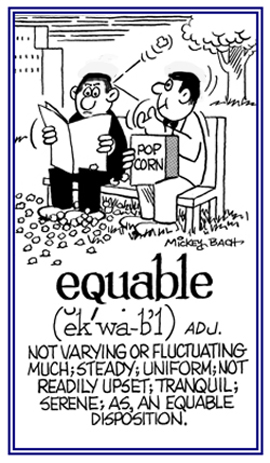
© ALL rights are reserved.
Go to this Word A Day Revisited Index
2. Pertaining to something which does not vary or fluctuate very much: The equable climate where Jane lives is very steady with mild and comfortable temperatures.
Go to this Word A Day Revisited Index
so you can see more of Mickey Bach's cartoons.
equably (adverb), more equably, most equably
1. Pertaining to how a person is even-tempered and composed: Jerry seemed to be an equably easy-going fellow who always had time to help others and enjoy drinking coffee with them in the afternoons.
2. Concerning how something stays in a constant or uniform way: Bill and Nigel wanted to plan their vacation in an equably unvarying climate, especially because they wanted to go camping!
2. Concerning how something stays in a constant or uniform way: Bill and Nigel wanted to plan their vacation in an equably unvarying climate, especially because they wanted to go camping!
equal
1. Identical in size, quantity, value, or standard.
2. Having the same privileges, rights, status, and opportunities as others.
3. Evenly balanced between opposing sides.
4. Equipped with the necessary qualities or means to accomplish something.
5. Treating or affecting all things impartially.
6. Having the same effect, application, or meaning as someone or something else.
7. Showing or having no variance in proportion, structure, or appearance.
8. Etymology: from Latin æqualis, "uniform, identical"; from æquus, "level, even, just".
2. Having the same privileges, rights, status, and opportunities as others.
3. Evenly balanced between opposing sides.
4. Equipped with the necessary qualities or means to accomplish something.
5. Treating or affecting all things impartially.
6. Having the same effect, application, or meaning as someone or something else.
7. Showing or having no variance in proportion, structure, or appearance.
8. Etymology: from Latin æqualis, "uniform, identical"; from æquus, "level, even, just".
Parallel formation egal (from Old French egal) was in use from 1380 to the 1600s.
equal rights
Equality of rights; especially, between men and women.
equalibrious, equilibrious
1. That which is in a state of equilibrium; evenly balanced.
2. Evenly poised; balanced.
2. Evenly poised; balanced.
