acidemia, acidaemia
(s) (noun): acidemias; acidaemias
(pl)
A situation in which the acidity of the blood is much higher than normal and desirable:
Acidaemia is one feature of severe untreated diabetes.
Acidemia is a condition in which the blood pH is below normal.
afibrinogenemia
1. The absence of fibrinogen (a protein present in blood plasma which converts to fibrin when the blood clots) in the plasma leading to prolonged bleeding.
2. Absence or deficiency of fibrinogen in the circulating blood.
The defect is inherited in goats, causing a severe hemorrhagic diathesis.
agammaglobulinemia, agammaglobulinaemia
A rare disease where the body is unable to produce immune antibodies due to the lack of gamma globulin, a non-specific immunoglobulin, in the blood.
The disease can be acquired or inherited as an X-linked recessive genetic disease.
alcoholemia
(s) (noun), alcoholemias
(pl)
The presence of ethanol in the blood: Alcoholemia is also said to be the blood-level of alcohol.
aleukemia, aleukaemia
(s) (noun); aleukemias; aleukaemias
(pl)
A lack of a diminished total of white blood cell count in the peripheral blood cells: Aleukemia consists of varieties of diseases in which the white cell count of the blood is not normal, or is so inadequate that it can even result in death.
alkalemia
Abnormal alkalinity of the blood.
alloxuremia
(s) (noun), alloxuremias
(pl)
The situation of excess purine bases in the blood and associated signs of toxicity: Dr. Lawson told the elderly Mr. Jones that he had a condition of alloxuremia and should avoid drinking coffee, which was also a purine.
analbuminemia
1. Properly, an absence of albumin from the blood.
2. More loosely, a low level of albumin in the blood.
anemia
(s) (noun), anemias
(pl)
A condition in which a person's blood does not have enough red corpuscles; the severity of which is usually determined by how much the red blood cells have been decreased because when there is inadequate hemoglobin (iron-containing pigments of the red blood cells), all parts of the body receive less oxygen and have less energy than is normally needed to function properly: The results of the blood work done by Dr. Nelson indicated that Lora was suffering from
anemia.
The degree of anemia in Percy alarmed the doctor and so she prescribed medications.
Many people who are suffering from various degrees of anemia are often pale, lifeless, and lacking in energy or vitality.
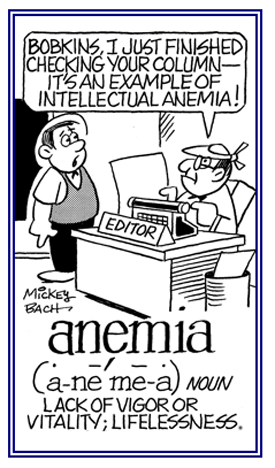 © ALL rights are reserved.
Go to this Word A Day Revisited Index
so you can see more of Mickey Bach's cartoons.
anoxemia
(s) (noun), anoxemias
(pl)
Absence of oxygen in arterial blood: Paula was having breathing problems and the emergency medical personnel recognized it as severe anoxemia; so, they started to administer oxygen to her.
azotemia, azotaemia
1. An excess of nitrogenous bodies in the blood as a result of kidney insufficiency.
2. A higher than normal blood level of urea or other nitrogen containing compounds in the blood.
Usually caused by the inability of the kidney to excrete these compounds.
carotenemia
Carotene in the blood, marked by yellowing of the skin (pseudojaundice or yellow discoloration of the skin, whites of the eyes, etc., due to an increase of bile pigments in the blood, often symptomatic of certain diseases; such as, hepatitis).
It can be distinguished from true jaundice by the lack of yellow discoloration of the conjunctivae (transparent membrane covering the eyeball and the under surface of the eyelid) in carotenemia; and it is considered to be a benign condition.
chloremia, hyperchloremia
An excess of chloride (salt of hydrochloric acid) in the blood.
cryoglobulinemia
(s) (noun), cryoglobulinemias
(pl)
In medicine, the presence of abnormal quantities of cryoglobulin in the blood plasma that causes gelling at low temperatures: When blood contains an overabundance of proteins that become insoluble at low temperatures, a condition of
cryoglobulinemia exists.
Cryoglobulins are abnormal proteins that by definition have the unusual property of precipitating from the serum specimen in the laboratory when it is chilled and redissolving into the serum upon rewarming.
Cryoglobulins may or may not be causing disease. Cryoglobulins can accompany another condition (such as dermatomyositis, multiple myeloma, or lymphoma) or be an isolated condition themselves, called cryoglobulinemia.
Relating to the state of being cold-blooded: Some cryohemic animals are fish, reptiles, and ticks.
Inter-related cross references, directly or indirectly, involving "blood" word units:
angi-;
apheresis;
hemo-;
hemoglobin-;
phleb-;
sangui-;
vas-;
vascul-.

