dom-, domo-, domat-, domato-
(Greek > Latin: house, home; master or lord of the house)
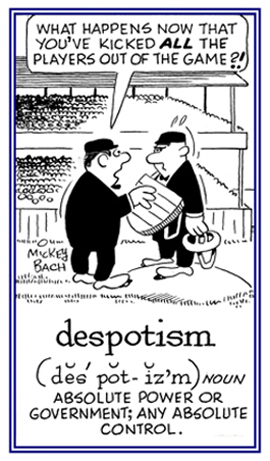
2. A building or complex containing apartments or townhouses: The condominium on the corner has a great view of the ravine and river that is just across the street.
3. In politics, a country governed by two or more different countries with joint responsibilities: The countries on both sides of the river agreed to a condominium so that neither one would have sole ownership of the river and the commerce that used it.
4. Etymology: from Modern Latin, "joint sovereignty", apparently coined in German about 1700 from com-, "together" + dominum, "right of ownership".
The sense of "privately owned apartment" came into existence in American English, about 1962, as a special use of the legal term.
Go to this Word A Day Revisited Index
so you can see more of Mickey Bach's cartoons.
2. Someone or something that may cause harm, injury, or loss: The two boys were aware of the danger involved in mountain climbing and took as many precautions as they could before starting their trip.
3. Etymology: "power of a lord or master, jurisdiction", from Anglo-French daunger, from Old French dangier, "power to harm, mastery"; alteration of dongier, from Vulgar Latin dominarium, "power of a lord", from Latin dominus, "lord, master"; so, danger is said to be a parallel formation of dominion.
2. Characteristic of the involvement of something that is perilous, hazardous, or risky and unsafe: Going down the torrent inn a raft was known to be quite dangerous.
2. To make a person feel slightly frightened or worried about the ability to achieve something: After listening to all the performers in the recital, Jill felt quite daunted at playing her piece on the piano in front of all the others in the audience.
3. Etymology: from Old French danter, a form of donter, from Latin domitare, domare, "to tame, to subdue, to vanquish, to conquer"; literally, "to accustom to the house", from domus, "house".
2. Relating to the state of being depressed, intimidated, demoralized, or frightened: The fact that she was newly divorced was especially daunting to Mrs. Evens who had two little children to take care of.
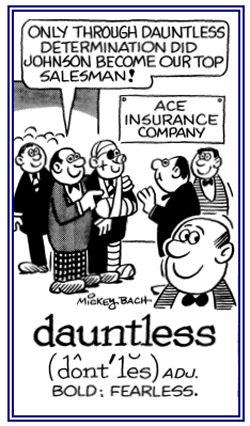
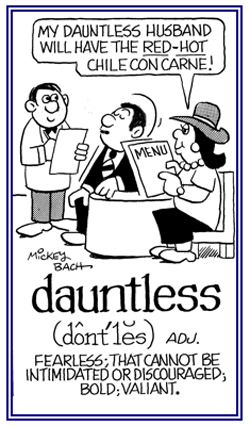
The dauntless soldier received a great deal of praise from his comrades for saving them from death after they had run out of ammunition and he had returned with a new supply of bullets, despite the dangers he had to face as he went back to them.
2. Unlikely or unable to be frightened or to be discouraged; not afraid: Carol's small but dauntless cat braved going out into the hall where she encountered the large cat which lived down the hall.
Go to this Word A Day Revisited Index
so you can see more of Mickey Bach's cartoons.
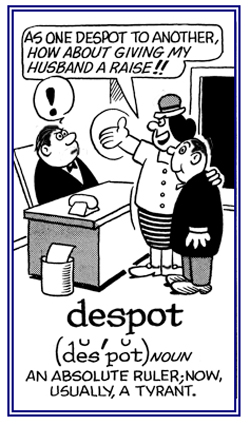
2. Any tyrant or oppressor: There are some despots, even in these modern times, who rule their people in cruel and inhumane ways.
3. Etymology: from Greek: despotes, "a master, a lord"; from Latin domus "house, home" + potis, "master, husband".
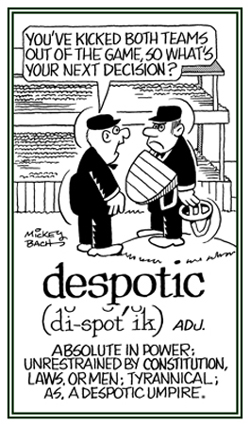
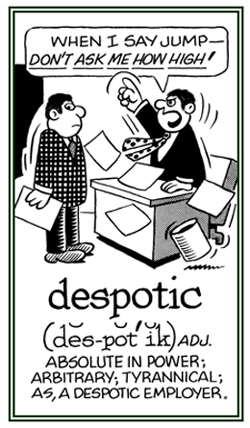
Originally, a title meaning "master", applied to certain classes of rulers, an honorary title applied to a Byzantine emperor, afterward to members of his family, and later to Byzantine vassal rulers and governors, then to bishops or patriarchs of the Greek Orthodox Church, etc. Now, it refers to anyone who is in charge and acts like a tyrant or a ruler who exercises his or her power in a harsh or oppressive way.
Go to this Word A Day Revisited Index
so you can see more of Mickey Bach's cartoons.
Go to this Word A Day Revisited Index
so you can see more of Mickey Bach's cartoons.
Other names include the following modern dictators who have advocated despotism:
- Joseph Stalin (U.S.S.R or Russia)
- Mao Zedong (Mao Tse Tung) (China)
- Kim Jong-il (North Korea)
- Muammar Al-Gaddafi (Libya)
- Robert Mugabe (Zimbabwe)
- Plus many others throughout history!