
doloro-, dolor-, dolori- , dol-
(Latin: to feel pain, to grieve; sorrow, grief, mourning)
ad partes dolentes, ad part. dolent (Latin statement)
To the painful or aching parts.
After Ginny got her prescription for the medicine she was to take, the enclosed information mentioned that it should relieve ad partes dolentes during the next few days.
condolatory (adjective), more condolatory, most condolatory
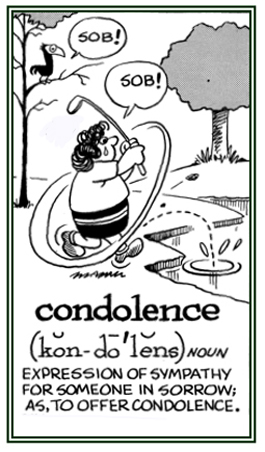
1 A reference to the offer of sympathy to someone who is experiencing grief, loss, or pain, especially over a death. Condolatory sympathy is expressed to a person who is suffering sorrow, misfortune, or grief.
2. Etymology: from Latin condolere, "to suffer pain"; from com-, "together" + dolere, "to feel pain, to grieve".
2. Etymology: from Latin condolere, "to suffer pain"; from com-, "together" + dolere, "to feel pain, to grieve".
condole (verb), condoles; condoled; condoling
To express sympathy or sorrow: Henry appreciated the nurse at the hospital who tried to condole him for the loss of his daughter.
1. An expression or declaration of sympathy with someone who has experienced pain, grief, or misfortune: Mary offered her condolences to her neighbors who had just lost their son in a car accident.
2. Etymology: from Late Latin condolere, "to suffer together" from com- "with" + dolere, "to grieve".
© ALL rights are reserved.

© ALL rights are reserved.
Go to this Word A Day Revisited Index
2. Etymology: from Late Latin condolere, "to suffer together" from com- "with" + dolere, "to grieve".
Go to this Word A Day Revisited Index
so you can see more of Mickey Bach's cartoons.
Someone who conveys sympathetic sorrow with a person in grief: Jim thanked his condoler for expressing such kind words and understandings regarding the recent loss of his wife.
condolingly (adverb), more condolingly, most condolingly
Descriptive of how a person expresses sympathetic grief: Jane added consolingly that she understood completely the suffering and sadness he was going through.
1. Archaic, sorrow, grief, sadness, misery; dolor: Mrs. Smith felt the dole of the relatives of the deceased grandfather when she entered the room..
2. Etymology: via Old French dol, "mourning, grieving" from Vulgar Latin dolus which came from Latin dolere, "to grieve, to suffer pain".
2. Etymology: via Old French dol, "mourning, grieving" from Vulgar Latin dolus which came from Latin dolere, "to grieve, to suffer pain".
1. A regular sum of money paid by the government to someone who is unemployed: Jack received his dole, or unemployment benefits, every two weeks.
2. The charitable provision of clothes, money, or food to someone who is in need: A dole can be donated or provided by an individual, or individuals, or by an organized charity.
3. Primarily British, the distribution by the government of relief payments to the unemployed; welfare: A dole, or money, is given to those who are very poor, or who do not have jobs.
4. Etymology: dole is something given or dealt out and comes from Old English daelan and from a Germanic base dail-, which also is the basis for the English word deal. By the 14th century, this developed into the more specific "portion (of money, clothing, food, etc.) handed out as a charitable donation to those in need". The phrase on the dole, "receiving government benefits", was first recorded in the 1920's. In the 15th century, the verb dole, "to distribute" was in use, then the modern usage, to dole out, came into existence in the 18th century. —Compiled from information located in Dictionary of Word Origins by John Ayto; Arcade Publishing; New York; 1990. and The Barnhart Dictionary of Etymology, Robert K. Barnhart, Editor; The H.W. Wilson Company; 1988.
2. The charitable provision of clothes, money, or food to someone who is in need: A dole can be donated or provided by an individual, or individuals, or by an organized charity.
3. Primarily British, the distribution by the government of relief payments to the unemployed; welfare: A dole, or money, is given to those who are very poor, or who do not have jobs.
4. Etymology: dole is something given or dealt out and comes from Old English daelan and from a Germanic base dail-, which also is the basis for the English word deal. By the 14th century, this developed into the more specific "portion (of money, clothing, food, etc.) handed out as a charitable donation to those in need". The phrase on the dole, "receiving government benefits", was first recorded in the 1920's. In the 15th century, the verb dole, "to distribute" was in use, then the modern usage, to dole out, came into existence in the 18th century. —Compiled from information located in Dictionary of Word Origins by John Ayto; Arcade Publishing; New York; 1990. and The Barnhart Dictionary of Etymology, Robert K. Barnhart, Editor; The H.W. Wilson Company; 1988.
doleful (adjective), more doleful, most doleful
1. A reference to the condition of being filled with grief or sadness: Jimmy was in a state of doleful misery when his dog was run over by a car.
2. Sorrowful, mournful, melancholy: At the funeral of their son, Karl and his wife were in a doleful condition.
2. Sorrowful, mournful, melancholy: At the funeral of their son, Karl and his wife were in a doleful condition.
dolefully (adverb), more dolefully, most dolefully
Referring to how someone expresses sadness; in a sorrowful manner: Joe's mother looked at him dolefully when he told her he had failed his final exam in school.
Mr. Smart looked at his wife dismally, sadly, and dolefully when he told her the extremely sad news.
dolesome (adjective), more dolesome, most dolesome
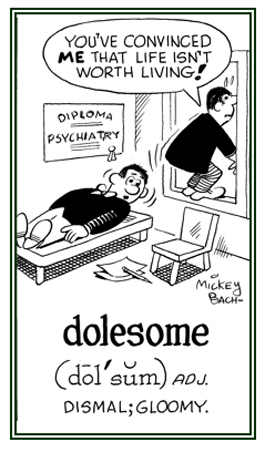
1. A reference to the situation of being very gloomy, dismal, unhappy, and sorrowful: The funeral for Jim's mother was a long dolesome ceremony and all of the people who attended expressed their sadness.
2. Etymology: from Latin dolus, "pain".
© ALL rights are reserved.
Go to this Word A Day Revisited Index
2. Etymology: from Latin dolus, "pain".
Go to this Word A Day Revisited Index
so you can see more of Mickey Bach's cartoons.
1. In medicine, pain: Dolor id one of the principal indications of inflammatio, and some others include rubor (redness), tumor (swelling), "functio laesa" (loss of function), and calor (heat).
Dolor is used in old medicine as one of five cardinal symptoms of inflammation.
2. A mental suffering or anguish: When Susan went to work in the morning, her dog looked at her with a great amount of dolor.
dolor capitis (s) (noun (no pl)
A headache: Dolor capitis is a result of changes in the scalp or bones instead of the intracranial structures.
Dolor capitis can also be due to ntal suffering or anguish
A pain in the hip: When Jim went to see Dr. Smart about the discomfort in the region of his left hip, he was told that he had a case of dolor coxa which caused him much suffering while taking his dog out for a walk.
Vague, diffuse, or fleeting pains in the chest or abdomen: Because Jill complained of a tenderness in the area of her stomach that did't seem to get better, her parents took her to see Dr. Match who diagnosed her as having a condition of dolor vagus which involved the vagus nerve.
