dis-, di-, dif-
(Latin: separation, apart, asunder; removal, away, from; negation, deprivation, undoing, reversal, utterly, completely; in different directions)
The meaning of dis- varies with different words; dif-, assimilated form of dis- before f; di-, form of dis- before b, d, g, l, m, n, r, and v.
2. To have or express a different opinion; to disagree: Ted and Jane differed with each other as to where they would spend their vacation.
3. Etymology: from Latin differre, "to set apart".
Mary believes that the difference between grocery store produce and Farmer's Market produce is the freshness.
2. The degree or amount by which some things are not the same or what is left after subtracting one number from another number: There is a 10-year difference between Jack's oldest daughter and her youngest sister.3. A situation in which there is a divergence of opinion or direction that should be undertaken: The city councilors had several differences with Mr. Richison, the mayor, about how the parade for the summer festival should be organized.
2. The distinguishing degree of not being similar to another person or items: There was a considerable differential in salaries between the newly hired salespeople and the those with years of experience.
Although there was an obvious price differential between the two cars, Samuel and Gertrude decided it was worth it to get the one that had more safety features.
There is little to differentiate one dictionary from another one because they all tend to have the same or very similar definitions and too often lack clarity because they use another form of the word that is being presented.
2. To identify that which sets one thing apart from something else; to tell one thing apart from another based on characteristics: For some people, including Janet and Linda, it is not easy to differentiate between ice cream and frozen yogurt.2. The similarity between a normal cell and the cancerous cell defines what degree of change has occurred: Cancerous cells that are well differentiated are close to the original cells and are usually less aggressive.
Poorly differentiated cells which have changed more and are more aggressive.
The literal and actual meaning of difficult is "not easy".
2. A troublesome or embarrassing state of affairs; especially, of financial affairs.
3. A laborious effort or struggle; trouble: "She had difficulty walking into the classroom where she completed the exam with difficulty."
4. A disagreement or dispute about an issue.
5. Having a reluctance, objection, or unwillingness to do something.
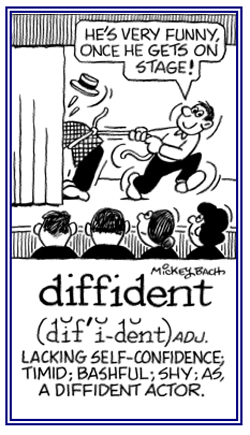
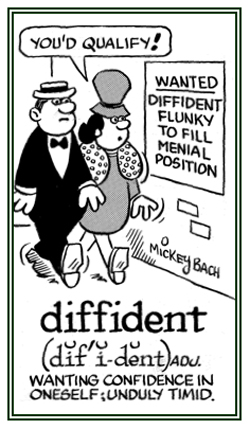
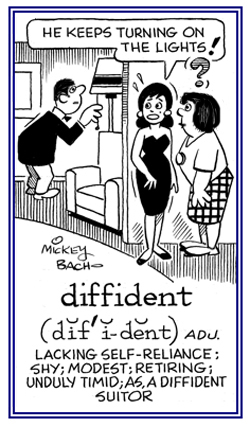
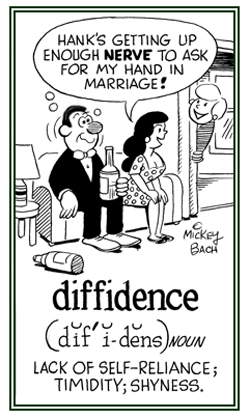
A diffident man is one who has finally discovered that there are some problems for which no one has a solution. It seems that when a person thinks he knows all the solutions to a problem, some fool comes along and asks the wrong questions.
Go to this Word A Day Revisited Index
so you can see more of Mickey Bach's cartoons.
2. A reference to being very careful about acting or speaking: As Mrs. Hoover, the reporter, asked the politician, Mrs. Traviss, if she would be running for a third term, she made a diffident response because she didn't want to say anything that could be interpreted as being slanderous about her opponent.