
demo-, dem-, demio-, -demic, -deme, -demically
(Greek: people, population)
From Greek: district, country, land, and the people who inhabit those areas or territories.
The science dealing with the integration of ecology and the genetics of human populations: Biodemographies consist of information about birth and death processes as they relate to populations in general and to humans in particular.
1. A new government for the people: In the story, Meg read that the people on the island wanted to have a cenodemocracy to replace the present one they did not like anymore.
2. Etymology: from Greek kainos = ceno, "new, recent" + Greek demokratia, "popular government" from demos, "common people".
2. Etymology: from Greek kainos = ceno, "new, recent" + Greek demokratia, "popular government" from demos, "common people".
The use of information and communication technologies and strategies in political and government systems: Cyberdemocracy deals with the use of data and the study of scientific knowledge to involve people, to support principles of equality when political administrations make decisions, and to increase societies without class distinctions.
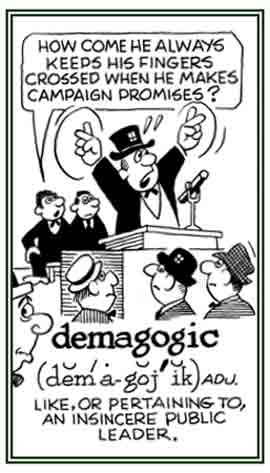
demagogic (adjective), more demagogic, most demagogic
1. Pertaining to a political leader who seeks support by appealing to popular desires and prejudices of the voters rather than by using rational arguments: People often experience the presentations of demagogic politicians who are running for various offices in governments around the world!
2. Etymology: from Greek demagogos which came from demos, "‘the people" + agogos, "leading"; from agein, "to lead".
© ALL rights are reserved.
Go to this Word A Day Revisited Index
2. Etymology: from Greek demagogos which came from demos, "‘the people" + agogos, "leading"; from agein, "to lead".
In ancient Greece and Rome, a reference to a leader or orator who supported the cause of the common people.
Go to this Word A Day Revisited Index
so you can see more of Mickey Bach's cartoons.
demagogical, demagogic, (adjective); more demagogical, most demagogical; more demagogic, most demagogic
Concerning a politician who panders to great numbers of people for egoistical purposes: The young politician seemed to be demagogical in that he appealed to the emotions of the crowds instead of presenting reasonable or rational arguments.
1. In a bad sense, a leader of a popular faction, or of the mob: A demagogue is a political agitator who appeals to the passions and prejudices of the mob in order to obtain power or to further his or her own interests.
2. In ancient or former times, a popular leader who represented the ordinary people: It is said that a demagog acted or spoke for the uncivilised mob of people.
2. In ancient or former times, a popular leader who represented the ordinary people: It is said that a demagog acted or spoke for the uncivilised mob of people.
Two examples of demagogs in past history were Adolf Hitler and Josef Stalin.
3. Etymology: from Greek demagogos which is from demos, "the people" + agogos, "leading".
1. The actions of a leader who acquires benefit by stiring up the emotions and prejudices of the folk: The demagoguery of Mr. Big's speeches was most agitative and manipulative and not based on facts or reasoning.
2. The use of persuasive language to appeal to the biases of the people: The usage of demagoguery by politicians creates fear and hatred among people, and is, sad to say, very common among politicians.
2. The use of persuasive language to appeal to the biases of the people: The usage of demagoguery by politicians creates fear and hatred among people, and is, sad to say, very common among politicians.
The methods or practices of a politician who strives for support by stressing the popular desires and prejudices of people: Mr. Smart didn't admire the practice of demagogy, but spoke about practical, logical, and factual aspects of his town. He was not interested in agitating the citizens at all.
1. A government by the people who vote for citizens either directly by them or by officers elected by them: In modern usage, a democracy is often more of a social state in which everyone has equal rights, without hereditary or arbitrary differences of rank or privilege.
2. The free and equal right of every person to participate in a system of government, often practiced by electing representatives by them: Norman's teacher at school taught the students that democracy was important in their country, and even in their school where all of the students could vote for their own student body president, for example.
3. A country with a government which has been elected freely and equally by all of its citizens: Most of the western countries of the world have decmocracies and the people living there are encouraged to vote for their representatives in the government.
4. The control of an organization by its members who have a free and equal right to participate in decision-making processes: The teacher of Jane's psychology class conducted his classroom like a democracy because his students were free to express their ideas and desires.
2. The free and equal right of every person to participate in a system of government, often practiced by electing representatives by them: Norman's teacher at school taught the students that democracy was important in their country, and even in their school where all of the students could vote for their own student body president, for example.
3. A country with a government which has been elected freely and equally by all of its citizens: Most of the western countries of the world have decmocracies and the people living there are encouraged to vote for their representatives in the government.
4. The control of an organization by its members who have a free and equal right to participate in decision-making processes: The teacher of Jane's psychology class conducted his classroom like a democracy because his students were free to express their ideas and desires.
1. Someone who believes that his country has political leaders of a system of government and works in their favor: Mary grew up in California, U.S.A., and enjoyed the life of a democrat being free to express her ideas and desires.
2. A member of the Democratic party, a political party in the U.S.: Some important democrats in America are Joe Biden, Hillary and Bill Clinton, and Barack Obama.
2. A member of the Democratic party, a political party in the U.S.: Some important democrats in America are Joe Biden, Hillary and Bill Clinton, and Barack Obama.
The trouble with this country is that there are too many politicians who believe, with a conviction based on experience, that you can fool all of the people all of the time.
democratic (adjective), more democratic, most democratic
1. Of the nature of, or characterized by, democracy; advocating or upholding democracy: Jack learned in school that being a democratic person was very worthwhile and had many positive aspects, including being able to articulate one's own opinion.
2. Name of the political party originally called Anti-Federal and afterwards Democratic-Republican: The democratic faction initially favored a strict interpretation of the Constitution with regard to the powers of the general government and of the individual States, and the least possible interference with local and individual liberty. Since 1854I, it is in opposition to the Republican party, formerly called Federals and Whigs.
2. Name of the political party originally called Anti-Federal and afterwards Democratic-Republican: The democratic faction initially favored a strict interpretation of the Constitution with regard to the powers of the general government and of the individual States, and the least possible interference with local and individual liberty. Since 1854I, it is in opposition to the Republican party, formerly called Federals and Whigs.
democratically (adverb), more democratically, most democratically
Characterized by free and equal participation in government or in the decision-making processes of an organization or group.
The introduction of a government from an authoritarian system, which includes various factors including economic development and a civil society where the people have a right to vote and to have a voice in determining the policies of the country.
democratize (verb), democratizes; democratized; democratizing
1. To put a country under the control of its citizens by allowing hem to participate in a government of decision-making processes in a free and equal way.
2. To take steps toward establishing the features of liberal democracy in a state.
3. To put an organization under the control of its members by giving them free and equal decision-making powers.
2. To take steps toward establishing the features of liberal democracy in a state.
3. To put an organization under the control of its members by giving them free and equal decision-making powers.
1. A report of anthropology that deals with the life-conditions of communities of people, as shown by statistics of births, deaths, diseases, buying habits, etc.
2. A written summary of populations, especially with reference to size, density, fertility, mortality, growth rate, age distribution, migration, and vital statistics.
2. A written summary of populations, especially with reference to size, density, fertility, mortality, growth rate, age distribution, migration, and vital statistics.
