
cosmo-, cosm-, cosmico-, cosm, -cosmia, -cosmos, -cosmic, -cosmics, -cosmical, -cosmology, -cosms
(Greek: kosmos to cosmos; "world, universe"; from its "perfect order and arrangement"; to order, to arrange, to adorn; well-ordered, regular, arranged; skilled in adornment, which came into English as cosmetic.)
acosmic (adjective), more acosmic, most acosmic
Conveying a denial of the existence of the universe as distinct from God: According to this viewpoint, the phenomenal dualistic acosmic world is ultimately an illusion, regardless of the apparent reality it possesses at the mundane or empirical level.
Someone who denies the existence of the universe or of a universe that is distinct from God.
anticosmetic (adjective), more anticosmetic, most anticosmetic
A reference to a preparation that is destructive or injurious to beauty.
biocosmetics (plural used as a singular) (noun)
A term for cosmetics that have some sort of biotechnologically produced ingredient or that have a mechanism of action based on biologic principles: Many biocosmetics have to undergo the same scrutiny that a biopharmaceutical does before they can be brought to market.
1. Someone who considers the earth in its relationship to the universe and its celestial phenomena.
2. Anyone who investigates and studies the effects of cosmic phenomena on earthly life.
2. Anyone who investigates and studies the effects of cosmic phenomena on earthly life.
1. A science that considers the earth in relationship to the universe and its celestial phenomena.
2. The investigation and study of the effects of cosmic phenomena on life.
2. The investigation and study of the effects of cosmic phenomena on life.
1. The preservation, restoration, or bestowing of bodily beauty.
2. The surgical correction of a disfiguring physical defect.
3. A concern in therapeutics, especially in surgical operations, for the appearance of the patient; for example, a resort to an operation which will improve a person's appearance.
2. The surgical correction of a disfiguring physical defect.
3. A concern in therapeutics, especially in surgical operations, for the appearance of the patient; for example, a resort to an operation which will improve a person's appearance.
1. A preparation; such as, powder or a skin cream that is designed to beautify the body by direct application: Cosmetics are substances especially prepared to improve, beautify, and generally increase the attractiveness of a person.
3. An item that is decorative rather than functional: As a hobby, Henry likes to put special fenders on cars that are cosmetic.
Preparations of cosmetics are therefore intended to promote the health and beauty of the complexion, hair, hands, and nails of the hands and even of the feet.
2. Something superficial that is used to cover a physical deficiency or defect: Even men utilize cosmetics to enhance their physical appearances.3. An item that is decorative rather than functional: As a hobby, Henry likes to put special fenders on cars that are cosmetic.
Any surgical operation directed at improving appearance, except when required for the prompt repair of accidental injury or the improvement of the functioning of a malformed body part.
cosmetical (adjective), more cosmetical, most cosmetical
Imparting or improving beauty, particularly the beauty of the complexion: The pharmaceutical company had a special cosmetical preparation available for customers.
cosmetically (adverb), more cosmetically, most cosmetically
1. Relating to, or making for beauty; especially, of the complexion; beautifying.
2: A reference to something that is done, or made, for the sake of appearance; such as, correcting physical defects, especially of the face.
2: A reference to something that is done, or made, for the sake of appearance; such as, correcting physical defects, especially of the face.
1. Someone who makes, or sells, cosmetics; or who applies them professionally.
2. A person who works in a beauty parlor.
2. A person who works in a beauty parlor.
cosmetological (adjective), more cosmetological, most cosmetological
A reference to the study, or art, of cosmetics and their uses.
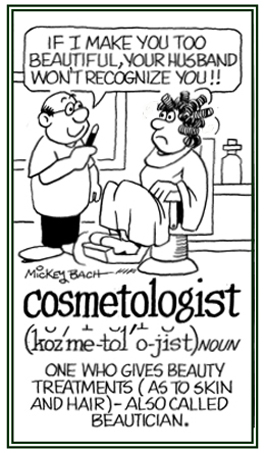
An expert who gives beauty treatments; such as, to the skin and the hair; also known as a beautician.
© ALL rights are reserved.
Go to this Word A Day Revisited Index
Go to this Word A Day Revisited Index
so you can see more of Mickey Bach's cartoons.
The study of cosmetics, or the art, or profession, of using cosmetics: Cosmetology is a term used to designate the practice of beauty culture in beauty shops and hairdressing establishments.
