
coimetro-, coimetr-; koimetro-, koimetr-
(Greek: koimeterion, sleeping-room, burial-place; grave, grave yard; final resting place)
A cemetery is a burial ground which is located in a graveyard.
2. Etymology: from Old French cimetiere, "graveyard"; from Late Latin coemeterium, from Greek koimeterion, "sleeping place, dormitory", from koiman, "to put to sleep", keimai, "I lie down".Early Christian writers were the first to use the term for "burial ground".
Usually, the most common "final resting place" throughout the world is the burial in a cemetery.
Sign at the gate of a cemetery: "New lots available." Subtitle: "The dead real estate market."
On the pathway of life. . .
And fewer on graves
At the end of the strife.
A news story began: "During the grave diggers' strike, local cemeteries will be manned by skeleton crews."
To dig the dust enclosed here;
Blest be the man that spares these stones,
And curst be he that moves my bones.
Epitaph collections
Sum quod eris, fui quod sis. "I am what you will be; I was what you are."A message engraved on tombstones as a reminder to the living as in the following poem:
Forebear and cast an eye.
As you now are so once was I,
As I am now, so shall ye be.
Prepare to die and follow me.
A response was written on a wooden sign next to the grave stone:
Whether in heaven or in hell;
But to follow you I can not consent,
Until I know the way you went!
Sarcophagi, subjects of coimetrophiliac interest
Sarcophagus, our term for a stone coffin, or "burial place", located above ground and often decorated, has a terrifying origin befitting a macabre subject. The word comes to us from Latin and Greek, having been derived in Greek from sarx, "flesh", and phagein, "to eat".
The Greek word sarkophagos meant "eating flesh", and in the phrase lithos, "stone"; sarkophagos it represented a limestone that was thought to decompose the flesh of corpses placed in it.
Used by itself as a noun, the Greek term came to mean "coffin". The term was carried over into Latin, where sarcophagus was used in the phrase lapis sarcophagus, referring to the same stone as in Greek.
Sarcophagus, used as a noun in Latin meant "coffin of any material". This Latin word was adopted into English, first being recorded in 1601 with reference to the flesh-consuming stone and then in 1705 with reference to a stone coffin.
Some people who have coimetrophobia will drive long distances out of their way to avoid going by such a place reserved for human and animal remains, or they will even walk on the other side of the street to avoid being close to one.
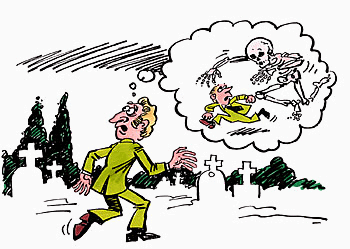
A man was so afraid of dying that he always stayed in his living room.
He or she who pretends to look on death without fear, lies.
Cross references of word groups that are related, directly or indirectly, to: "bury, burial, cemetery, grave; sleeping place": Epitaphs; funer-; sepulc-; sheol; tapho-.