
cogni-, cogn-, cognosc-
(Latin: know, learn; comprehend, perceive)
archaeological reconnaissance, archeological reconnaissance (s) (noun); archaeological reconnaissances, archeological reconnaissances
The technique of finding, specifying, and documenting the locations of very old historical sites on the ground by examining different contrasts in the various environments and geographic configurations: In his class of archaeological reconnaissance, James used a special tool called an auger to make holes in the ground so he could extract samples of soil in order to understand the physical features of what once existed in certain areas.
1. The procedure of becoming knowledgeable, including perception, reasoning, judgement, awareness, and intuition: Janet used her cognition to learn different foreign languages which otherwise would not have been possible!
Some people have mental disabilities that affect their cognitions and judgments in a negative way.
2. Etymology: from the Latin stem cognition-; from cognoscere, "to get to know"; from (g)noscere, "to know".
cognitional (adjective), more cognitional, most cognitional
A reference to the act or process of perceiving and learning about something; including, both awareness and judgment: Mrs. Smith was very pleased to see the cognitional progress her students were making in her German class because now they could speak in that language and actually understand what they were saying to each other!
cognitive (KAHG ni tiv) (adjective), more cognitive, most cognitive
1. Pertaining to the mental processes of perception, memory, judgment, and reasoning, as contrasted with emotional and volitional processes: Cognitive development in a child can be seen in his or her ability to think in order to solve problems.
2. Relating to acquiring knowledge by the use of thought processes of intuition or perceptions: Sharon had a premonition or cognitive discernment of what could happen if she pealed an apple too fast, so she pared it slowly to avoid cutting herself.
2. Relating to acquiring knowledge by the use of thought processes of intuition or perceptions: Sharon had a premonition or cognitive discernment of what could happen if she pealed an apple too fast, so she pared it slowly to avoid cutting herself.
The progression of acquiring intelligence and increasingly advanced thinking and the capacity for problem-solving abilities throughout one's life from infancy on into adulthood: Cognitive development takes place in all families when the children learn how to crawl, to hold a cup, to utter their needs, etc.
Psychological conflicts or anxieties that result simultaneously when having contradictory, or otherwise incompatible attitudes, beliefs, etc.: Joan had a cognitive dissonance because, although she liked her friend Max, she strongly disapproved of his habit of smoking so often.
A branch of mental behavior that is concerned with the study of thinking processes that are involved in perceptions, learning, memory, and reasoning: As a part of her educational studies to become a teacher, Mary had to take a course involving cognitive psychology, in order to learn how to present her lessons to students in the most effective manner.
The study of the exact nature of various mental tasks and the functions of the brain that enable them to be accomplished by utilizing branches of linguistics, philosophy, psychology; in addition to, computer operations: Since Jack was particularly interested in a career dealing with the engineering of computable processes and structures, he decided to extend his knowledge in cognitive science by taking special courses dealing with research about behavior, perceptions, emotions, etc.
A medical method of treating mental disorders; such as, anxiety or depression, from the perspective that the way people think about themselves and the world all have influences on their emotions and behavior: Cognitive-behavior therapy is based on the way in which every person relates to his or her environment and it provides treatment to be more specific to meet each individual's needs.
cognitively (adverb), more cognitively, most cognitively
A reference to conscious mental activities involving learning and remembering: Sally's aunt was cognitively impaired in her old age as indicated by her loss of memory about so many daily things.
cognizable (KAHG ni zuh buhl, kahg NIGH zuh buh) (adjective), more cognizable, most cognizable
1. The capability of being aware of something or able to perceive with the mind: The dates for the city events were all cognizable because they had been discussed and were publicized to take place in the spring.
2. Regarding something within a law court's jurisdiction of a particular court of law and therefore able to be tried by that court: The facts of the case of a cognizable malpractice were ordered by the judge to be determined by another legal trial.
2. Regarding something within a law court's jurisdiction of a particular court of law and therefore able to be tried by that court: The facts of the case of a cognizable malpractice were ordered by the judge to be determined by another legal trial.
cognizably (adverb), more cognizably, most cognizably
Regarding the way a person perceives or is aware of what is going on: Sally read a poem to the class very cognizably, showing that she understood what she was reciting.
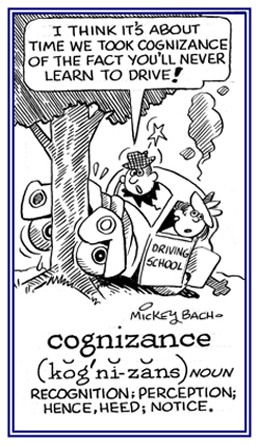
1. Conscious knowledge or awareness: The cognizance of the importance of the issue at hand was realized by the board of directors.
2. The range of what one can know or understand: Harriet's cognizance and perception of the nature of the species of the bird was quite amazing!
3. Observance; notice: The administrator will take cognizance of Jill's objections at the proper time.
4. In law, acknowledgment, recognition, or jurisdiction; the assumption of jurisdiction in a case: The court, being within cognizance, was able to act upon the case of murder without needing any further proof.
5. In heraldry, a crest or badge worn to distinguish the bearer: The knight was honored with a cognizance because of his bravery in battle.
6. Etymology: from Anglo-French conysance, "recognition"; later, "knowledge" from Old French conoissance, "acquaintance, recognition; knowledge, wisdom" (Modern French connaissance), from conoistre, "to know"; from Latin cognoscere, "to get to know, to recognize"; from com-, "together" + gnoscere, "to know".
© ALL rights are reserved.
Go to this Word A Day Revisited Index
2. The range of what one can know or understand: Harriet's cognizance and perception of the nature of the species of the bird was quite amazing!
3. Observance; notice: The administrator will take cognizance of Jill's objections at the proper time.
4. In law, acknowledgment, recognition, or jurisdiction; the assumption of jurisdiction in a case: The court, being within cognizance, was able to act upon the case of murder without needing any further proof.
5. In heraldry, a crest or badge worn to distinguish the bearer: The knight was honored with a cognizance because of his bravery in battle.
6. Etymology: from Anglo-French conysance, "recognition"; later, "knowledge" from Old French conoissance, "acquaintance, recognition; knowledge, wisdom" (Modern French connaissance), from conoistre, "to know"; from Latin cognoscere, "to get to know, to recognize"; from com-, "together" + gnoscere, "to know".
Go to this Word A Day Revisited Index
so you can see more of Mickey Bach's cartoons.
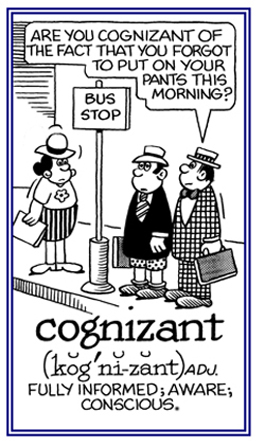
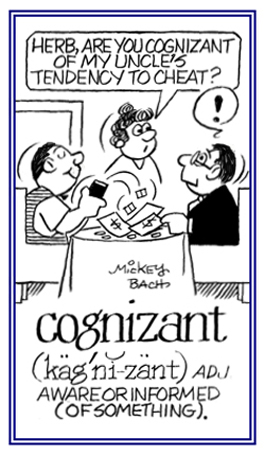
cognizant (KAHG ni zuhnt) (adjective), more cognizant, most cognizant
A reference to a person who knows or is fully aware of something: Hank was cognizant of the difficulty in completing the assignment that he gave to his workers.
© ALL rights are reserved.
© ALL rights are reserved.
Go to this Word A Day Revisited Index
James is cognizant of his responsibilities as the father of his two boys.
Go to this Word A Day Revisited Index
so you can see more of Mickey Bach's cartoons.
cognize (noun), cognizes; cognized; cognizing
To realize or to actually know something: After graduating from the university, Bert cognized that he had really learned a great deal more than when he enrolled there four years ago.
Inter-related cross references, directly or indirectly, involving word units meaning "know, knowledge; learn, learning": discip-; gno-; histor-; intellect-; learn, know; math-; sap-; sci-; sopho-.
