
climato-, climo-
(Greek: inclination, slope; the [supposed] slope of the earth from the equator towards the poles; hence, the latitudinal zone of the earth and prevailing weather in a given zone)
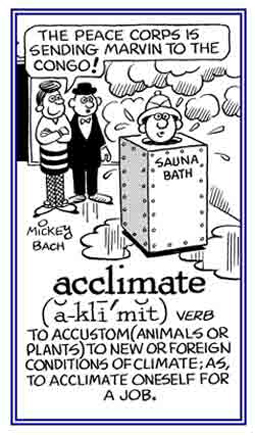
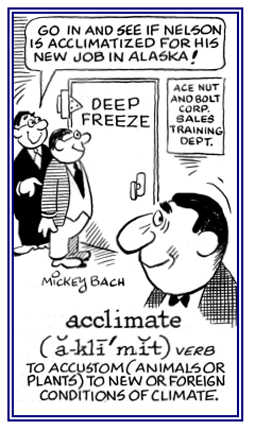
acclimate (verb), acclimates; acclimated; acclimating
To conform to, to adjust or to adapt to a new climate, a different place, or situation: It took several months for Carol to acclimate herself to living in the northern climate of Canada.
© ALL rights are reserved.
© ALL rights are reserved.
Go to this Word A Day Revisited Index
Josh worked hard to acclimate himself to his new work environment.
Go to this Word A Day Revisited Index
so you can see more of Mickey Bach's cartoons.
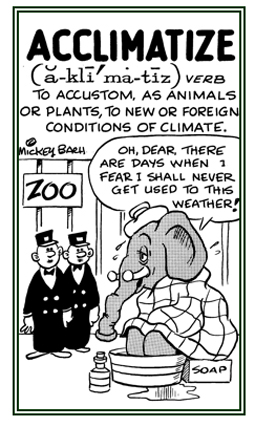
acclimatize (verb), acclimatizes; acclimatized; acclimatizing
To adapt, to adjust, or to get used to a situation or environment: Seth worked hard to acclimatize himself to the new office culture after his promotion.
© ALL rights are reserved.
Go to this Word A Day Revisited Index
Go to this Word A Day Revisited Index
so you can see more of Mickey Bach's cartoons.
The study of climates as applied to the effect on the productivity of plants and animals of agricultural importance: Agroclimatology is a field of climatology that deals particularly with the factors and effects of agroclimate.
bioclimatic
1. Relating to the relationship between climate and living organisms, or to the study of bioclimatology.
2. Referring to the effects of climate on living organisms.
2. Referring to the effects of climate on living organisms.
bioclimatologist
An individual skilled in bioclimatology.
bioclimatology
1. The study of climate in relation to living organisms and especially to human health.
2. The science of the relationship of climatic factors to the distribution, numbers, and types of living organisms (fauna and flora) of conditions of the natural environment (rainfall, daylight, temperature, humidity, air movement) prevailing in specific regions of the earth; an aspect of ecology.
2. The science of the relationship of climatic factors to the distribution, numbers, and types of living organisms (fauna and flora) of conditions of the natural environment (rainfall, daylight, temperature, humidity, air movement) prevailing in specific regions of the earth; an aspect of ecology.
climate
climatology
That vocation in science concerned with meteorology which is concerned with the mean physical state of the atmospher together with its statistical variations in both space and time as reflected in weather behavior over a period of many years.
climatotherapy
Treatment of disease by removal of the patient to a region having a climate more favorable for recovery.
cryptoclimate
The climate of the inside of a building, airliner, or space ship; as distinguished from that on the outside.
dendroclimatology
1. The determination of past climatic conditions from the study of the annual growth rings of trees.
2. The study of past climates by the examination of the annual growth rings in (ancient) timber.
2. The study of past climates by the examination of the annual growth rings in (ancient) timber.
ecoclimate, ecoclimatology
The climate as an ecological factor; the climate of a habitat.
hydroclimatology
The study and therapeutic utilization of waterfront climates.
macroclimate
The general climate over a broad area of the earth's surface, as distinguished from mesoclimate or microclimate.
Regional weather that is influenced primarily by the sea: oceanic climate; maritime climate: In comparison to a continental climate, marine climate is found typically on the west coast in the middle latitudes and has mild summers and cool, but not cold, winters.
Marine climate occurs where the prevailing winds blow onshore and is characterized by a limited range in temperature with few extremes.

Showing page 1 out of 2 pages of 23 main-word entries or main-word-entry groups.