
Confusing Words Clarified: Group H; Homonyms, Homophones, Homographs, Synonyms, Polysemes, etc. +
(lists of "H" sections that are organized into what for some people are confusing groups of words)
I don't mispell, as others mite,
But allways right each item rite;
So I emit resounding hoops
At other righter's speling bloops.
Your comments and suggestions are always welcome by writing to: E-mail Contact (just click it for an e-mail form) or by typing, [email protected], as the address in your e-mail heading.
If you have any problems understanding the pronunciation symbols, go to this Pronunciation Chart for clarifications.
2. To make a path by cutting plants: Each of the hikers used a machete to hack a path through the thick growth of brush.
3. To secretly get access to the files on a computer or network in order to get information, to cause damage, etc.: Those guys were trying to hack into the network so they could hack into the bank's financial records.
2. A writer who hastily or routinely produces a lot of work without much quality just so he or she can make some money without regard for accuracy or consequences to others: Charles was obviously a hack as an author because he couldn't find anyone who wanted what he was producing.
Almost every day the local hack on the staff of the paper used her computer to produce a column in her blog.
3. Someone who does work that is not important or original: Mildred was just an insignificant political hack, only doing menial desk jobs.Too often there is a radio hack who just wants to verbally hack at those whose positions he or she disagrees with.
This link about hack, hacking will provide more information.
2. Typically an amount of small objects or words that are thrown forcefully: There was a hail or a pelting of pebbles as the mountains were shaken by the earthquake.
Manfred received a hail or an outcry of criticism because of his political position.
Ryan's uncle, who is a farmer, was feeling less than hale after being hit on the head by so much hail during a hail storm while he was plowing in the field.
Some people say that rabbit fur is really simply hare hair.
2. A style in which people's tresses, ringlets, etc. are shapened and trimmed: The haircut Lenora got looked just like that of a famous rock singer.
2. A highly seasoned mutton or lamb stew with vegetables: After a long hike in the hills, the haricot at the inn tasted wonderful; especially, since the members of the group were very hungry.
After eating a hearty helping of spicy haricot, Karin noticed that her hair felt as if it were standing on end, as if she had had a new haircut. So, Karin went to the barber who gave her a haircut; then she went home and made a red haricot soup for dinner.
2. A designating term for a building or part of a university complex: Rena and Sherrie attended classes at Smith Hall when they were at the university.
2. To change the direction of a ship's course to take advantage of the wind: The sailors decided to haul the ship's course by raising new sails.
It was moving day and Peter and Trisha had to haul the furniture out of the hall so it could be put into the moving van.
2. A sense of idealized glory invested in a person: The woman who worked among the poor seemed almost to have a halo surrounding her.
2. Descriptive of a sound made by hitting or beating a object that has an empty space in it: Striking the hollow log created a hollow thud that seemed to echo.
3. Pertaining to an utterance which is empty and lacking in sincerity: Mildred gave a hollow promise to do all her homework.
Lucinda and Keith stood at the edge of the hollow in the remote valley and tried to holler loudly so they could hear the echos of their voices.
While they were standing there, they saw a halo surrounding the moon which seemed to hallow the place where they were.
2. To lessen or reduce by half: Francine decided to halve the meal with her sister so the two of them could eat the same amount.
2. To experience or to suffer from something: Josie said, "I feel terrible because I have a bad cold."
3. To come to a conclusion about an idea or an object: Ronda said, "I have an opinion about the new fashions."
Jill's mother said, "I have to halve the last piece of chocolate with your sister."
2. The part of a gun-lock that hits the primer or firing pin and causes a gun to shoot: When he pulled the trigger of the revolver, the hammer caused the bullet to fire and to leave through the barrel.
3. One of the padded wooden pieces of a piano that strikes a long piece of wire that is fixed across a musical instrument, like a harpsichord, when the player presses a key: When a musician depresses the black or white pieces of wood at the front of the piano, each hammer hits a tuned string that produces music.
2. To use a striker that is covered in felt and that causes the piano strings to vibrate: Mary's mother commented, "Mary, if you hammer the cembalo keys, you might actually be hammering some good tunes!"
3. To hit something in a very forceful way: The people in this area can be sure that the next hurricane will hammer many more towns.
4. To keep talking about something or trying to get something done: Julia apparently is hammering her political opponent for his failure to cut taxes.
No matter where Sally goes, it's amazing how many people she sees who are yammering on their cell phones.
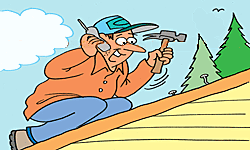
While listening to the politician yammer away, trying to hammer out the party platform to the group of people, it made Ed think that the politician was like a hammer banging up and down on the members of the audience.
2. Generous or copious: The family offered a handsome reward for the return of their lost dog.
The handsome young man reserved a hansom and driver for the afternoon for which he paid a handsome fee to take him and his friend for a ride through the park.
2. Someone whose job is to affix or to place something in a specified location: Celeste hired a house painter who also worked as a paper hanger.
Jonathan rented an abandoned hangar to use as an art gallery; then, he hired a professional hanger to help him hang his works of art.
In the entry hall, Rebekah set up a cloak room equipped with hangers on which to hang the patron’s coats.
In our history books, we read about the pirate who was hanged for his crimes. Julia's father had a painting that hung in his study which portrayed that event.
That test was hard because the teacher asked a lot of difficult questions.
Hardly anyone showed up for the meeting that day.
Lenora, although you claim that your work is hard, you are hardly making any effort to get any work done.
2. Concerning excellent and vigorous good health: The elderly man enjoyed a hearty lifestyle and was rarely ill.
The hearty enthusiasm of each hearty on the ship was supported by the hearty meals which the ship's cook prepared.
It made each hearty hardy and strong so all of them could climb the rigging and furl the sails.
2. The vital center and source of one's being, emotions, and sensibilities: Jake's heart swelled with pride when his friend was determined the winner of the contest.
3. The firmness of will or the callousness required to carry out an unpleasant task or responsibility: Mike didn't have the heart to send the poor children away without something to eat.
4. The central or innermost physical part of a place or region: Samuel worked in the heart of the financial district of New York City.
The heart of the hart was pounding when he got confused and was roaming on the streets in the heart of the city before finding his way back into the large park.
After Justin's horse galloped away with him, he found himself hunched over the saddle which had slipped back onto the haunch of the horse. He had a hunch that he was destined for a fall and sure enough, he fell off.
 Confusing Words: Homonyms, Homophones, and Homographs; explained and demonstrated.
Confusing Words: Units, Groups A to Z.
Confusing Words: Vocabulary Quizzes Listed.
