
rumin-, rumina-
(Latin: to chew over again, to chew the cud; to muse or to meditate; that is, to think about something in a deep and serious or dreamy and abstracted way or to think about something carefully, calmly, seriously, and for a long time)
Partly digested food that ruminants (cattle, goats, etc.) return to the mouth, after it has passed into the first stomach, to chew again as an aid to more complete digestion: Certain animals, like sheep and cows, can be seen chewing their cuds.
Although it is not etymologically related to "rumin-", this term is primarily associated with the various activities of "rumination" and "ruminants".
A continuous focus on or brooding about memories, plans, or ideas; some of which are usually not serving any useful purpose: Janet was having obsessive ruminations for weeks before going on the reporting assignment the editor gave her regarding how well the U.S. military families were living in Germany because she had never been to a foreign country before.
The large first chamber of a cud chewing animal's stomach in which microorganisms break down plant cellulose before the food is returned to the mouth for additional chewing: In the rumen, food is collected and then it is returned to the mouth as cud for chewing.
The rumen contains bacteria that can break down cellulose or the substance that forms the outer layer of plant cells and plant fibers.
Partially digested food from the rumen is digested further in the second chamber, or the "reticulum", and then regurgitated to be chewed as the cud.
When swallowed again, the food passes directly to the third and fourth chambers (the "omasum" and the "abomasum") which are considered to be the true stomachs for further digesting.
Inflammation of the first stomach of cud chewing animals: One cause of rumenitis is when certain species ingest irritating substances while eating vegetation that is polluted with crude oil or other oil products.
Any cud-chewing hoofed mammal with stomachs that have multiple chambers for digesting their food: There are many ruminants in the world, including cows, sheep, bison, buffalo, deer, antelopes, giraffes, and camels.
Ruminantia (pl) (noun)
The mammalian suborder of animals that chew their cuds: The vegetable food, after the first chewing, enters the first stomach; after that, it passes into the second stomach, where it is moistened, and formed into pellets which the Ruminant have the power of bringing back to the mouth to be chewed again. After it is swallowed into the third stomach, it passes to the fourth stomach, where it is finally digested.
ruminate (verb), ruminates; ruminated; ruminating
1. To think carefully about something for a long period of time: Ron was ruminating about which university he would go to long before he graduated from high school.
2. To regurgitate some of the partially digested food and to chew it again; referring to various cud-chewing hoofed mammals having a stomach divided into four or occasionally three compartments: Cows, sheep, goats, deer, camels, and giraffes are some of the animals that ruminate their food.
3. Etymology: "to turn over in the mind", also "to chew cud" (1547); from Latin ruminatus, ruminare, "to chew the cud; to turn over in the mind".
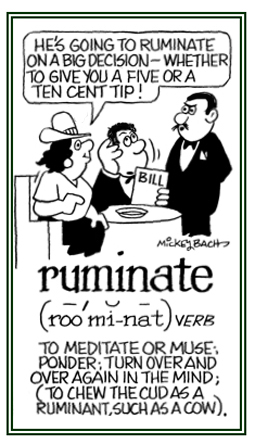
© ALL rights are reserved.
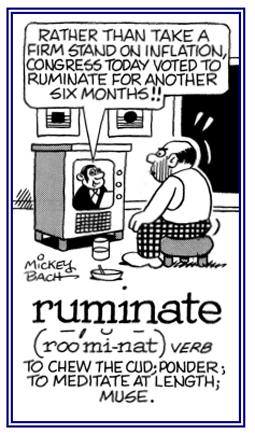
© ALL rights are reserved.
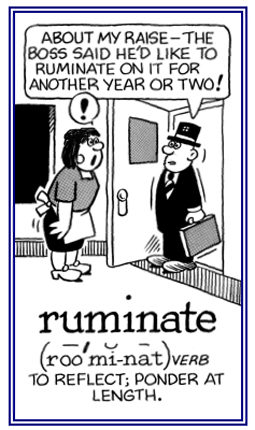
© ALL rights are reserved.
Go to this Word A Day Revisited Index
2. To regurgitate some of the partially digested food and to chew it again; referring to various cud-chewing hoofed mammals having a stomach divided into four or occasionally three compartments: Cows, sheep, goats, deer, camels, and giraffes are some of the animals that ruminate their food.
3. Etymology: "to turn over in the mind", also "to chew cud" (1547); from Latin ruminatus, ruminare, "to chew the cud; to turn over in the mind".
Go to this Word A Day Revisited Index
so you can see more of Mickey Bach's cartoons.
1. The act of pondering or thinking; meditation: Some people have psychological ruminations involving distressing thoughts for a very long time.
2. Persistent meditation on a subject, particularly thinking about and reviewing one's past: For some people, rumination is known to obsess them with a single idea, or set of thoughts, with the inability to get rid of them or to dislodge them from their minds.
3. In certain animals, the fast swallowing of food and then ejecting it and chewing it more thoroughly at a later time until digestion is completed in their other digestive areas: Cows and sheep are just two examples of animals that break down the vegetable matter that they eat by rumination.
3. In certain animals, the fast swallowing of food and then ejecting it and chewing it more thoroughly at a later time until digestion is completed in their other digestive areas: Cows and sheep are just two examples of animals that break down the vegetable matter that they eat by rumination.
ruminative (adjective), more ruminative, most ruminative
Characterized by a preoccupation with certain ideas or feelings: Harry is having more ruminative thoughts as he is continuously disturbed about the passing away of his wife.
ruminatively (adverb), more ruminatively, most ruminatively
A reference to pondering or mentally reviewing something with a lot of thought and consideration: Now that Alva has a good job, she is ruminatively thinking about whether she should continue to attend the university and get her M.A. (Master of Arts) degree.
1. A reflective thinker characterized by quiet thoughtfulness: The head of the project urged his group to be ruminators and to come up with suggestions that would make the results of their efforts be of real value.
2. Someone who turns a subject over and over in his or her mind by thinking about it for a long time: As a serious ruminator, Jan spent some months trying to reach a decision as to whether she could really afford to spend so much money to go on a trip to Europe.
2. Someone who turns a subject over and over in his or her mind by thinking about it for a long time: As a serious ruminator, Jan spent some months trying to reach a decision as to whether she could really afford to spend so much money to go on a trip to Europe.
<img src="/img/left_arrow_sm.gif" alt="" /> <img src="/img/right_arrow_sm.gif" alt="" />
Showing 1 page of 11 main-word entries or main-word-entry groups.