
pil-
(Latin: to gather, to pillage, to plunder, to rob, to steal, to snatch, to heap up (as stones) and to carry off)
Don't confuse the words in this pil- unit with the pil-, pilo- or "hair" group of words.
Lorene's aunt, Mrs. Jones by compellation, gained academic recognition through her compilation of Folk Legends from the Far North.
2. Something, such as a set of data, a report, or an anthology, that is collected, or the process of bringing things together from various places to form a whole.
3. Anything that is produced; such as, reference books, dictionaries, encyclopedias, etc.; which have been made up of material gathered from other printed sources.
4. The production of a new or revised map or chart from existing maps, aerial photographs, surveys, new data, or other sources.
5. The process of translating a high-level programming language into a machine-executable form.
2. To create something by putting things that have been gathered from various places into one group or collection: Henry tried to compile the statistical data about a company before he made any investments in it.
3. To gather into a single book or to put in one composition, from materials assembled from several sources: Jack spent a great deal of time trying to compile a dictionary of word families and he had a better collection than just about any other source.
4. To gather materials borrowed or transcribed into a volume or into an orderly form: The staff of writers took the best submissions of information they had gathered and were able to compile them into a single issue of the magazine they were working for.
5. Etymology: probably before 1325, compilen, borrowed from Old French compiler, a learned borrowing from Latin compilare, "to steal, to pillage, to plagiarize, to snatch together".
Originally, it meant "pile up"; com-, "together" + pilare, "to press, to compress, to ram down"; from pila, "pile, mass, heap".
As a result, compilare means "to gather for oneself by plundering or stripping from others".
The word first appeared in something related to its modern sense in a nickname applied to the poet Vergil (or Virgil) by an irreverent contemporary who called him compilator, "the plunderer", because of his imitation of Homer and other old authors.
Vergil's full name was Publius Vergilius Maro, a Roman poet. His greatest work is the epic poem Aeneid, that tells of the wanderings of the hero Aeneas after the sack of Troy, a mythical Greek warrior who was a leader on the Trojan side of the Trojan War.
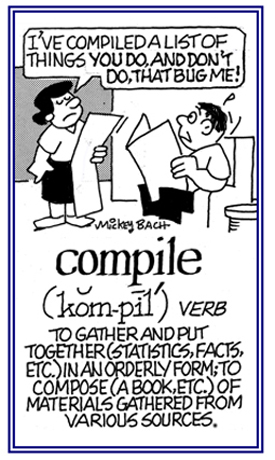
Go to this Word A Day Revisited Index
so you can see more of Mickey Bach's cartoons.
2. A reference to putting together various songs, pieces of writing, facts, etc. in a publication or collection: "We took the best compiled sources of information and put the data into a single issue of the magazine."
3. That which is borrowed, plundered, or plagiarized; from Latin, compilare, "to plunder" or "to plagiarize".
2. A collector of (written or spoken) parts of other authors, or of separate papers or accounts.
3. Anyone who forms a book or composition from various authors or separate papers.
4. A computer programmer who organizes operations that translate high-level language programs into a set of machine language instructions.
Most programs also provide error checking and diagnostic messages, code optimization, and memory usage information.
2. Etymology: from Latin oppilate-, past participle of oppilare, "stop up"; which came from pilare, "to heap up" (as stones).
2. A long stake or pointed pole which is pushed into the ground to support something; such as, a building.
3. A collection or group of objects that are heaped, stacked, or laid on top of each other.
4. Etymology: "a pillar, a pier of a bridge", from Latin pila, "a stone barrier"; from Latin "pier, harbor wall of stones" then to "something that is heaped up".
"Sam, what do you plan to do with those newspapers after you pile them up?"
2. A tall cylindrical vertical upright that is used to support a structure or a vertical structure standing alone and not supporting anything; such as, a monument.
3. A mainstay of an organization or society who is important and respected within a group: "Mike was a pillar of his church."
4. A basic fact, idea, or principle of something: "Henry's idea was the central pillar of the theory that the right to vote is a pillar of democracy."
5. Something which rises into the air in a tall, thin shape: "Leone could see pillars of smoke going up from the factory as she stood on a pillar of stone."
6. Etymology: from Old French piler; from Medieval Latin (about 700 to about 1500) pilare; from Latin pila, "pillar, stone barrier".
The figurative sense of "a prop" or "a support of an institution or community" is first recorded in the early 14th century.
"Mildred's friends were her pillars of strength when she was medically diagnosed as having incurable cancer."
