
cern-, cert-, cer-; cret-, creet-, cre-
(Latin: to separate, to sift, to distinguish, to understand, to decide, to determine; separated, separation, to set apart; the glandular extraction or the movement out of a natural substance)
Used to express the ability a person has to distinguish, or to perceive, something with the eyes and the mind. Related to crit-; as in criticize, diacritical, critique, etc.
ascertain (verb), ascertains; ascertained; ascertaining
1. To discover and to determine by means of examination or experimentation: The fire department was unable to ascertain the cause of the fire.
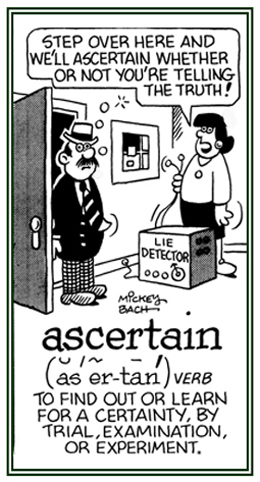
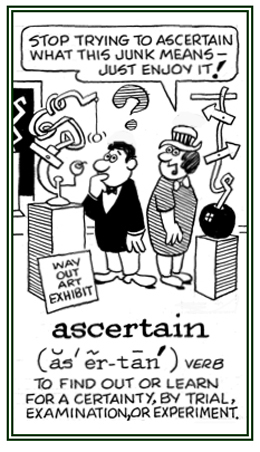
2. To learn or to find out about something; such as, information or the truth: Debora's doctors have been unable to ascertain the cause of her illness.
© ALL rights are reserved.
© ALL rights are reserved.
Go to this Word A Day Revisited Index
2. To learn or to find out about something; such as, information or the truth: Debora's doctors have been unable to ascertain the cause of her illness.
A great deal of information these days can be ascertained by anyone with a computer.
3. Etymology: from Middle English acertainen, "to inform"; from Anglo-French acerteiner, Old French acertener, "to assure, to certify"; from a-, "to" [from Latin ad] + Latin certus, past participle of cernere, "to determine".Go to this Word A Day Revisited Index
so you can see more of Mickey Bach's cartoons.
ascertainable (adjective), more ascertainable, most ascertainable
Capable of being discovered and learned through examination or experimentation; determinable; discoverable: It was important for the students to find the ascertainable facts for completing their term papers.
1. Something that is exact or precise.
2: A situation that is learned, or determined with certainty; usually, by making an inquiry or other effort to establish what is going on or what the status is of something.
2: A situation that is learned, or determined with certainty; usually, by making an inquiry or other effort to establish what is going on or what the status is of something.
certain (adjective), more certain, most certain
1. Having no doubts about something "She was certain that he was the man who robbed the store."
2. Definitely known, fixed, or settled.
3. Guaranteed to happen or to do something.
4. Established beyond doubt or question; indisputable.
5. Etymology: used from about 1297, "determined, fixed", from Old French certain, from Vulgar Latin certanus, from Latin certus, "sure, fixed"; originally a variant of cernere, "to distinguish, to decide"; originally "to sift, to separate".
2. Definitely known, fixed, or settled.
3. Guaranteed to happen or to do something.
4. Established beyond doubt or question; indisputable.
5. Etymology: used from about 1297, "determined, fixed", from Old French certain, from Vulgar Latin certanus, from Latin certus, "sure, fixed"; originally a variant of cernere, "to distinguish, to decide"; originally "to sift, to separate".
certainly (adverb), more certainly, most certainly
1. Characterized by being without any doubt or qualification on the part of the speaker.
2. Relating to an emphatic denial or refusal.
3. Free from doubt or reservation; confident; sure: "I am certain she will come home tonight."
4. Capable of being relied on; dependable.
2. Relating to an emphatic denial or refusal.
3. Free from doubt or reservation; confident; sure: "I am certain she will come home tonight."
4. Capable of being relied on; dependable.
Although certain appears to be an absolute term, it is frequently qualified by adverbs; such as, in "fairly certain" or "quite certain".
1. A conclusion or outcome that is beyond doubt.
2. Someone who or something that is strongly expected to win or to achieve something.
3. A compete lack of doubt about something; without any doubt.
2. Someone who or something that is strongly expected to win or to achieve something.
3. A compete lack of doubt about something; without any doubt.
certifiable (adjective), more certifiable, most certifiable
1. Capable of being authentic, valid, or qualified: Jackie received her graduation certificate as being certifiable after passing all the qualifications and tests successfully.
2. Legally, or medically, declared to be affected by a psychiatric disorder: Sometimes a person can be so deranged mentally and uncontrollable that he or she is certifiable and insane and is committable to a special institution and treated accordingly.
2. Legally, or medically, declared to be affected by a psychiatric disorder: Sometimes a person can be so deranged mentally and uncontrollable that he or she is certifiable and insane and is committable to a special institution and treated accordingly.
certificate (suhr TIF i kayt") (verb), certificates; certificated; certificating
To authorize or to provide a valid document that declares something to be true or to be a proven fact: Jim's daughter, Leslie, has been certificated by the hospital with her name, date, and place of birth.
1. Validating the authenticity of something or someone.
2. A document attesting to the truth of certain stated facts.
3. A confirmation that some fact or statement is true.
4. Etymology: from Old French certifier, "make certain"; from Late Latin certificare, from Latin certus + a form of the root facere, "to make, do".
2. A document attesting to the truth of certain stated facts.
3. A confirmation that some fact or statement is true.
4. Etymology: from Old French certifier, "make certain"; from Late Latin certificare, from Latin certus + a form of the root facere, "to make, do".
certifier (s) (noun), certifiers )pl)
Someone who guarantees or assures.
certify (verb), certifies; certified; certifying
1. To state or confirm that something is true or correct: The document has been certified by the court.
2. To declare that someone or something has passed a test or achieved a certain standard: The car dealer certifies each car before it is delivered to the buyer.
3. In banking, to indicate on a check that there are sufficient funds to guarantee payment.
2. To declare that someone or something has passed a test or achieved a certain standard: The car dealer certifies each car before it is delivered to the buyer.
3. In banking, to indicate on a check that there are sufficient funds to guarantee payment.
1. In law, a writ issued by a higher court to obtain records of a case from a lower court so that the case can be reviewed.
2. Etymology: from 15th century Late Latin, literally "to be informed", the passive of Latin certiorare "to inform"; ultimately from, certus "sure", the word occurs in the Latin version of the writ.
2. Etymology: from 15th century Late Latin, literally "to be informed", the passive of Latin certiorare "to inform"; ultimately from, certus "sure", the word occurs in the Latin version of the writ.
1. The feeling of conviction about something; especially, an opinion or religious faith: Because Greg’s certitude that war is so very wrong, he has decided never to join any military group.
2. Something that is certain to happen or about which someone can feel very convinced is accurate: The certitude that Nancy’s father would be there to pick her up after school gave her a sense of safety and confidence which she needed for the exams that day.
3. Etymology: from Latin certitudo, "that which is certain" from certus, "certain" + -tude, "quality, condition of".
2. Something that is certain to happen or about which someone can feel very convinced is accurate: The certitude that Nancy’s father would be there to pick her up after school gave her a sense of safety and confidence which she needed for the exams that day.
3. Etymology: from Latin certitudo, "that which is certain" from certus, "certain" + -tude, "quality, condition of".
1. A reason to worry, or something that causes worry.
2. Emotions such as worry, compassion, sympathy, or regard for someone or something.
3. A matter that affects someone, or that someone has the right to be involved with.
2. Emotions such as worry, compassion, sympathy, or regard for someone or something.
3. A matter that affects someone, or that someone has the right to be involved with.
concerned (adjective), more concerned, most concerned
1. Worried or apprehensive, particularly about something such as a situation that is developing or that has newly arisen.
2. Caring and interested in general, or giving care and attention to a particular thing or area.
2. Caring and interested in general, or giving care and attention to a particular thing or area.
