
muni-, muner-, mun-
(Latin: service, performing services; duty, receiver of duties; office, function; gift)
2. Marked by the state of autoimmunity or having the property of responding immunologically to tissues of one's own body.
3. In autoimmune disorders, components of a body's immune system target one or more of the person's own tissues.
More than 40 autoimmune conditions have been identified, including such common examples as type 1 (insulin-dependent) diabetes, rheumatoid arthritis, and celiac disease.
Together they constitute the third leading cause of sickness and death after heart disease and cancer; and they afflict between five and eight percent of the U.S. population, racking up an annual medical bill in the tens of billions of dollars.
Forecasts of the future have always intrigued and frightened people. Handled properly, such knowledge could benefit the millions of patients and doctors destined to battle autoimmune diseases.
By making early intervention possible, predictive autoantibodies have the potential to alleviate much misery and to help provide extra years of healthy life.
2. Relating to or involved in a body's resistance to disease or the creation of this resistance.
3. Exempt from something that others are subject to or made to endure or to perform; such as, immune from prosecution.
4. Not sensitive or susceptible to something: "She was immune to flattery."
5. Etymology: from Latin immunis, "exempt from public service", from munis, "ready for service".
Immunity may exist naturally or as a result of inoculation or previous infection.
In active immunity, the body itself produces appropriate antibodies and lymphocytes, while in passive immunity, antibodies are introduced from another source, as from mother to fetus.
2. The protection against infectious disease conferred either by the immune response generated by immunization or previous infection or by other non-immunologic factors.3. Exemption or protection from something unpleasant; such as, a duty or penalty, to which others are subject.
4. An exemption from prosecution for someone who has knowledge of possible criminal activity and may be personally culpable, offered in exchange for giving sufficient information to the police or to a grand jury.
5. Etymology: "exempt from service or obligation", from Latin immunitatem, immunitas, "exemption from performing public service or charge"; from immunis, "exempt, free" from in- "not" + munis, "performing services".
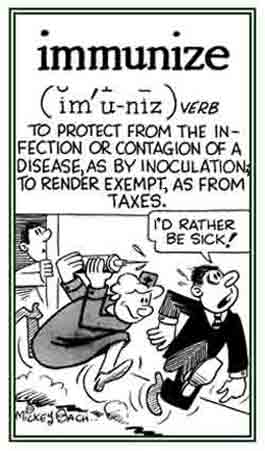
2. A vaccination or inoculation, a method of stimulating resistance in the human body to specific diseases using microorganisms (bacteria or viruses) that have been modified or killed: These treated immunizations of microorganisms do not cause the disease, but rather trigger the body's immune system to build a defense mechanism that continuously guards against such diseases.
2. To give a person an exemption, or protection, from something that others are subjected to, especially in a criminal matter under investigation: The witness was immunized, or safeguarded, during the police work and inquiry because of a murder that had been committed.
Go to this Word A Day Revisited Index
so you can see more of Mickey Bach's cartoons.
2. An older meaning: pertaining to the internal affairs of a state or nation rather than to international affairs.
3. Etymology: from Middle French (c.1400-c.1600) municipal, from Latin municipalis, "of a citizen of a free town, of a free town"; from municipium, municeps, municipis, "citizen, inhabitant of a free town".
The first element is from munus, munia, "service performed for the community, duty, work"; also "public spectacle paid for by the magistrate, (gladiatorial) entertainment, gift"; from Old Latin moenus, "service, duty, burden".
The second element is a root of Latin capere, "to assume, to take".
2. An urban district having corporate status and powers of self-government.
3. The appointed or elected members of a local government of a city or town.
The transfer may be from private ownership, often by purchase, or from other levels of government.
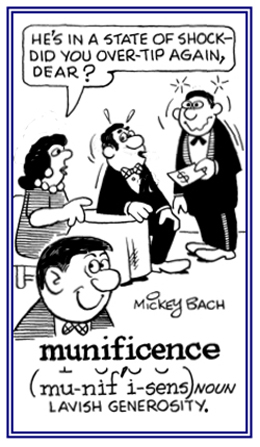
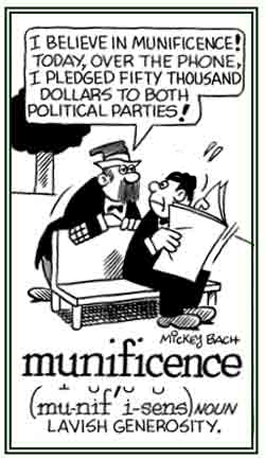
2. Etymology: from Middle French munificence, from Latin munificentia, from stem of munificus, "generous, bountiful, liberal"; literally, "present-making", from munus, muneris, "gift" or "service, duty, office" + the stem of facere, "to do".
Go to this Word A Day Revisited Index
so you can see more of Mickey Bach's cartoons.
2. Characterized by generosity.
2. Liberally; generously.
