par-, para-
(Latin: to make ready, to get ready, to put in order; to furnish, to prepare)
A full collection or set of implements, or utensils, for a given duty, experimental or operative; any complex instrument or appliance, mechanical or chemical, for a specific action or operation; machinery; mechanism.
2. The complex structure of a particular organization or system or method by which an organization is operated or maintained; such as, an apparatus of government.3. A group or system of body organs that collectively perform a specific function or process; such as, the respiratory apparatus, the digestive apparatus, or the vestibular apparatus (structures of the inner ear concerned with stimuli of equilibrium, including the semicircular canals, saccule, and utricle).
4. Etymology: from Latin apparatus, "tools, implements, equipment; preparation, a preparing" or "equipment which has been prepared for a particular use" or "purpose"; from the past participle stem of apparare "to prepare"; from ad-, "to" + parare, "to make ready".
The anatomical components involved include the external nose and nasal cavity, the oral cavity and pharynx, paranasal sinuses, larynx, trachea, bronchi, lungs, and thoracic cavity; as well as, the muscles related to their activities or functions.
It includes external clothing, vesture, garments, dress, garb, and other external habiliments or array.
2. A sea vessel's gear and equipment; such as, the furniture of a ship, masts, sails, rigging, anchors, guns, etc.: The apparel of a ship in the 18th Century was a higher expense than the sailors’ wages.3. To make o tor get (something) ready; to prepare.
4. Etymology: " to equip", from Old French apareillier, from Vulgar (Common) Latin appariculare, from Latin apparare "to prepare, to make ready".
This term comes either from Latin apparare, "to prepare, to make ready"; or from Common Latin, ad + particulare, "to put things together".
"Spoken to Claudius by gladiators prior to entering the arena to fight. This may have been a sarcastic salutation."
"Suetonius tells us in his Lives of the Caesars that Emperor Claudius (A.D. 41-A.D. 54) so enjoyed these spectacles, he ordered that even those who fell accidentally be put to death. He wanted to watch their faces as they died."
1. A reference to the policy of stirring up dissension and rivalries within the ranks of one's enemies, as Caesar did in Gaul and elsewhere.
2. This ancient political maxim, adopted by Machiavelli, is also given as Divide ut regnes and as Divide ut imperes, all of which mean "divide [the opposition] in order to rule" or "divide and conquer".
Words spoken by the Holy Roman Emperor Sigismund at the Council of Constance (1414-1418) when a cardinal corrected his Latin.
2. Etymology: from Old French empereor, French empereur from Latin imperatorem,"ruler, commander, emperor", from imperatus, "to command", from im-, "in" and parare, "to prepare".
2. The spouse or widow of an emperor: Catherine I of Russia, who succeeded her husband, was empress for only two years."
Another version is, "We cannot stop time in its tracks." The shorter Tempus fugit is taken from the longer Fugit irreparabile tempus which itself is a slightly shortened form of a line from Virgil's Georgics.
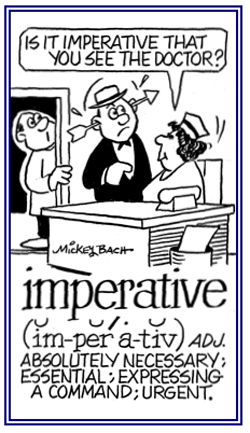
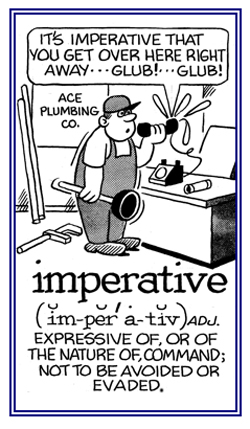
2. In grammar, a form that expresses a command instead of a normal statement or a question: "Jimmy, eat your spinach!" is an imperative sentence.