
real-
(Latin: from res, thing, object, matter, circumstance; factual)
2. Verifiable as actual fact; that is, legally or scientifically.
3. Existing as fact, rather than as a product of dreams or the imagination.
4. Genuine, true, and original, not artificial, counterfeit, factitious, or synthetic.
5. Prepared or made in a traditional or authentic way, rather than being mass-produced or artificial.
6. Based on fact, observation, or experience and so undisputed; not synthetic or spurious; of real or natural origin.
Real means being in accordance with appearance or a claim, not artificial or counterfeit, and is in this sense often synonymous with genuine; such as, a real (genuine) alibi; real (genuine) money.
7. Used to emphasize the accuracy or appropriateness of a particular thing: "She's a real teacher."8. Being honest or sincere, not feigned or faking.
9. In law, pertaining to things fixed, permanent or immovable; such as, lands and tenements; as real estate, the opposite of personal or movable property.
10. In mathematics, involving, relating to, or having elements of the set of rational or irrational numbers only.
11. Etymology: from the mid-15th century, "relating to things"; especially, property; from Old French, reel; from Late Latin realis, "actual", from Latin res, "matter, thing", of unknown origin.
The meaning of "genuine" is recorded from 1550's; then that of "actually existing" is attested from 1590's. The sense of "unaffected, no-nonsense" is from 1847. Real estate is first recorded in the 1660's and it keeps the oldest English sense of the word.
The noun phrase "real time" is from 1953.
Additional information about the etymology of real
In origin, real comes from the Latin word for “thing”. It’s a surprisingly late introduction into English, only dating for certain from the end of the sixteenth century.
Before then, it would appear that words like palpable, tangible, corporal, and incarnate were used in various of its senses. It seems to have been accepted very quickly, despite there being another word spelled exactly the same with the meaning "royal".
A person should not use the adjective real as a substitute for the adverbs really or very.
The rule is simple: if it is possible to substitute the word very for real in a sentence, then the use of real would be incorrect.
"It's a real diamond" is correct. Here real means genuine, and the sentence would make no sense if anyone substituted very for real.
Such sentences as, "It's a real nice day", "He's real good to his children", "We had a real good time", etc., are considered to be grammatically incorrect.
What is meant is "It's a very (really) nice day", "He's very (really) good to his children", "We had a very (really) good time."
GDP, gross domestic product, is often measured in real prices to eliminate the effects of inflation.
Ultrasound scanning uses real-time control systems, making results available almost simultaneously with the generation of the input data.
2. The theory that there is an objectively existing world, which is not dependent just on the views some have visualized in their minds, where people are able to understand aspects of that environment through their perceptions: The realism that some individuals have is unrealistic and so there are those who seem to live in a dream world and they are not able to achieve practical objectives or desires.
5. Etymology: from Latin realis, "actual"; from res, "matter" or "thing."
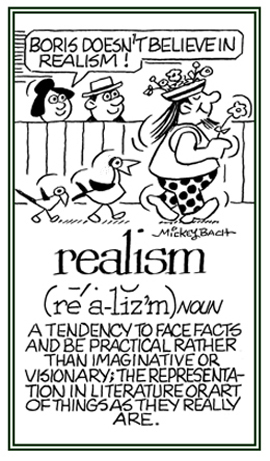
Go to this Word A Day Revisited Index
so you can see more of Mickey Bach's cartoons.
2. Someone who practices realism in the arts or believes in philosophical theories of realism.
3. Anyone who is inclined more to literal truth and pragmatism.
2. Of or relating to the representation of objects, actions, or social conditions as they actually are.
3. A reference to seeking what is achievable or possible, based on known facts.
4. Simulating real things or imaginary things in a way that seems real; such as, computer games with realistic graphics.
3. Trying to be reasonable; such as, having a realistic price for something that is not priced or valued too low or high.
4. In the arts and literature, representing life as it really is, rather than an idealized version of it.
"It was such a realistic movie anyone could easily relate to it."
Synonymous applications for realistic: pragmatic, down-to-earth; true-to-life, natural, naturalistic, lifelike, graphic, descriptive; real, authentic, genuine, truthful, faithful, precise.
2. In a realistic manner or in a way that shows that a person has accepted a situation as it really is, not as he or she would like for it to be.
3. Thinking about something in a way that seems real or is like real life.
