
aego-, aeg-; ego-, eg- +
(Greek > Latin: goat)
2. Etymology: From Ancient Greek, possibly derived from aig-, the stem of aix, "goat".
2. An ulcer in the inner corner of the eye: Aegilps means literally "goat in the eye" and is a fistula in the inner angle of a person's eye.
Although the name Aegina hints at a goat-nymph, such as was Cretan Amalthea, she was given a mainland identity as the daughter of the river-god Asopus and the nymph Metope.
The aegis of Athena is usually shown with a border of snakes and with the head of Medusa in the center.
The aegis is considered to be more emblematic of protection and power than a military shield.
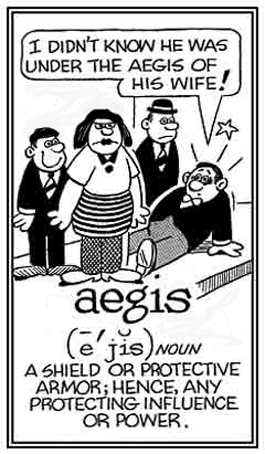
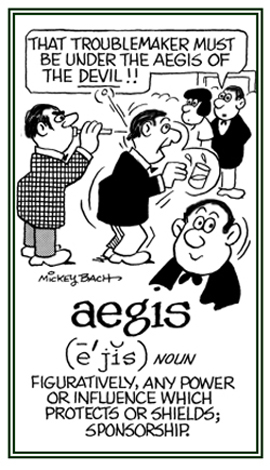
2. The power to protect, to support, or to control someone or something: The protection of a citizen's rights is under the aegis of the law.The local bowling team is under the aegis of a man who guarantees his sponsorship and financial support.
3. Etymology: from Greek aigis, and then from Latin aegis,, "the shield of Zeus", said to be made of goatskin, and therefore popularly derived from aig-, the stem of aix-, "goat".Zeus, who was the supreme deity of the Greeks, was suckled when he was a baby by a goat named Amalthaea whose skin was subsequently used to cover the great shield of Zeus.
Since this shield was the symbol of the power of the greatest of the gods, anyone who acted under the aegis had the power of the gods supporting him or her.

Go to this Word A Day Revisited Index
for a list of additional Mickey Bach illustrations.
2. Etymology: from Greek aig-, aix,, "goat" + -phony , "sound".