
spac-, spat-
(Latin: room, area, distance, stretch of time; space)
1. The Earth's atmosphere and outer space: Aerospace is the air surrounding the Earth and the universe beyond it.
2. Relating to the design, manufacture, and flight of vehicles or missiles that fly in and beyond the Earth's atmosphere: Aerospace is the company dealing with aircraft, missiles, spacecraft, rockets, and satellites.
2. Relating to the design, manufacture, and flight of vehicles or missiles that fly in and beyond the Earth's atmosphere: Aerospace is the company dealing with aircraft, missiles, spacecraft, rockets, and satellites.
The main branch of engineering pertaining to the design and construction of aircraft and space vehicles: Aerospace engineering is also concerned with power units, with the special problems of flight in both the Earth's atmosphere and in space, such as in the flight of air vehicles and the launching, guidance, and control of missiles, the Earth satellites, and space vehicles and probes.
1. The idea that electronic information exists or is exchanged: In this virtual cyberspace, people can do many of the things they do in "normal" physical domain; that is, interact with other people, shop, read the news, etc.
2. The imaginary world of virtual reality: Computer games often create specialized cyberspaces into which users enter while playing the games and all the actions involved with the games in that world.
3. A computer hookup consisting of a worldwide web of computer circuits use the TCP/IP network protocols to facilitate data transmission and exchange: Cyberspace is a conceptual electronic cosmic region unbounded by distance or other physical limitations.
4. Not a real location but rather the "world" created by computers and specifically the internet: It is said that there is a blurry line between free speech and criminality in cyberspace.
 Here is an explanation of where the word cyberspace came from.
2. The imaginary world of virtual reality: Computer games often create specialized cyberspaces into which users enter while playing the games and all the actions involved with the games in that world.
3. A computer hookup consisting of a worldwide web of computer circuits use the TCP/IP network protocols to facilitate data transmission and exchange: Cyberspace is a conceptual electronic cosmic region unbounded by distance or other physical limitations.
4. Not a real location but rather the "world" created by computers and specifically the internet: It is said that there is a blurry line between free speech and criminality in cyberspace.
When involved with cyberspace, people are dealing with a contrived world that has been formed by the display of data as an artificial three-dimensional area, which the user can manipulate and "move through" by providing certain commands to a computer.
Here is an explanation of where the word cyberspace came from.
expatiate (verb),expatiates; expatiated; expatiating
To speak or to write at length or in detail: After Rebecca returned from her trip to France, she expatiated to her parents about her adventures and all the difficulties she had with the language!

© ALL rights are reserved.

© ALL rights are reserved.
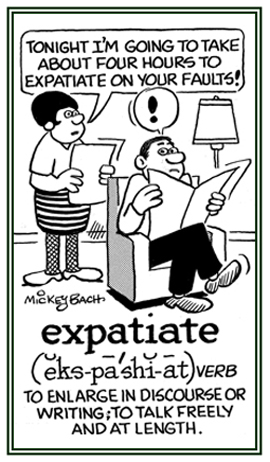
© ALL rights are reserved.
Go to this Word A Day Revisited Index
Go to this Word A Day Revisited Index
so you can see more of Mickey Bach's cartoons.
expatiation
hydrospace
The regions beneath the ocean's surface, especially when considered as an area to be studied.
interspace
interspatial
interspatially
Meckel space
Trigeminal cave, the cleft in the meningeal layer of dura of the middle cranial fossa near the tip of the petrous part of the temporal bone; it encloses the roots of the trigeminal nerve and the trigeminal ganglion.
space
spacer
spacious (adjective), more spacious, most spacious
Referring to an uncrowded and roomy area: The condo they saw had many large and spacious rooms, especially the kitchen!
spaciously
spaciousness

Showing page 1 out of 2 pages of 18 main-word entries or main-word-entry groups.