
hiber-
(Latin: winter, wintered, wintry; it also refers to: sleep, sleeping; inactive, inactivity; dormant, dormancy [suspended animation or a lack of activity])
2. The act of retiring into quiescence: The author emerged from his artificial hibernation to produce his first book after several years.
3. A condition of the retarded vital activity of an organism in warm-blooded animals, including humans, which is created in a simulated way, similar to the condition of an organism during the winter: Artificial hibernation can be created through nerve-blocking techniques which stop the neural and endocrine mechanisms of bodily thermoregulation or heat regulation.
2. In botany, the winter quarters of a plant: A bulb or a bud in which the embryo of a future plant is in a hibernacle or it is in an enclosed scaly covering that protects it from damage during the very chilly time during fall, winter and spring.
2. A protective case, covering, or structure; such as, a plant bud, in which an organism remains dormant for the winter: Even plants have their forms of hibernacula that protect them during the months between October and March.
3. The winter den, or home, of sleeping animals or insects during this time: There are various hibernacula for creatures that have latent or sleeping periods; such as, bears, bats, and insects.
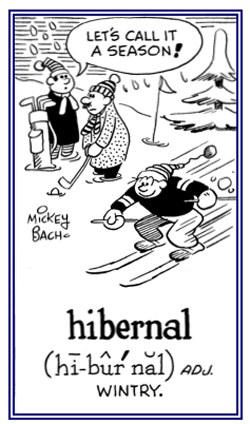
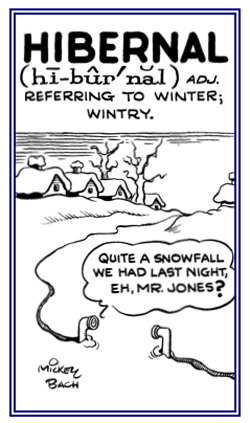
2. Relating to or occurring during the chilly seasons: Hibernal conditions include winter torpor (inactivity and lack of vigor or energy) in reptiles and winter lethargy (sluggishness) in larger mammals; such as, bears, badgers, skunks, and raccoons.
Go to this Word A Day Revisited Index
so you can see more of Mickey Bach's cartoons.
Snapping turtles hibernate deep in the mud at the bottoms of ponds and they stay there until spring comes.
Slugs hibernate by boring into the ground and secrete a mucus mantle around themselves for protection during periods of unfavorable-environmental wintery conditions.
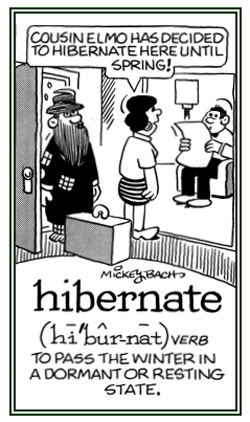
2. To be in a state of inertness resembling sleep during the very cold season while living off the reserves of body fat, with a decrease in body temperature and pulse rate, and slower metabolism: Animals that hibernate include bears, bats; as well as, many amphibians. 3. To become less active; especially, by staying at home rather than going out to socialize: There are some people, including Jake's neighbor Jane, who like hibernating in their houses or apartments with as little contact as possible with other people.The old man chose to hibernate or to live in seclusion after he retired from his job.
4. To spend the very chilly season in a place with a milder climate: Each winter Susan's friends hibernate in Florida or Hawaii.5. Etymology: from Latin hibernare, "to winter" and Latin hiems was also related to other "winter" or "snow" words; such as, Greek kheima.
The Himalayas are etymologically the "snowy" mountains.
Go to this Word A Day Revisited Index
so you can see more of Mickey Bach's cartoons.
2. A reference to anyone who withdraws or lives in seclusion away from other people: The hibernating man stayed away from any contact with anyone except when it was absolutely necessary.
2. A motionless, sleep-like condition characterized by lower body temperature and reduced energy consumption; as well as, heart and breathing rates: In certain climates, snakes find holes or cracks when autumn comes and they sleep in these places in hibernation during the winter; then, when they come out of hibernation, they start hunting for food.
In the course of hibernation, arctic lemmings are able to avoid severity of iciness by confining their life during winter to activities beneath the snow cover.
Some insects go into hibernation as eggs, larvae, nymphs, pupas, or adults. Since they can stand very low temperatures, few of these forms die if the bleak temperatures are within their normal range.
Even rather fragile creatures; such as, some butterflies are able to survive the frosty air in low shrubbery, where they may be completely covered by snow and ice for three or four months of hibernation.
Winter hibernations among reptiles are similar to the hibernations of mammals; however, instead of experiencing long, sustained periods of inertness, some hibernating reptiles move around occasionally to drink water; but they may go without food for several months.
When adders (nonvenomous snakes, such as the milk snake) experience temperatures of about 8°–10° C (46°–50° F), they start to look for suitable places in which to survive. Since these conditions vary, the adders' periods of hibernation extends from 275 days in northern Europe to 105 days in southern Europe, and it is about two weeks in the United Kingdom, where the Gulf Stream provides warmer conditions.
The term hibernation is often loosely used to indicate any state of sustained torpor, inactivity, or dormancy that an organism might exhibit; however, use of the term should be confined only to warm-blooded homoiotherms—i.e., birds and mammals whose feathers or fur serve as insulation to reduce heat radiating from the body and aid in the maintenance of constant body temperatures, which normally are independent of those of the environment.
Hibernation and sleep are somewhat similar in that essential body processes continue during both periods at a lowered level. In sleep, the heart beats less rapidly, and breathing is slower; the body produces less heat, making it necessary for a sleeping person to be protected from the cold with adequate covers.
This Hibernation link has much more interesting information about this topic.
The term hibernoma is also called: "fetal fat cell lipoma", "lipoma fetalocellulare", or "brown fat tumor".
Cross references of word families that are related directly or indirectly to "winter, freezing, frost, and/or cold": algid- (cold, chilly); cheimo-, chimo- (winter, cold); crymo-, krymo- (cold, chill, frost); cryo-, kryo-; (cold, freezing); pago- (cold, freezing); psychro- (cold); rhigo- (cold, frost; shiver).