algid
(AL jid) (adjective), more algid, most algid
1. Referring to something cold; severely chilled or chilling: Mona was thinking that it was the most
algid day she had experienced that winter.
Sometimes people may have a more algid attitude towards others who are insulting or misbehaving in a social situation, as expressed by the first and third cartoons shown below!
2. Characterized by feeling less than warm or frigid, however having sweaty skin and utter exhaustion; a reference to certain severe conditions or stages of a disease:
Algid malaria is characterized by prostration, cold and clammy skin, as well as, low blood pressure.
3. Etymology: from Latin
algere, "to feel cold, to be cold".
There is another word entry, gelid, which is also a Latin-derived adjective that describes ice and arctic temperatures.
Algid is not related to the Greek term algesi-, etc., "pain, sense of pain; painful; hurting".
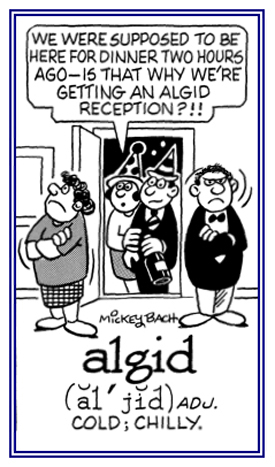 © ALL rights are reserved.
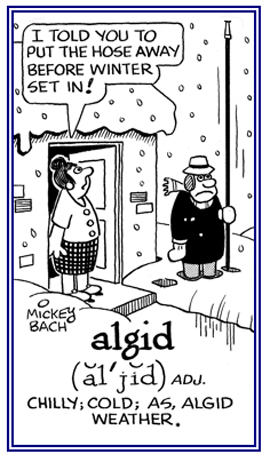 © ALL rights are reserved.
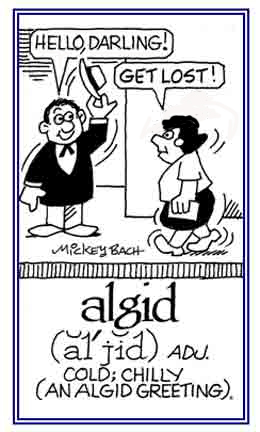 © ALL rights are reserved.
Go to this Word A Day Revisited Index
for a list of additional Mickey Bach illustrations.
algid malaria, algid pernicious fever
(s) (noun); algid malarias; algid pernicious fevers
(pl)r
A type of falciparum malaria with gastrointestinal manifestations predominating:
Algid malaria is characterized by cold, clammy skin, and hypotension.
Falciparum malaria is characterized by paroxysms of fever occurring at irregular intervals and often by the localization of the organism in a specific organ, causing capillary blockage in the brain, lungs, intestinal mucosa, spleen, and kidneys.
algid stage
(s) (noun), algid stages
(pl)
A phase of collapes occurring in cholera, falciparum malaria, and other diseases marked by extensive intestinal discharges: The algid stage is characterized by subnormal temperature, feeble flickering pulse, hypotension, and various neurologic symptoms.
algidism
(s) (noun), algidisms
(pl)
A spontaneous sensation of extreme cold: When algidism happens, a sensation of chilliness is quite noticeable.
algidity
(s) (noun), algidities
(pl)
The condition of being very cold
Aalgidity can be an episode during a severe fever when the patient's body temperature suddenly drops to an unusually low level.
Algidity is extreme chilliness, especially which is caused by the collapse of vital bodily functions.
algidness
(s) (noun) (no pl)
The state of being algid; chillness; algidity: When Mike was in bed with a high fever, he experienced a phase of algidness although he had many blankets on top of him..
algifacient, algefacient
(s) (noun); algifacients; algefacients
(pl)
An agent that has a cooling action; a refrigerant: Jack took some medicine called algifacient twice a day in order to sooth and allay the symptoms of his fever.
algific
(adjective), more algific, most algific
Causing cold, chilling; covered in ice: The illness that Susan had produced a very high temperature and an algific sensation with shivering.
algifical
(noun), more algifical, most algifical
A reference to that which makes anyone chilly or cold: Mary used an algifical element from the freezer to cool and alleviate the swelling caused by the injury on her foot..
Cross references of word families that are related directly or indirectly to "winter, freezing, frost, and/or cold":
cheimo- (winter, cold);
crymo-, krymo- (cold, chill, frost);
cryo-, kryo-; (cold, freezing);
frigo-, frig- (cold, frost);
gel-, gelati- (freeze, frost, congeal);
hiber- (winter, wintry);
pago- (cold, freezing);
psychro- (cold);
rhigo- (cold, frost; shiver).
