
linqu-, lict-
(Latin: to leave, to abandon)
The basic [or body] of facts [necessary to prove the existence of a specific crime]. This refers to evidence which can be used to convict a thief; such as, catching him with stolen goods; or proof in a murder trial of the actual death of the victim. It does not mean the body of the victim.
Another translation: "The terrible evidence that a crime has been committed." An example might be arson, in which the corpus delicti might be some proof (a gasoline can?) that the fire was set on purpose not just a burned-down building.
2. A legal offense; a misdemeanor.
3. An offense or transgression against the law.
4. Etymology: from Latin delictum, "fault, offense, transgression"; a form of delinquere, "to fail, to be lacking, to transgress, to offend"; from de and linquere, "to leave".
2. Antisocial or illegal behavior or acts; especially, by young people.
3. A tendency to be negligent and uncaring: Peter inherited his delinquency from his father.
4. A failure in or the neglect of duty or obligation; dereliction; default; such as, a debt, that is past due: Sharon was accused of delinquency in payment of her car payment.
5. Any misdeed, offense, or misdemeanor: Delinquency is the failure of any kind to perform a required duty or obligation.
2. Overdue in payment; such as, a delinquent account.
3. A person who neglects or fails to do what the law or duty requires: A delinquent leaves off doing what he or she ought to do; such as, delinquent debtors leave their bills unpaid.
4. Etymology: from the late 15th century, from Middle French délinquant, délinquer, and directly from Latin delinquentum and delinquens, forms of delinquere, "to fail; to be wanting, to fall short; to offend"; from de-, "completely" + linquere, "to leave".
2. A vessel (a boat or a ship) abandoned in open water by its officers and crew without any hope or intention of returning to it; a ship abandoned on the high seas.
3. Personal property abandoned or thrown away by the owner.
4. Someone who is guilty of neglect of duty: A human derelict is someone who by reason of his/her actions, etc., has been abandoned by respectable people.
5. Etymology: from Latin derelictus, "solitary, deserted"; the past participle of dereliquere. "to abandon, to forsake, to desert"; from de-, "entirely" + relinquere, "to leave behind".
2. Descriptive of a person who does not take care of another individual: The derelict husband neglected to wake up his wife so she could get ready for work in time.

Go to this Word A Day Revisited Index
so you can see more of Mickey Bach's cartoons.
2. An act of not doing what a person or people are responsible for: A dereliction of military duty that soldiers were obligated to perform was the reason for their punishment.
3. Etymology: from the 1590s, "abandonment"; formerly with an extended sense than in modern use; that is, of the sea withdrawing from the land; from Latin derelictionem, derelictio, from the stem of derelinquere, "to forsake wholly, to abandon"; from de- "entirely" + relinquere, "to leave behind".
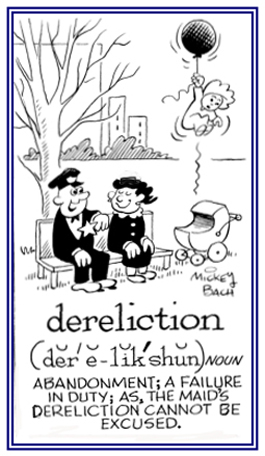
Go to this Word A Day Revisited Index
so you can see more of Mickey Bach's cartoons.
The phrases: "caught red-handed" or "caught in the act" are English equivalents of in flagrante delicto.
A corpus delicti establishes that a crime has been committed; while a locus delicti is the place where the crime occurred.
No one shall be placed in peril (jeopardy) of legal penalties more than once upon the same accusation.
Double jeopardy is forbidden in the United States constitution and protects against a second prosecution for the same offense after acquittal or conviction and against multiple punishments for the same offense.
2. Something kept in remembrance; a souvenir; a memento.
A relic is any object surviving from an earlier culture, especially a valuable or symbolic object.
In religion, a relic is the mortal remains of a saint and includes any object that has been in contact with the saint. Christianity was governed throughout the Middle Ages by the belief that spiritual virtue could be transmitted through relics of a person who in life was blessed with miraculous powers.
Coffins and small objects; such as, combs, jewelry, and clothing were commonly sanctified and subsequently housed in beautiful reliquary caskets or shrines.
Ecclesiastical centers with a collection of relics would be visited by large numbers of pilgrims, especially on saints' days, when the objects were put on special display and sometimes paraded.
3. Etymology: from early in the 13th century; "a body part or other object from a holy person"; from Old French relique, from Late Latin reliquiæ (pl.), "remains of a martyr"; from Latin, "remains, remnant" a noun use of the feminine plural of reliquus, "remaining, that which remains"; from re-, "back" + root of linquere, "to leave".The meaning of "remains, ruins" is from the early 14th century of Old English that used reliquias, which came directly from Latin.
2. An organism or species surviving as a remnant of an otherwise extinct flora or fauna in an environment which has changed considerably from that in which it originated.
3. A species of organism surviving long after the extinction of a related species, or a once widespread natural population, surviving only in isolated localities because of environmental changes.
4. Etymology: from Middle Latin relicta, "widow"; a noun use of the feminine form of relictus, "abandoned, left behind"; which came from Latin relinquere, "to leave behind".
