
unguent-, unction-
(Latin: ointment; anoint; smear)
inunction
1. The act of anointing.
2. In medicine, the process of applying and rubbing in an ointment.
3. The act of anointing, or the state of being anointed; unction; specifically, the rubbing of ointments into the pores of the skin, by which medicinal agents contained in them, such as mercury, iodide of potash, etc, are absorbed.
4. In pharmacy, an unguent.
5. The act of anointing, as in a religious ceremony.
2. In medicine, the process of applying and rubbing in an ointment.
3. The act of anointing, or the state of being anointed; unction; specifically, the rubbing of ointments into the pores of the skin, by which medicinal agents contained in them, such as mercury, iodide of potash, etc, are absorbed.
4. In pharmacy, an unguent.
5. The act of anointing, as in a religious ceremony.
unction
1. The act of anointing as part of a religious, ceremonial, or healing ritual.
2. An ointment or oil; a salve.
3. Something that serves to soothe; a balm.
4. Affected or exaggerated earnestness, especially in choice and use of language.
5. Excessive but superficial compliments given with affected charm.
6. A semisolid preparation (usually containing a medicine) applied externally as a remedy or for soothing an irritation; ointment, unguent, balm, salve.
7. Anointing as part of a religious ceremony or healing ritual; inunction.
2. An ointment or oil; a salve.
3. Something that serves to soothe; a balm.
4. Affected or exaggerated earnestness, especially in choice and use of language.
5. Excessive but superficial compliments given with affected charm.
6. A semisolid preparation (usually containing a medicine) applied externally as a remedy or for soothing an irritation; ointment, unguent, balm, salve.
7. Anointing as part of a religious ceremony or healing ritual; inunction.
unctuous (adjective), more unctuous, most unctuous
1. A reference to something which is greasy or oily: The salad dressing seemed to be very unctuous and too creamy, and was not tasty at all!
2. Relating to an individual who is suave or insincerely fervid: The oily nature of ointments may have led to the application of unctuous to describe things marked by an artificial gloss of sentimentality.
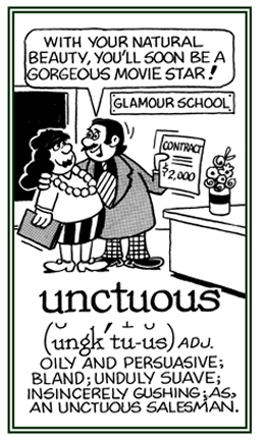
© ALL rights are reserved.
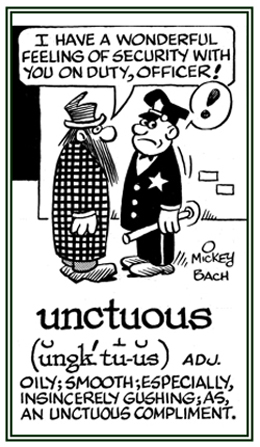
© ALL rights are reserved.
Go to this Word A Day Revisited Index
2. Relating to an individual who is suave or insincerely fervid: The oily nature of ointments may have led to the application of unctuous to describe things marked by an artificial gloss of sentimentality.
Unctuous people or behavior indicates too much praise, interest, friendliness, etc., in a way that is false or unpleasant.
3. Etymology: from Latin unguere, ungere, "to anoint."Go to this Word A Day Revisited Index
so you can see more of Mickey Bach's cartoons.
unguent (s), unguents (pl)
1. An ointment or salve, usually liquid or semi-liquid, for application to wounds, sores, etc.
2. A salve for soothing or healing.
2. A salve for soothing or healing.
1. Small containers used for holding oils and other ointments associated with ancient Greek or Roman civilizations: "Many of the unguentaria were often constructed with ceramic or glass and found in tombs."
2. Etymology: a term commonly applied to ancient Roman toilet bottles; however, it appears that the term was "invented" in the 19th century, on analogy with unguentarius ("perfume seller") and similar Latin words that the Romans used in connection with perfumes."
2. Etymology: a term commonly applied to ancient Roman toilet bottles; however, it appears that the term was "invented" in the 19th century, on analogy with unguentarius ("perfume seller") and similar Latin words that the Romans used in connection with perfumes."
unguentary
Like an unguent, or partaking of its qualities.
unguentous
Like unguent, or consisting of its qualities.
unguentum; ung.
Ointment.
A medical term used in prescriptions.
<img src="/img/left_arrow_sm.gif" alt="" /> <img src="/img/right_arrow_sm.gif" alt="" />
Showing 1 page of 8 main-word entries or main-word-entry groups.