viti-, vitu-, vic-
(Latin: vitium; a fault, a defect, a blemish; a corruption, a crime)
2. A minor bad and uncontrollable habit: Steve admitted that eating too much was his vice.
3. Criminal activities that can involve sex or drugs or both of them: Bert was arrested by the police who were dealing with such vices as narcotics.
A reporter was investigating a vice in which prostitutes were parked in campers on some streets of the town to entice or to lure customers to come and to visit them.
2. Dangerous and aggressive and liable to attack or bite: Dina's vicious dog was kept on a strong leash whenever he was taken out for a walk.
3. Conveying maliciousness and intended to cause someone mental anguish or to defame that person: Gossips often have very vicious tongues and take pleasure in causing discomfort among their victims.
4. Pertaining to extremely severe or powerful and damaging results: The effect of the vicious hurricane was reported widely in the press which used graphic photographs.
5. Involving a chain of cause and effect or action and reaction in which things get progressively worse: After her fall on the concrete steps, Allison felt as if she were caught in a vicious cycle of appointments; first the doctor; followed by the therapist, then the home nurse, etc.
6. Wicked and immoral; such as, displaying or given to immoral behavior: Hanging out with street gangs was a vicious behavior that often got Lawrence into trouble.
7. Etymology: from Anglo-French vicious, Old French vicieus, from Latin vitiosus, "faulty, defective, corrupt" from Latin vitium, "fault".
2. A depiction of an object, condition, or remark that causes great physical or emotional pain: Sara's viciously cruel remarks were aimed at the woman who was perceived as her rival in the affections of the man she admired.
3. Corruptly; in a manner contrary to what is considered right and a corruption of moral principles, propriety or purity: Manfred turned on his political opponents, viciously accusing them of lying.
2. A trait of extreme cruelty: Using his spurs mercilessly on his horse was an act of viciousness by Jack, the rider.
3. Given to immorality, depravity, and extreme harshness or savagery: By day the businessman appeared to be an upright citizen; by night he was committing viciousness against prostitutes.
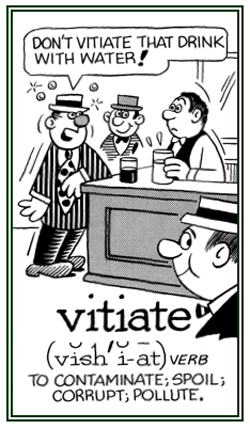
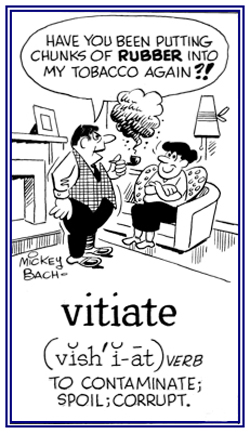
2. To morally corrupt: The landlady was attempting to vitiate some of her tenants by serving strong liquor to them during dinner.
3. To make ineffective; to invalidate: One heartless remark by the boss vitiated all the goodwill that Bill felt about his workplace.
4. Etymology: from Latin vitiatus, past participle of vitiare, "to make faulty, injure, spoil, corrupt"; from vitium, "fault, defect, blemish, crime, vice".
Go to this Word A Day Revisited Index
so you can see more of Mickey Bach's cartoons.
2. A change in a process that hampers a utility or reduces efficiency: Turning on only one bank of lights instead of two in the storeroom was a vitiation which made it difficult for Tom and the other workers to complete their repairs.
3. A weakening or the prevention of doing something: Breaking her leg was a vitiation of Jean's ability to run her Bed & Breakfast business efficiently.
2. A condition in which skin turns white due to the loss of melanocytes also known as leukoderma: Mark received a series of treatments for the vitiligo which was especially noticeable on his right arm.
In vitiligo, the melanocytes, or pigment that gives the skin its normal color, are mysteriously destroyed, leaving depigmented patches of skin on different parts of the body. The hair that grows in areas affected by vitiligo may also turn white.
Vitiligo is more noticeable in darker skinned people because of the contrast of white patches against dark skin.
As the skin gradually loses its color, patch by patch, other people often treat the person with vitiligo like a leper, thinking he/she has a contagious skin disease. In fact, vitiligo is called "white leprosy" in India. Women with it are often discriminated against in marriage. If they develop vitiligo after marriage, it can be grounds for divorce.
3. Etymology: Latin vitiligo, "a kind of tetter" (any of various skin diseases; such as, eczema, psoriasis, or herpes, characterized by eruptions and itching); coined by Aulus Cornelius Celsus, a Roman physician and writer of the early first century; from vitium, "fault, blemish, taint".
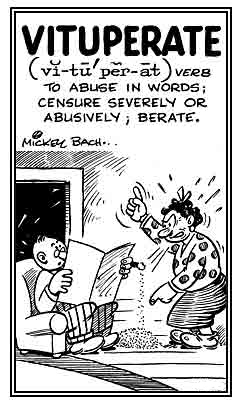
2. To attack someone in a violently abusive or a severely critical language; to revile: Sabina's supervisor vituperated or strongly criticized her for not getting her report in on time.
3. Etymology: from Latin vituperat-, "censured, disparaged"; from the verb vituperare; from vitium, "fault" + parare, "prepare".

Go to this Word A Day Revisited Index
so you can see more of Mickey Bach's cartoons.
Some voters are getting fed up with all of the vituperations that are being thrown back and forth during the campaign.
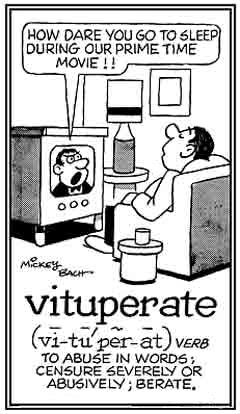
This vituperate image provides an example of what vituperation means.

Go to this Word A Day Revisited Index
so you can see more of Mickey Bach's cartoons.
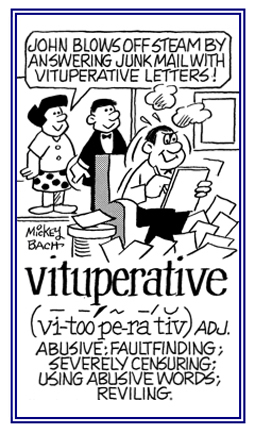
Some talk-show hosts make more vituperative remarks about their political rivals than is justified or rational.