
carr-, carri-; car-, cari-
(Latin: wagon, cart; wheeled vehicle)
2. A vehicle running on rails; such as, a streetcar or a railroad car.
3. The part of an elevator, balloon, modern airship, etc., that carries the passengers, freight, etc.
4. Especially in Britain, any wheeled vehicle; such as, a farm cart or wagon (which is closer to its Latin origin).
5. A chariot, as of war or triumph.
6. From earlier times: a cart or a carriage.
7. Etymology: from Latin carrum, carrus; plural, carra; originally "a two-wheeled Celtic war chariot".
2. A person's progress or general course of action through life or through a phase of life; such as, in some profession or undertaking.
3. Someone's success in a profession, occupation, etc.
4. From earlier times, to charge at full speed.
5. To run or move rapidly along; to go at full speed.
–adjective 6. Etymology: from about 1534, "a running course" (especially of the sun, etc., across the sky), from Middle French carriere, "road, racecourse", from Vulgar Latin (via) cararia, "carriage (road), track for wheeled vehicles" from Latin carrus, "chariot".
The sense meaning "course of a working life" first attested in 1803. The verb is first attested in 1594 from the notion of a horse "passing a career" on the jousting field, etc.
2. The freight carried by a ship, an aircraft, or another transporter.
3. Etymology: from Spanish cargo, "burden" from cargar "to load, impose taxes", from Late Latin carricare, "to load on a cart", from Latin carrus, "wagon".
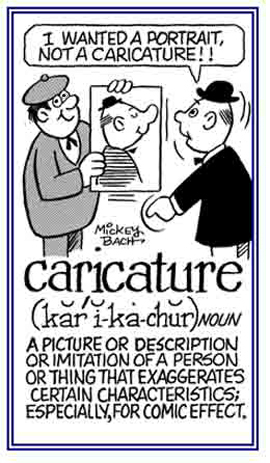
2. Any imitation or copy so distorted or inferior as to be ludicrous: Mary bought a book for her art class with lots of caricatures showing people and animals that are quite grotesque, exaggerated, and peculiar.
3. Etymology: from French caricature, from Italian caricatura "satirical picture"; literally, "an overloading", from caricare "to load, exaggerate" from Vulgar Latin carricare; from Latin carrus, "car".
Accordingly, caricature properly means "an excess in drawing or painting".
The history of the word caricature goes back through the centuries to a time when the Romans occupied Gaul, offering the blessings of civilization to the Gauls but also borrowing from them as well.
One such borrowing, the Gaulish word karros, “a wagon or cart”, became Latin carrus, “a Gallic type of wagon". This Latin word continued to roll through the English language, giving us car, career, cargo, carry, and charge, among others.
Caricature, is another offspring of carrus, which came to us via French from Italian, in which caricatura, the source of the French word, was derived from Italian caricare, “to load, to burden", or "to exaggerate".
Caricare in turn came from Late Latin carricre, “to load”, derived from the Romans' Gaulish borrowing of carrus.
Go to this Word A Day Revisited Index
so you can see more of Mickey Bach's cartoons.
2. Someone who parodies in an exaggerated manner.
2. Liable to be held responsible for or accused of something: The state law held Sam to be chargeable for his base and evil behavior.
