
cat, cats
(Greek: katta to Late Latin: cattus)
2. Any of various other carnivorous mammals of the family "Felidae", which includes the lion, tiger, leopard, and lynx: With her binoculars, Mildred could see a large cat, perhaps a lynx, moving across the ridge of hills in the mountains.
3. As an informal application, a woman who is regarded as spiteful: There is always at least one cat among the women gossipers in the town.
4. In slang usagea a man; a player or devotee of jazz music: Hank was a cool cat who played a brass trombone in a band.
5. Etymology: The related words in the Romance languages; such as, Spanish and Portuguese gato, gata and Italian gatto, gatta, came from Medieval Latin gattus, gatta, variants of Late Latin cattus, catta. French chat, chatte came directly from Late Latin cattus, catta. Late Latin cattus and catta are possibly loan words from an African language: Nubian kadis, "cat".
Cats are believed to have been living in close association with humans for thousands of years
The cat, also called the "domestic cat" or "house cat", is a small carnivorous mammal of the subspecies "Felis silvestris catus". Its most immediate pre-domestication ancestor is believed to be the African wild cat, "Felis silvestris lybica".
Cats had a special place in the lives of ancient Egyptians
About 5,000 years ago cats were accepted members of the households of Egypt. Many of the breeds we now know have evolved from these ancient cats. The Egyptians used the cat to hunt fish and birds as well as to destroy the rats and mice that infested the grain stocks along the Nile.
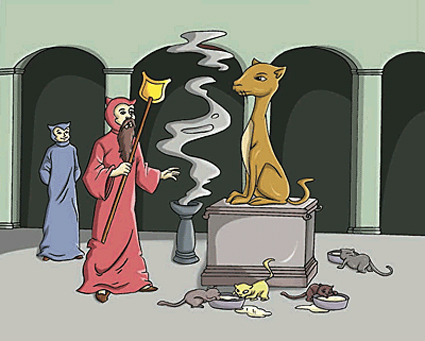
The cat was considered so valuable that laws protected it, and eventually a cult of cat worship developed that lasted for more than 2,000 years. The cat goddess "Bastet"—whose name was also spelled "Bast", "Pasht", and many other ways—became one of the most sacred of all figures of worship. She was represented with the head of a cat. Soon all cats became sacred to the Egyptians, and all were well cared for.
After a cat's death, its body was mummified and buried in a special cemetery. One cemetery found in the 1800s in Egypt contained the preserved bodies of more than 300,000 cats.
The Egyptians had strict laws prohibiting the export of cats, however because cats were valued in other parts of the world for their rat-catching talents, they were taken by the Greeks and Romans to most parts of Europe. Domestic cats have also been found in India, China, and Japan where they were prized as pets as well as rodent catchers, and in China (and other parts of Asia), as meat for meals.
Cats come in all sizes, breeds, colors, and fur styles
There are dozens of breeds of cats, some hairless or even tailless because of mutations, and they exist in a variety of different colors. Cats are skilled predators and have been known to hunt over one thousand different species for food. They are also intelligent animals, and some can be trained, or learn by themselves, to manipulate simple mechanisms, such as lever-handled doors.
2. Etymology: from Latin catta pilosa, "hairy cat".
Literally, "a hairy she-cat", the word being derived from Old (North) French catte (French chatte, "she-cat") and pelue, "hairy".

Go to this Word A Day Revisited Index
so you can see more of Mickey Bach's cartoons.
Cross references of word families that are related directly, or indirectly, to: "cat": aeluro-, eluro-; feli-, felin-; galeo-; gato-.